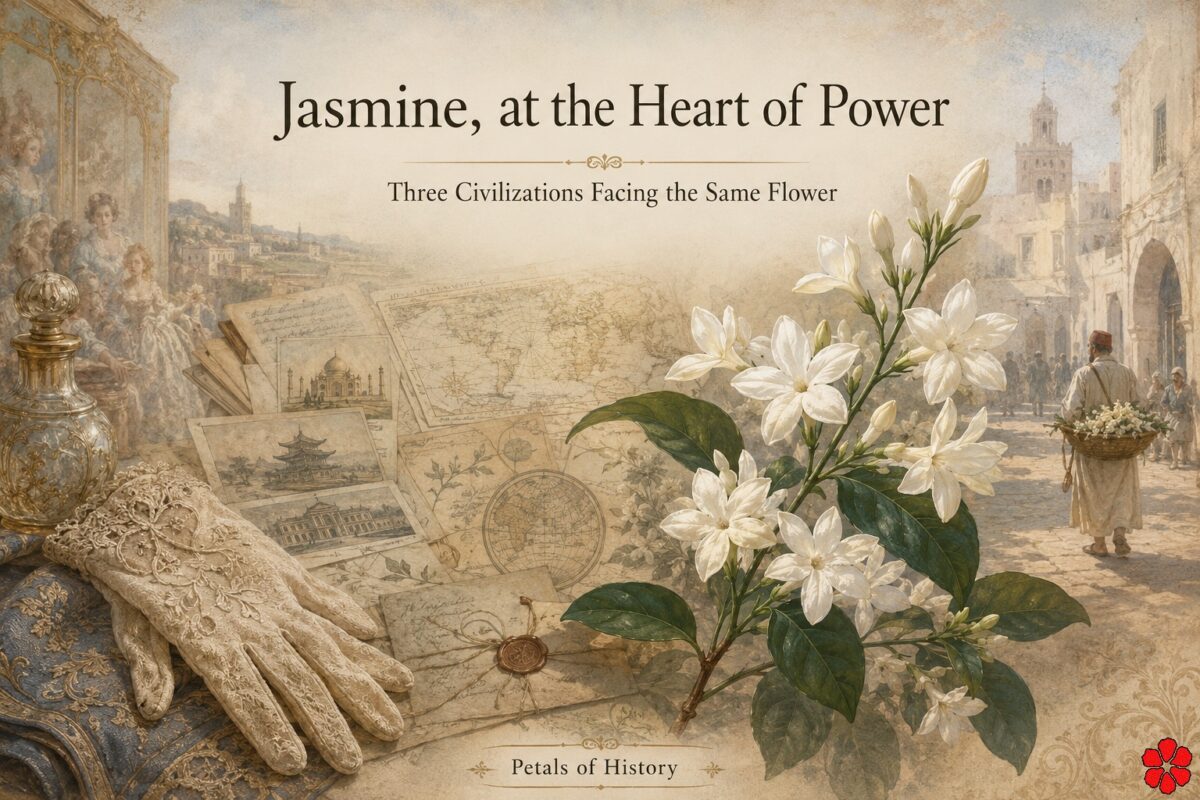
On Pétales d’Histoire, from the perfumed glove of the French court to the Tunisian popular uprising, by way of UNESCO‘s hushed offices, jasmine has moved through history as a curious instrument of power — never an actor, always instrumentalized. Three continents, three centuries, a single question: who decides what a flower represents, and for whom?
A flower with no ambitions, men who have plenty
There is something strange about looking closely at jasmine. This small white flower, which weighs nothing and lasts only a single night, never sought to represent anything at all. It opens, it perfumes the air, it withers — and yet, from the Renaissance to the Arab Spring, men and institutions have never stopped loading it with meanings it never asked for.
This paradox is precisely what makes jasmine so revealing when viewed through the lens of power. Other flowers carry an imperial dimension in their very nature — Japan’s chrysanthemum, the French monarchy’s fleur-de-lis. Jasmine, by contrast, had nothing going for it as an emblem. Discreet, nocturnal, almost invisible by day, it seemed destined to remain in the shadow of gardens. It is this very discretion that turned it, through a curious twist, into an ideal surface for projection: a flower that can be made to say whatever one wishes, precisely because it says nothing of itself.
Three episodes, separated by centuries and continents, allow us to trace this mechanism at work. A royal court that seizes on it to set itself apart. Nations that contest it to establish heritage legitimacy. A people, finally, who find themselves saddled with its name without ever having chosen it. Each time, jasmine merely registers a tremor of power passing through it, one it never truly owns.
What this article sets out to explore:
- How a garden flower became, in the Renaissance, an instrument of social distinction in the hands of a queen.
- Why several nations today contest the heritage paternity of the very same plant.
- How a single jasmine can embody, without apparent contradiction, the official identity of several countries at once.
- What happens when a people is handed, from abroad, the name of a flower to describe its own revolt.
- What these episodes, taken together, reveal about civilizations’ enduring need to make nature speak for their own struggles over power.
Fragrance as a weapon of the court
In the sixteenth century, the town of Grasse, in the hinterland above Nice, did not smell of jasmine. It smelled of leather and tanneries. Its craftsmen worked hides into gloves famed across Europe, but the tanning process — animal fat, lye, the decomposition of skins — left behind an odor that even the wealthiest nobles struggled to bear. It was to solve this problem, far more mundane than one might imagine, that the glovemakers of Grasse began steeping local flowers in the fat used to soften the leather.
History turned a corner when this innovation reached the French court. Catherine de Médicis, who arrived from Italy to marry the future King Henry II, brought with her a taste for perfume not yet widespread in the kingdom. According to the tradition recorded by several historians of perfumery, it was a pair of perfumed gloves, presented to the queen by an artisan from Grasse, that sealed a lasting bond between the town and its olfactory destiny. The fashion then spread throughout the French aristocracy, to the point that the trade of glove-perfumer received official recognition in 1614, in the form of a dedicated guild.
At this stage, jasmine was only one fragrance among others — rose, lavender, and tuberose accompanied it in the compositions of the time. But this founding moment established a logic that would never leave it: to smell of jasmine was to display a refinement not everyone could afford. Fragrance became a social marker before it was ever a sensory pleasure, a way of signaling, through the nose, one’s belonging to a class. It is no accident that, centuries later, jasmine would continue to circulate through the hands of economic power, still seen through the lens of luxury.
Three centuries later, power changes face but not logic
The story of Grasse does not end with the court of the Valois. In the eighteenth century, the invention of cold enfleurage — a technique for capturing the fragrance of the most delicate flowers without damaging them through heat — turned a small artisanal production into a genuine economic industry. Jasmine grandiflorum, imported later by way of Moorish gardens, became one of the most sought-after materials of this emerging trade.
The scarcity of Grasse jasmine continues, even today, to feed an economic narrative that has, at its core, hardly changed since the sixteenth century. Nearly eight thousand flowers are needed to produce a single kilogram of raw material, hand-picked by workers able to harvest roughly 350 grams an hour. The resulting jasmine absolute can fetch prices exceeding 59,000 euros per kilogram — and it is precisely on this self-proclaimed scarcity that, since 1921, the house of Chanel has built the central argument for its perfume No. 5. The nose Ernest Beaux composed his formula around jasmine grandiflorum grown specifically in Grasse, and the house has maintained ever since that the same jasmine grown in Egypt or Morocco would yield a different result: a way of turning an argument about terroir into an argument about prestige, and an argument about prestige into an argument about price.
This equation explains why, even as the area under cultivation in Grasse has shrunk considerably — from roughly 12,000 acres at the start of the twentieth century to an annual output that now caps out at thirty to forty tons — the town continues to embody a symbolic summit of global perfumery. Power, here, is no longer measured in volume, but in claimed scarcity. And it is precisely this shift, from volume to symbolic rarity, that would play out again on an entirely different scale in the decades that followed — no longer in the hands of a luxury house, but in those of international institutions.
When power becomes heritage diplomacy
A century of labels for a single flower
If the Renaissance had invented power through courtly distinction, the twenty-first century invented its institutional version: power through the label. In under a decade, jasmine has accumulated a remarkable number of official heritage recognitions, each issued by a different nation, each claiming its own share of cultural legitimacy over the very same plant.
It all begins in India, in 2013, when jasmine sambac grown around Madurai, in Tamil Nadu, obtains a geographical indication — the very first ever awarded to a flower from that state. This label protects what is locally known as the Madurai Malli, sold every morning at one of the subcontinent’s busiest flower markets, already documented in our pages devoted to this singular place where the entire city seems to breathe to the rhythm of the nighttime harvest. This recognition is more than a symbolic gesture: it protects an ancient craft, mentioned in Sangam literature, and grants a region the exclusive right to claim its name around a flower it has cultivated since antiquity.
The following year, China in turn secures two recognitions in near-simultaneous fashion: the inscription of the Fuzhou jasmine-and-tea agricultural system on the FAO’s register of Globally Important Agricultural Heritage Systems, and the entry of the tea-scenting technique into China’s national intangible cultural heritage. Four years later, in 2018, it is France’s turn to have UNESCO recognize the know-how tied to the perfumes of the Pays de Grasse — the cultivation of perfume plants, knowledge of raw materials, the art of composition. And in 2022, UNESCO completes the picture by inscribing the full set of traditional tea-processing techniques in China, explicitly including Fuzhou’s jasmine scenting, on its Representative List of the Intangible Cultural Heritage of Humanity.
A diplomacy without direct negotiation
What stands out, in observing this accumulation of labels in barely ten years, is that none of these nations ever needed to negotiate directly with the others. Each had its own relationship to jasmine recognized by a different international body — a geographical indication for India, the FAO for China, UNESCO for both France and China again — without any global arbitration ever ranking these claims against one another. Jasmine thus finds itself simultaneously protected, celebrated, and claimed by three powers that, on this particular ground, never had to confront one another: each secured its recognition within its own diplomatic lane, with no apparent collision.
This is a very different form of power from that of royal courts — one no longer exercised through conquest or social distinction, but through the accumulation of parallel institutional legitimacies. Jasmine thus becomes a rare terrain where three great civilizational traditions — Indian, Chinese, and French — can each claim a form of precedence or excellence, without ever having to settle which, at bottom, holds the greater claim to the flower itself. But this heritage appropriation, however muted within diplomatic corridors, finds an even more striking echo once one leaves the realm of institutions for the more intimate terrain of national identities.
One flower, three nations, three incompatible stories
Jasmine is not only contested by heritage institutions: it is also, simultaneously, the official floral emblem of several states that have, among themselves, almost nothing in common.
In the Philippines, it is jasmine sambac, locally known as sampaguita, that fills this role. Designated the national flower, it embodies there values of purity, simplicity, humility, and strength — a repertoire of civic virtues found throughout the legends and folk songs the Philippines has devoted to this small white flower.
In Pakistan, it is a different species, common jasmine, locally known as chambeli, that was chosen as the national flower in the decades following the country’s independence. Here too, the choice was no accident: the authorities of the time were seeking symbols capable of embodying the purity of the young state, and jasmine was selected to complete a symbolic triptych conceived as a coherent whole, alongside the mango, designated the national fruit, and the deodar cedar, designated the national tree.
In Tunisia, finally, jasmine occupies a more diffuse but equally profound place in national identity: it has long been tied to everyday life there, worn in small woven bouquets — the machmoum — sold on every street corner in Tunis, tucked behind an ear or offered as a gesture of hospitality.
Three countries, three different species or varieties, three distinct symbolic stories: civic purity in the Philippines, identity-building in Pakistan, an everyday gesture of hospitality in Tunisia. None of these stories conflicts with the others, simply because none claims exclusivity. It is precisely this absence of any claim to exclusivity that makes what happens in Tunisia at the turn of 2011 all the more striking — the moment when, for the first time, the name of jasmine becomes a matter of power in the most direct sense of the term: the power to name a revolt.
December 2010: a flower no one consulted
An uprising, a name that did not come from within
On December 17, 2010, a young street vendor in the town of Sidi Bouzid set himself on fire after a confrontation with local police. His act triggered, within a few weeks, one of the fastest and most closely watched protest movements in the contemporary history of the Arab world: street demonstrations, repression, and then, on January 14, 2011, the flight of President Zine el-Abidine Ben Ali after more than twenty-three years in power.
It was in the days leading up to that downfall that the term “jasmine revolution” first appeared, on the blog of a Tunisian journalist, on January 13, 2011 — though its worldwide spread, relayed in particular by foreign observers, played a large part in popularizing the expression in the international press. On the surface, the choice of word was not absurd: jasmine is indeed Tunisia’s national flower, ubiquitous in the streets of the capital in the form of small bouquets sold by street vendors. The shorthand seemed almost natural for Western media accustomed, since Portugal’s Carnation Revolution in 1974 and, more recently, the so-called “color revolutions” — the Rose Revolution in Georgia, the Orange Revolution in Ukraine, the Tulip Revolution in Kyrgyzstan — to reaching for an easily memorable floral or chromatic name to describe a popular uprising.
A people’s refusal
But this shorthand, however elegant it might sound for a television news segment, was never truly embraced by Tunisians themselves. On the ground, a very different expression took hold: Thawrat al-Karama, the “Revolution of Dignity” — a name that points directly to the uprising’s economic and social causes, to unemployment, corruption, and the absence of freedoms, rather than to a floral image that some Tunisian intellectuals considered almost inappropriate given the real violence of the events and the number of victims.
This gap is no minor detail. It reveals, on the scale of an entire country, exactly the same mechanism observed in sixteenth-century Grasse or in the corridors of UNESCO in the twenty-first century — except that here, for the first time, it is no longer the powerful who appropriate jasmine to distinguish or legitimize themselves, but an outside gaze imposing a name on those who are revolting. The Tunisian people, who have carried jasmine through their streets for generations as a simple gesture of hospitality, suddenly find themselves saddled with that same symbol to describe their own political suffering, without ever having been asked whether the image even fit.
What jasmine never chose
Placed side by side, these three episodes do not tell three separate stories, but a single pattern that runs through the centuries without ever wavering. At the French court, jasmine serves to set apart an elite that recognizes itself through scent. In the corridors of UNESCO and the FAO, it serves to establish heritage legitimacies that nations negotiate, each within its own institutional framework, without ever having to confront one another directly. In the streets of Tunisia, it serves, finally, to name, from the outside, a revolt that those who lived through it prefer to call something else.
Each time, jasmine decided nothing. It did not choose to perfume Catherine de Médicis’s gloves rather than some other royal accessory, it did not ask to be contested among three heritage civilizations, and it certainly did not ask to lend its name to a political movement whose main participants did not recognize themselves in that label. The flower remains exactly the same, night after night, whether it opens in Grasse, in Madurai, in Fuzhou, or in Tunis: a small white petal, fragrant, fleeting, profoundly indifferent to the uses made of it.
What a flower asks of us once we stop seeing it as one
One question remains, reaching beyond jasmine alone to touch on something more fundamental in our relationship with the natural world: why do civilizations feel this almost irrepressible need to make a flower speak for their own struggles over power? Why not simply let it be what it is — a plant that blooms at night and withers by morning — rather than turning it, in turn, into a courtly argument, a diplomatic stake, or a political label?
Perhaps because nature, precisely because it never answers back, offers a perfectly docile mirror for our own narratives of power. One can project onto it whatever one wishes; it will never contradict. Jasmine will go on, next year as it did a thousand years ago, opening at dusk in the gardens of Madurai, on the hillsides of Grasse, in the streets of Tunis — while elsewhere, others will no doubt go on disputing what it is supposed to mean.
This captivating story is part of our comprehensive anthology on civilizations and the symbolism of jasmine. Explore our collection of articles to further discover its impact on human history and world cultures:
Star Jasmine: The Fake Flower That Fooled Everyone: Star jasmine isn’t jasmine at all — discover the botany behind nature’s best impostor, the chemistry of true jasmine, and how it’s extracted into perfume.
Jasmine: Spiritual Meaning, Myths, and the Sampaguita Legend: The spiritual meaning of jasmine across cultures — from Hindu myths of Kamadeva and Krishna to the Philippine legend of the sampaguita and its sacred gardens.
Jasmine Tea: History and Tradition, from China to India: The history of jasmine tea, from China’s scenting ritual to India’s spiced chai — and the rituals of hospitality and beauty that surround this fragrant flower.
To verify or explore further
These references anchor the article’s three power registers: courtly perfume, heritage diplomacy, and political naming
| UNESCO Intangible Cultural Heritage – The skills related to perfume in Pays de Grasse | Confirms the 2018 inscription and the three pillars of Grasse perfume heritage: cultivation, raw-material knowledge, and composition. |
| Government of India, Press Information Bureau – GI tagged Madurai Malli export release | Supports the Madurai Malli geographical-indication frame, its Tamil Nadu cultivation area, fragrance reputation, and export/heritage value. |
| FAO – Jasmine and Tea Culture System of Fuzhou City, China | Confirms Fuzhou’s institutional recognition as a Globally Important Agricultural Heritage System and supports the heritage-diplomacy comparison with India and France. |
| Kenneth J. Perkins, A History of Modern Tunisia, Cambridge University Press | A serious historical reference for the background to the 2010-2011 Tunisian uprising and the political context behind the contested “Jasmine Revolution” label. |