
There are flowers that merely decorate a spring day, and then there is the peony: a sprawling history whose roots dive deep into mythological soil and whose petals have dictated fashion, medicine, and painting. No other has so consistently received the crown of « Queen of Flowers. » From ancestral China, where its opulence mirrored imperial honor under the Tang, it traveled maritime routes to seduce Europe. Every shade—from deep carmine to pure white—is a line of prose, carrying the weight of symbolism: wealth and love, but also, more secretly, healing and fragility. This narrative is a crossing of centuries, where we unfurl the parchment of its destiny, from the gardens of scholars to the daring palettes of the Impressionists, to capture its full grace and timeless significance.
The Golden Thread Spun by Petals: An Overview of Your Journey
- The Radiance of Imperial Cities: How the peony transitioned from a medicinal cauldron to the « Queen of Flowers » in the gardens of Chang’an.
- Beauty Woven into Art: From the secret influence of Japanese Ukiyo-e to the light captured on the canvases of the French Impressionists.
- The Bridge Between Myth and Garden: How the ancient name of Paeon blends into the modern conservatories that preserve its immense heritage today.
Ancient Roots: Paeon, the Elixir, and Chinese Sovereignty
Before the East, the peony first bloomed under the aegis of Greek myths. Its name, Paeonia, is an homage to Paeon, a pupil of Asclepius, the god of medicine. Legend has it that Paeon was transformed into this magnificent flower by Zeus to save him from his master’s jealousy. This grounding in ancestral medicine weaves a powerful symbolic link between its therapeutic use in China and its Western legend.
For over two millennia, the « Queen of Flowers » has woven a tapestry of elegance in Chinese history. Under the Qin Dynasty (221–206 BC), its roots, prized in traditional medicine, soothed pain and fever, as noted in the Shennong Bencao Jing. But it was under the Han (206 BC–220 AD) that its vibrant petals captured hearts, adorning the gardens of the elite as symbols of prosperity. Yet, it sometimes had to share its sovereignty with the Lotus, the flower of the sacred.
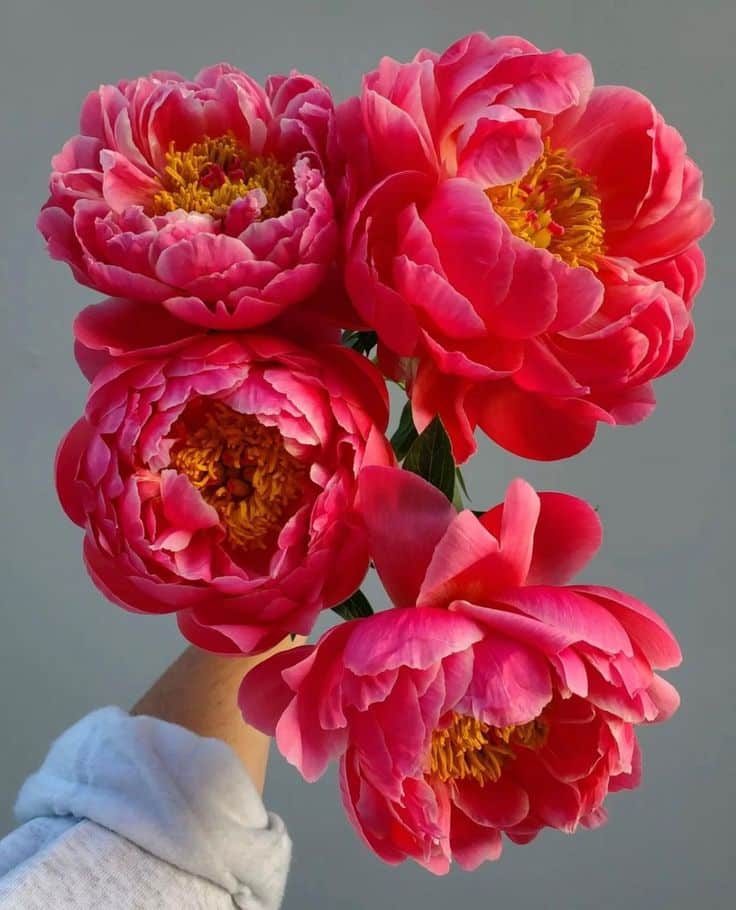
Under the Tang (618–907), the peony became an imperial obsession. In Chang’an, Empress Wu Zetian commanded their bloom in sumptuous gardens, while Luoyang, the capital of peonies, ignited during festivals where poets like Liu Yuxi sang of their « spring cheeks. » Silk paintings and ceramics immortalized their vibrant colors, blending love and opulence in every petal.
The Song Dynasty (960–1279) elevated the peony to a horticultural art. Scholars such as Ouyang Xiu described varieties with unprecedented hues, the fruit of expert grafting. A symbol of wealth, it sat enthroned in the gardens of the literati, but also served as an echo of the ephemeral in Buddhist philosophy. Under the Ming (1368–1644) and Qing (1644–1912), it flourished in « flower and bird » art, captured by brushes such as that of Yun Shouping, embodying a timeless beauty.
In Fuzhou, Fujian, peonies illuminate the historic gardens of Xihu Park, dialoguing with jasmine tea. Their presence in rituals and weddings, where they promise happiness and fertility, anchors their local legacy. Despite the upheavals of the 20th century, the peony has been reborn. Since 1994, the Luoyang International Festival has celebrated this flower, attracting souls enamored with its grace. In Fujian, it still adorns festivals, weaving a link between past and present. Every peony petal carries the history of a nation, a hymn to resilience and Chinese elegance.
The Dual Majesty: Tree vs. Herbaceous
It is crucial to distinguish the two souls of this sovereign. The most revered peony, that which adorned the imperial gardens under the Tang, is the Tree Peony (Paeonia suffruticosa), known in China as Mǔdān. It is a woody shrub, a living architecture that retains its stems year after year, and whose longevity can defy centuries. It symbolizes permanence and high rank.
Beside it stands the Herbaceous Peony (Paeonia lactiflora), whose stems vanish each winter only to be reborn from the soil in spring. More humble, it was nonetheless the species prized for its medicinal roots, and it was often its more delicate brilliance that was captured by European brushes. This duality—the eternal shrub and the cycle of herbaceous rebirth—reflects the complexity of its Asian heritage.
The Peony in Art: The Influence of Asia and the Impressionists
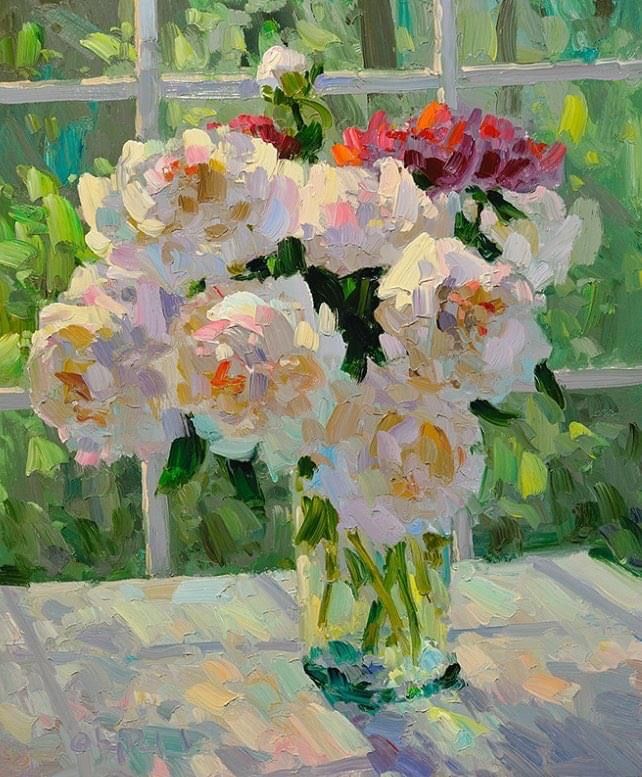
In the 19th century, peonies were not merely ornaments in Parisian gardens: they became « peonies in painting, » capturing light on Impressionist canvases. Impressionism, born in the 1860s in France, marked an artistic revolution.
Facing the strict rules of the Academy of Fine Arts, artists like Édouard Manet, Pierre-Auguste Renoir, and Mary Cassatt painted daily life and the fugitive moment. The peony, with its ephemeral glow, embodied this freedom.
Introduced to Europe from China as early as the 18th century, peonies conquered France in the 19th century through exchanges with Asia. Accessible in bourgeois gardens and Parisian markets, they seduced painters. Bouquets of peonies, with their silky petals and vibrant tints, inspired bold works that defied convention. A critic for Le Figaro dismissed these canvases as « unfinished, » but for the Impressionists, these peonies in painting symbolized a living art.
The influence of the peony extended to Parisian florists, who composed bouquets mixing white or pink peonies with light foliage, reflecting the Impressionist aesthetic. Thus, the peony united the canvas to the vase in a vibrant cultural echo.
Where to See the Most Beautiful Peonies? Bagatelle and the Sourches Conservatory
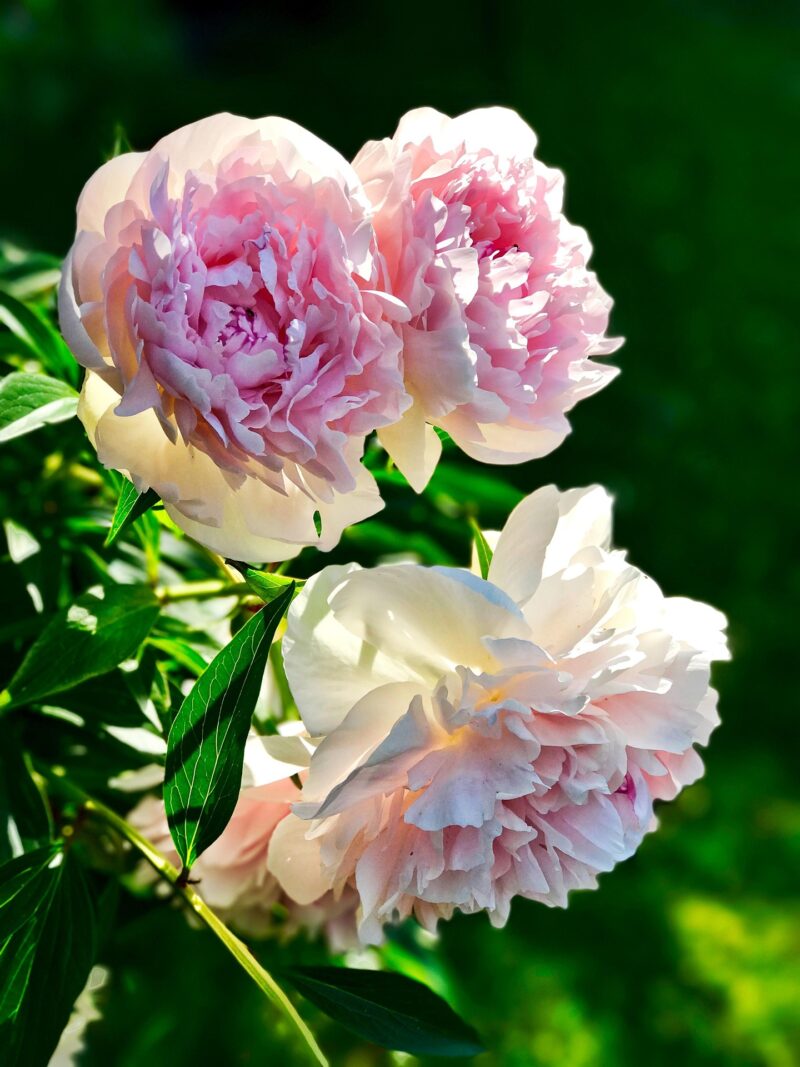
The peonies, muses of the painters, continue to bloom in our heritage. In Paris, the peonies in the Bagatelle Garden, nestled in the Bois de Boulogne, flourish every year in May and June. Created in 1775 following a bet between Marie-Antoinette and the Count of Artois, this historic garden marries art and nature. The pink, white, or red peonies evoke the peonies of the Impressionist painters, inviting a new form of contemplation.
This heritage is perpetuated at the Peony Conservatory in the garden of the Château de Sourches, in the Sarthe. With over 3,200 varieties, this site is the largest collection of peonies in the world. Initiated in 2003 by Bénédicte de Foucaud, this collection flourishes in the château’s medieval moats. Open from late April to early June, the conservatory attracts enthusiasts fascinated by rare peonies from China, Japan, or America.
This place, where floral symbolism meets botanical passion, embodies a living heritage. Wandering among the peonies in the Sourches garden, one can imagine Manet or Emperor Meiji, offering a wish for harmony.
A Crimson Thread Through the Centuries
From imperial China, where peonies danced under the gaze of emperors, to the Impressionist canvases where their petals captured bursts of light, to the gardens of Bagatelle and Sourches where they still whisper today, these flowers weave a timeless ode to beauty. Each petal carries a breath of history, a song of harmony and defiance, binding the centuries in a shiver of grace.
Vous pouvez naviguer par thématique via l’onglet « Collection Florale » dans le menu, ou revenir au cœur de notre univers floral :
Fil d’ArianeFAQ : The Royal Peony Experience
Is the Peony truly the « Queen of Flowers »?
In the French and Chinese traditions, absolutely. While the Rose is often seen as the flower of romance, the Peony represents sovereignty, opulence, and wealth. In the 18th and 19th centuries, having peonies in your garden was a definitive « statement » of taste—a French obsession that continues today in the most exclusive gardens of Paris.
What is the difference between a Tree Peony and a Herbaceous Peony?
his is the secret to a professional-grade garden!
The Tree Peony (Mǔdān): Think of this as the « Aristocrat. » It’s a woody shrub that stays above ground all winter, growing more majestic with every decade.
The Herbaceous Peony: This is the « Perennial Classic. » It disappears in winter and triumphantly returns every spring. It’s the variety you most often see in Impressionist paintings and Parisian floral boutiques.
I love Impressionist art. Which peonies should I look for?
If you want to recreate the look of a Manet or Monet canvas, focus on the Paeonia lactiflora varieties. Look for silken petals in shades of soft pink and carmine red. These were the « muses » of the 19th-century avant-garde because of how they capture and reflect the natural morning light.
Where can I see the world’s most prestigious peony collection?
For the ultimate « Flower Pilgrimage, » you must visit the Château de Sourches in the Loire Valley region (Sarthe). It houses the world’s largest collection with over 3,200 varieties planted in the dramatic setting of medieval moats. It is a breathtaking fusion of French history and botanical mastery.
When is the best time to visit Paris for the peony season?
Timing is everything. To see the legendary blooms at the Bagatelle Garden (in the Bois de Boulogne), plan your trip for May or early June. It’s the perfect time to experience Paris exactly as the Impressionists did—in a literal explosion of color and fragrance.
Is it true that peonies have medicinal roots?
Yes! Long before they were a status symbol, they were an elixir. From Ancient Greek myths to the Han Dynasty in China, peonies were used to soothe pain and fever. Today, they represent « healing and resilience »—making them a deeply meaningful gift for someone you care about.