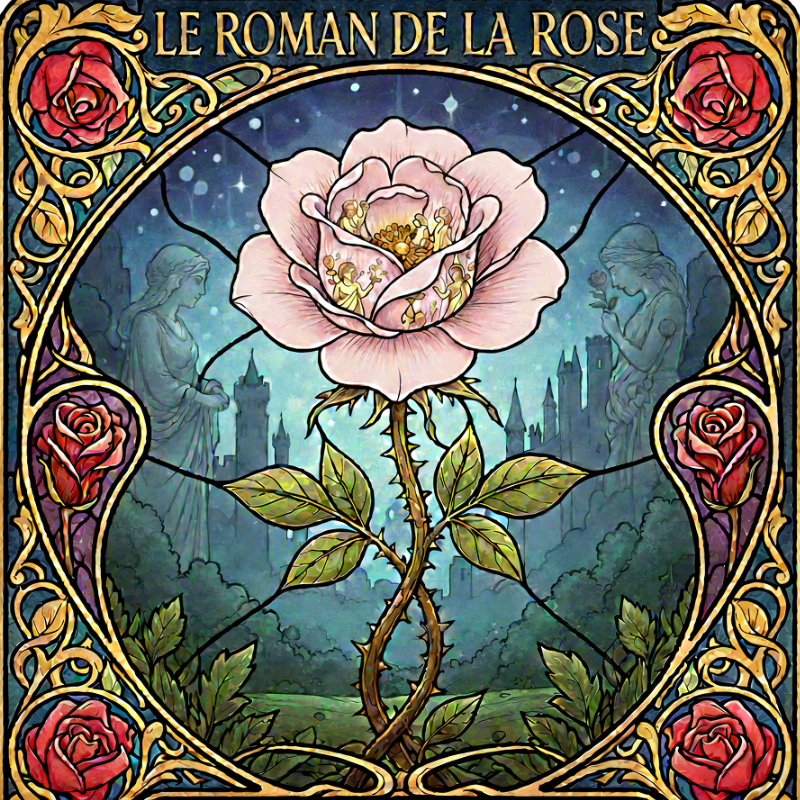
Through the lens of the Roman de la Rose, this article explores the rose as a cornerstone of medieval art and literature. Spanning allegory, courtly romance, and cultural legacy, the flower emerges as a defining symbol of love in the Western world—one whose echoes still resonate in our modern-day Valentine’s Day traditions.
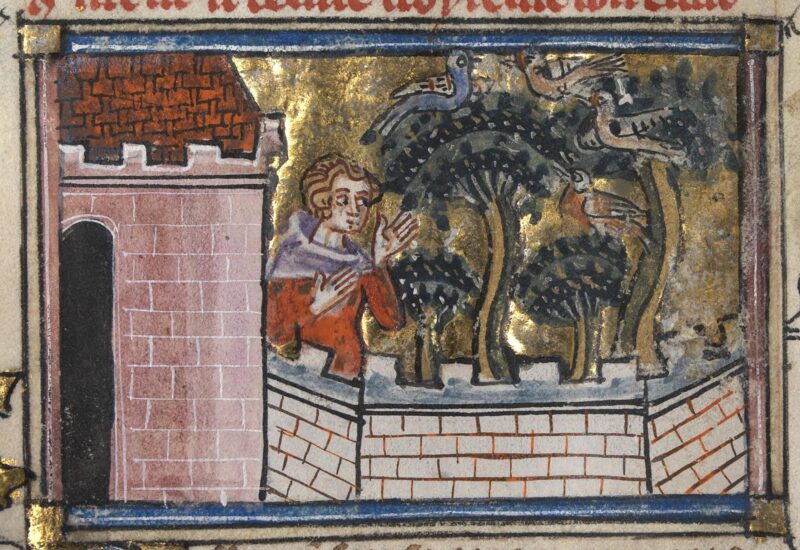
Everything began on a night in May, nearly eight centuries ago. A young man, our narrator, falls asleep to the murmur of a stream and awakens within a dream—a vision destined to define the landscape of Western love for eternity. He crosses the threshold of the Verger de Déduit (the hortus conclusus), a walled garden shielded from the wind.
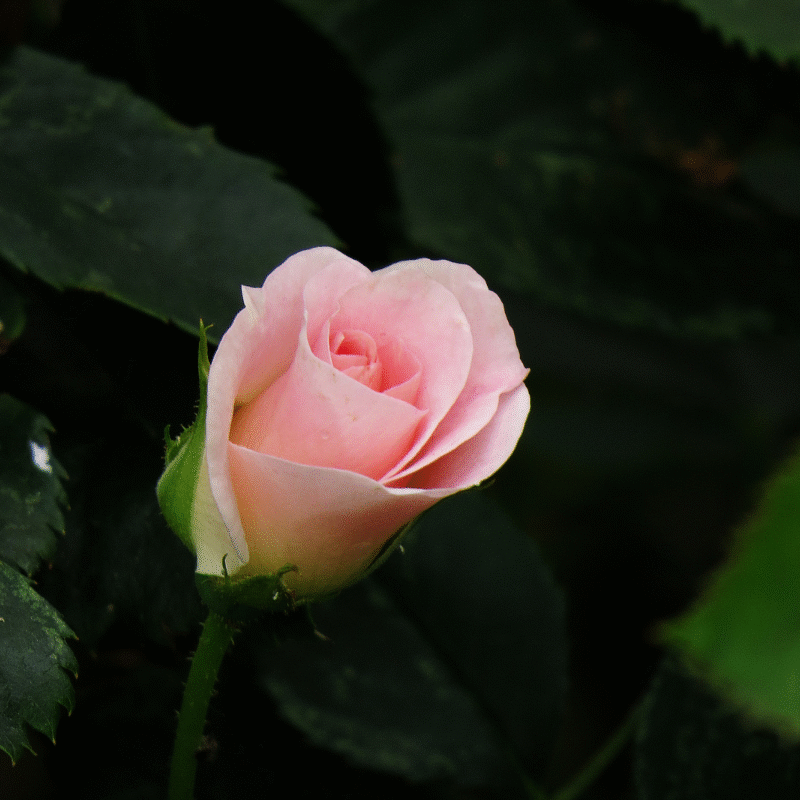
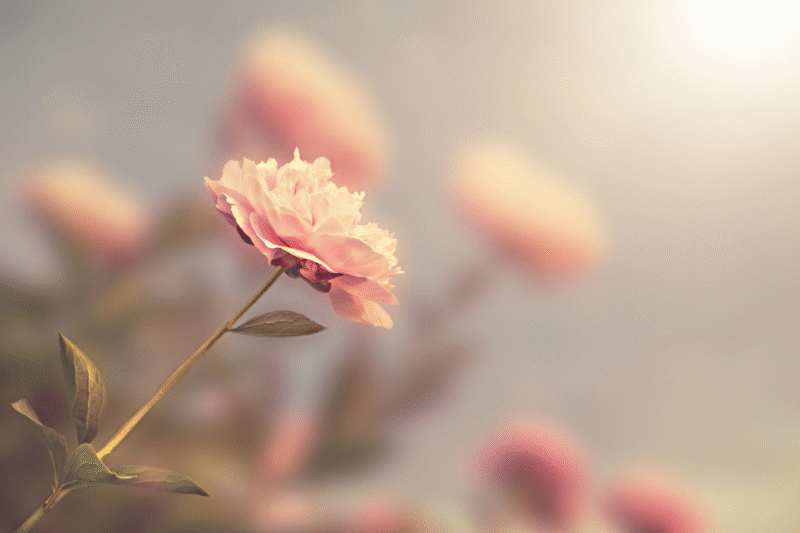
In this earthly Eden, the air is a warm, fragrant caress, vibrating with the songs of birds celebrating God’s Grace. Among the humble violets, daisies, and towering lilies, one queen reigns supreme: the Rose. At the heart of a bush of burning green, a single bud captivates the Lover : The Rose (though not all these flowers bloom in early spring, they certainly do in May or June). At the heart of a bush of burning green, a single bud captivates the Lover. This rose, pale and pearlescent, is more than a mere flower; she is the allegory of the Beloved, a silken promise still protected by her sepals.
The Arcana of the Dream: What You Will Discover
- The Dreamer’s Path: Explore the Verger de Déduit, the archetypal medieval “walled garden” where every path maps the geography of the human soul.
- Two Masters, Two Visions: Dive into the heart of the 13th-century literary debate, contrasting the spiritual patience of Guillaume de Lorris with the conquering naturalism of Jean de Meung.
- A Living Legacy: Discover how a 22,000-line poem shaped our modern Valentine’s Day rituals and the universal language of flowers.
I. The Verger de Déduit: A Geography of Desire
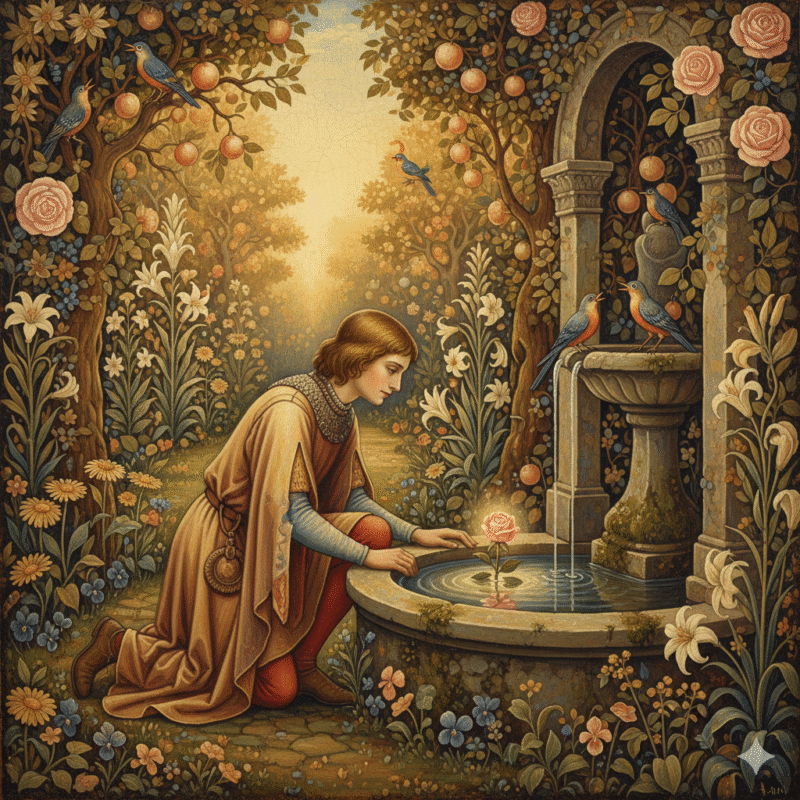
The garden is not a mere backdrop; it is a map of the human soul. By scaling the walls of the orchard, the Lover leaves the real world to enter the realm of Fin’Amor (courtly love).
- The Mirror of Narcissus: At the center of the orchard lies the Fountain of Love. As Guillaume de Lorris described around 1230, it is the “mirror” in which desire contemplates itself before daring to act. It is while gazing into these crystalline waters that the Lover glimpses the reflection of the rosebud and falls hopelessly in love.
- A Paradise of Light: Guillaume depicts a flower whose petals catch the sunlight like a golden mirror, eclipsing all other blooms. For him, she represents the incarnation of the feminine ideal: grace, sweetness, and mystery.
II. Guillaume’s Rose: An Ethic of Patience
For Guillaume de Lorris, the quest for the Rose is a spiritual initiation. The garden is not a “self-service” of pleasure, but a labyrinth of codes.
- Sentinels of the Soul: Guarding the coveted bud are allegorical figures: Shame, Fear, Jealousy, and Danger (Resistance). This bud represents the lady’s resistance—her modesty, her dignity, and her refusal of a conquest without merit.
- Contemplation vs. Possession: In this first part of the text, love is spiritual. The Lover does not seek to break the stem, but to earn the fragrance. To touch the rose too soon is to wound it; to wait is to allow it to bloom. The rose remains a suspended ideal, a beauty approached through the gaze and the respect of social conventions.
This rose is not inert; she evolves through the dream. First a closed bud symbolizing hope, then half-open, she embodies promise. Yet, in Guillaume’s mind, true love remains a matter of contemplation, not conquest.
III. Jean de Meung’s Turning Point: From Ideal to Reality
Forty years after Guillaume’s death, Jean de Meung took up the mantle around 1270. Under his pen, the poem’s sap changed radically, swelling from 4,000 to over 21,000 verses.
- A Philosophy of Nature: Jean de Meung transforms the garden into an encyclopedia of life. For him, the rose is meant to be plucked. He invokes the goddess Nature, who exhorts lovers to procreate to ensure the eternity of the species.
- The Final Conquest: The text concludes with a metaphor of romantic conquest, where the rose is finally won. This shift from contemplation (Guillaume) to action (Jean) reflects the transition from a mystical Middle Ages to a more rational, earthly era, foreshadowing Renaissance humanism.
IV. The Rose Through Time: From Illumination to Ritual
How did this romantic flower end up on our Valentine’s Day tables? The connection is more direct than it seems.
- The Myth of St. Valentine: While the martyr Valentine celebrated secret marriages under the Roman Empire, it was in the 14th century, under the direct influence of courtly literature, that his feast became that of lovers. French and English poets, nourished by the Roman de la Rose, began associating February 14th—the date when birds supposedly chose their mates—with the exchange of “valentines,” sweet notes often adorned with roses.
- The Code of Colors: The medieval rose was often depicted as pink or white, symbolizing purity and modesty. Legend tells of Aphrodite wounding herself on a thorn while running toward Adonis; her blood stained the flower, creating the red rose. Over centuries, this color became the symbol of ardent passion, fusing Guillaume’s courtliness with Jean de Meung’s desire.
V. An Eternal Bloom in the Arts
The Rose of the poem scattered its seeds across every layer of European art:
- Illumination: More than 250 manuscripts survive, each adorned with delicate miniatures. One sees the rose painted in gold and pink, sometimes floating in the air like a suspended dream. The manuscript at the Bibliothèque Nationale de France (BnF Fr. 1567) is famous for depictions where the flower seems to truly breathe upon the parchment.
- Tapestry: 15th-century “Millefleurs” tapestries adopt the orchard motif, transforming stone interiors into gardens. These works were often hung in nuptial chambers, a reminder that love must be cultivated like the flowers of a garden.
- Literary Posterity: It inspired the greatest minds: Chrétien de Troyes, Dante and his “mystic rose” in the Divine Comedy, and Petrarch mourning his Laura.
Did You Know? From Manuscript to Screen
While the public today may associate the medieval rose with the dark mystery of the film The Name of the Rose, Umberto Eco’s title is actually a melancholy homage to our poem. Where the film loses us in the folds of a stone abbey, the Roman de la Rose guides us through the meanders of a silken garden. One treats the end of a world; the other, the birth of a sentiment.
Conclusion: Why We Still Offer the Rose
Every Valentine’s bouquet is a distant echo of this medieval dream. To offer a rose is to tell another that they are that precious bud in the middle of the world’s brambles. It is to accept, for the duration of a gesture, becoming a 13th-century Lover—one who sees in a flower the summary of all virtues and all desires. The rose is not merely February merchandise; she is humanity’s oldest poem, a literary sap that has never ceased to flow.
Further reading
- The Extraordinary History of the Rose: From Persian Roots to European Allegories
- The Rose and the Nightingale: A Song of Love and Blood in Floral Art
- Eden Within the Walls: Secrets and Splendors of Medieval Gardens
FAQ: Unveiling the Secrets of the Roman de la Rose
Who were the masterminds behind this legendary poem?
Journey back to the 13th century! This masterpiece was a dual feat: started by Guillaume de Lorris, who captured the dream of courtly love, and finished forty years later by Jean de Meung, who turned it into a bold philosophical revolution.
What secret does the Rose truly hold?
More than just a flower, the Rose is a mirror of the soul. It embodies the Beloved, the thrill of the forbidden, and the raw power of Nature. To understand the Rose is to unlock the medieval code of passion and desire.
Is the Roman de la Rose the true ancestor of Valentine’s Day?
es! Before the greeting cards and bouquets, there was this poem. By turning the rose into the ultimate prize of a romantic quest, it gave us the symbols we still use every February 14th. Discover how 22,000 lines of verse defined modern love.
hat is the mystery of the “Walled Garden”?
Step into the Hortus Conclusus—a sanctuary where every flower and fountain tells a story. This “enclosed garden” is a metaphor for the heart’s most private secrets. Are you ready to scale its walls and discover what lies within?
Continue Your Exploration
Immerse yourself in the world of flowers through our various themes and discoveries.
Start ExploringReceive Our Next Discoveries
Subscribe ✉️