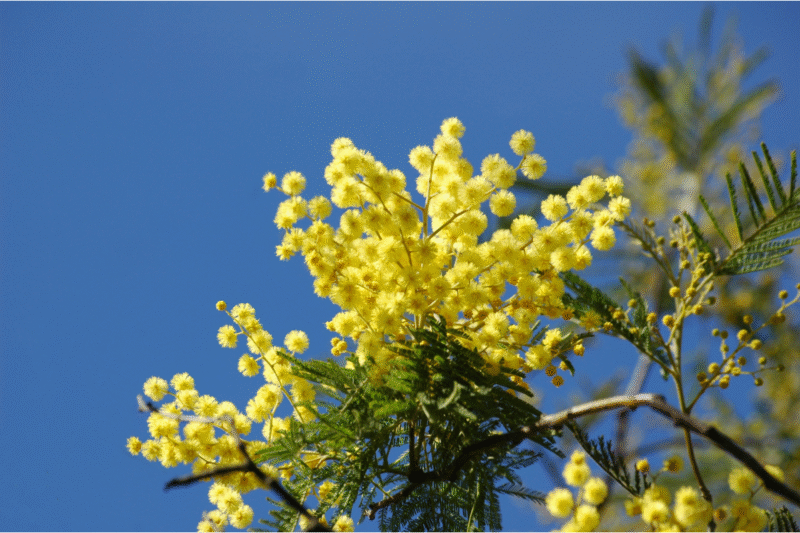
A sun-drenched bloom emerging in the dead of winter, the mimosa is far more than just a plant. It represents a crossroads where botanical history, the floral trade, political symbolism, artistic vision, and collective memory all intersect. This profile offers a cultural, interdisciplinary look at a paradoxical flower: it is at once a Mediterranean icon, a fleeting commodity, and a universal social emblem. From the Australian bush to the French Riviera, and from painters’ studios to feminist movements, the mimosa reveals how a single plant can become a true cultural phenomenon.
When the frosts of January still freeze the gardens of Europe, a sudden explosion of gold defies the grayness. The mimosa, with its powdery pom-poms and its scent of almond honey, seems to be a spring miracle lost in the calendar. Yet, behind the apparent fragility of its small blossoms hides an exile’s destiny, a biology of iron, and a history woven with botanical misunderstandings, artistic obsessions, and social revolutions. Journey to the heart of a solar radiance that has learned to tame fire to better conquer the winter.
Les Saisons de l’Or : Ce que ce récit vous dévoilera
- Le Paradoxe des Noms : Pourquoi notre “Mimosa” est botaniquement un Acacia.
- La Phénix Végétal : Le secret des pyrophytes ou comment naître de la caresse des flammes.
- L’Ingénierie de la Vapeur : L’art du forçage, où l’homme dérobe le printemps au calendrier.
- La Palette et le Parfum : L’obsession de Pierre Bonnard et les céphalées poudrées des salons d’antan.
- Le Hiéroglyphe Social : Du rameau sacré d’Osiris à l’emblème de la lutte pour les droits des femmes.
The Name Misnomer: Between Acacia and Mimosa
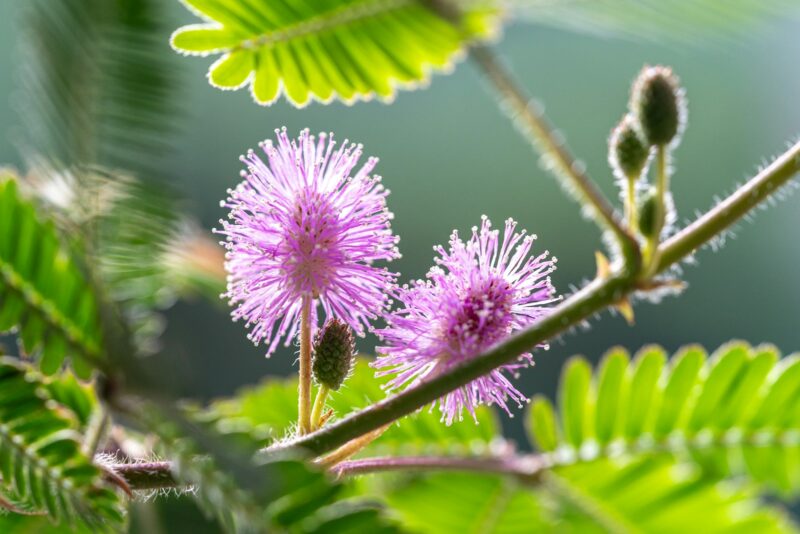
Before diving into its epic, it is essential to clear up a confusion that has lasted since the 18th century. What we buy today under the name “mimosa” is, to a botanist, an Acacia (primarily Acacia dealbata, the winter mimosa). The true Mimosa genus does indeed exist, but it designates plants with very different characteristics, such as the famous Mimosa pudica, the sensitive plant that folds its leaves at the slightest touch.
This naming error dates back to the era of the first classifications: the term comes from the Greek mimos (to mime), because its leaves seemed to mimic animal sensitivity. By extension and poetic drift, popular usage eventually baptized these Australian acacias with this name.
They arrived in the cargo holds of great explorers like James Cook and Sir Joseph Banks during their botanical expeditions to Terra Australis. However, the mimosa was then only a greenhouse specimen, a jealously guarded rarity. It was not until around 1850, when the British aristocracy began to winter on the French Riviera, that it was planted in the open ground in the villa gardens of Cannes and Grasse. What was once a collector’s curiosity became, in a few decades, the very face of the Mediterranean winter, escaping iron gates to colonize the wild hills of the Tanneron massif.
The Sacred Pyrophyte: A Genealogy of Fire
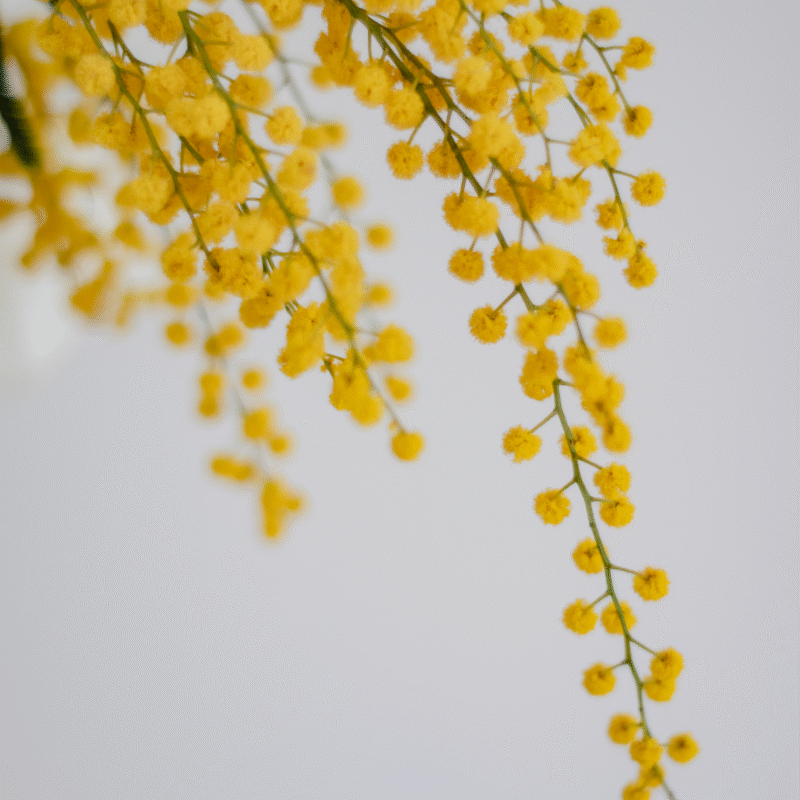
The true nature of the mimosa is much more resilient than it appears. In its native Australian bush, it belongs to the category of pyrophytic plants. Unlike most vegetation for whom fire is a death sentence, fire for the mimosa is a promise of life and a condition for its propagation. Its seeds are encased in a stone-hard coat—a nearly impenetrable armor that allows them to remain dormant in the soil for several decades, indifferent to droughts.
It takes the searing heat of a wildfire to cause a thermal shock capable of cracking this protection. Where the forest is devastated, the mimosa is the first to emerge from the black, ash-covered earth, taking advantage of the disappearance of the canopy and the potassium-rich soil to transform disaster into a tide of yellow flowers. This resilience “born of fire” explains why it has spread so vigorously in Southern France: it does not fear brushfires; it waits for them to conquer new territories. This phoenix-like biology makes it a natural symbol of life extracting itself from chaos, a concept that resonates with its blooming in the heart of the cold.
The Alchemy of Forcing: The Secret of the Steam Chambers
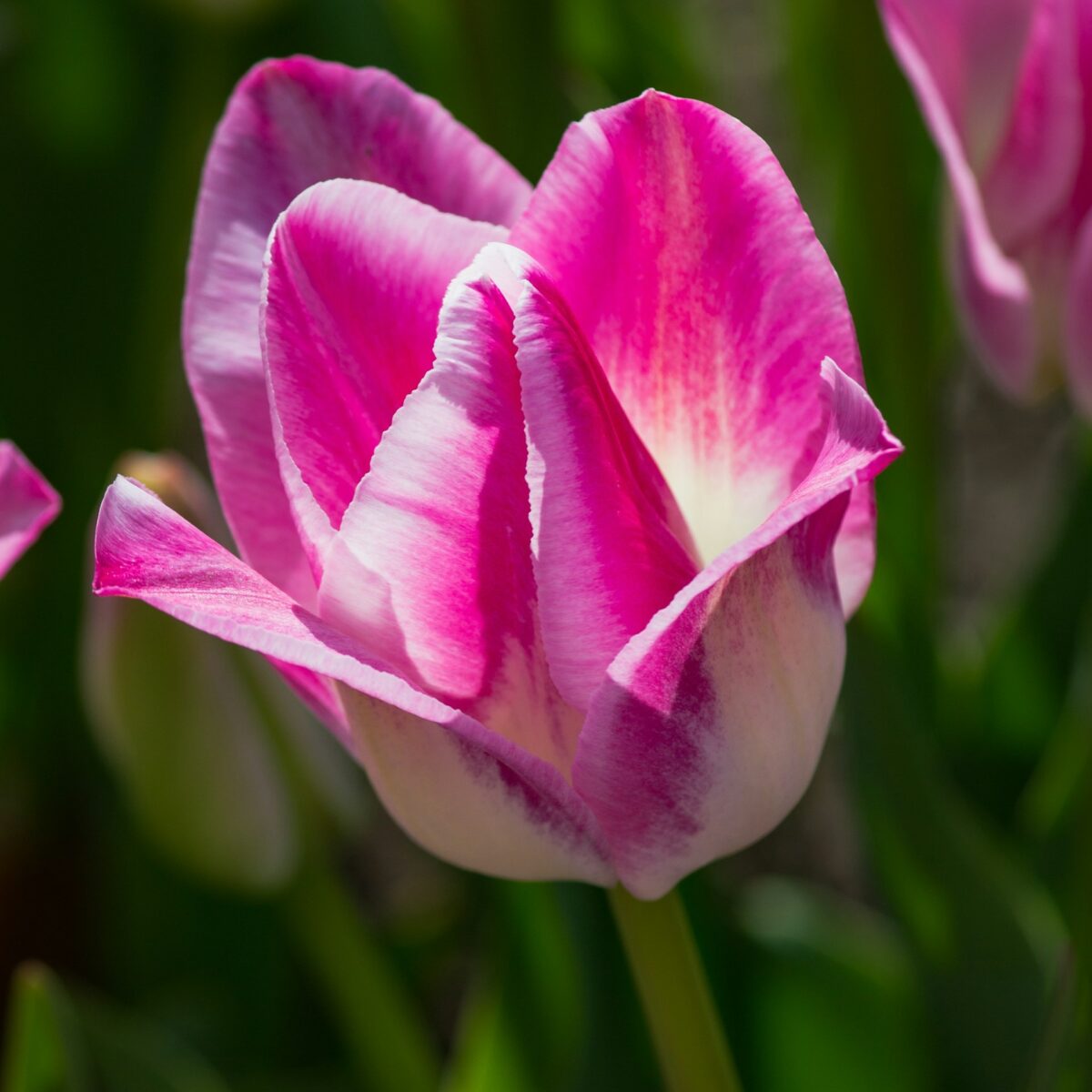
If the mimosa brightens interiors as early as January, it is thanks to a unique horticultural expertise: forcing. This technique establishes a fascinating parallel with another specialty of the Var region in Southeastern France: specifically those grown using forcing techniques, and more precisely the famous ‘early tulips’ of Carqueiranne and Hyères.
In this “golden triangle” of cut flowers, growers have learned to “steal” spring from nature. For the tulip, forcing begins with a thermal manipulation of the bulb (vernalization), simulating an artificial winter to trigger an early bloom. For the mimosa, the process is even more spectacular: it is a true midwifery by steam.
The branches are cut with surgical precision while the buds are still small, green, airtight grains. They are then placed in forcing chambers—technological sanctuaries where a constant temperature of 77°F and a saturated humidity of 90% are maintained. Just as Riviera producers protect their tulips under tunnels to gain a few degrees, the mimosa grower uses moisture to soften the envelope of the pom-poms. To guarantee a perfect bloom without the pom-pom wilting, aluminum sulfate is sometimes used in the vase water to block ethylene—the plant’s aging hormone.
This thermal and humid shock artificially mimics the conditions of an ideal Australian spring. Without this steam engineering, the mimosa would remain a flower of March, capricious and late; thanks to it, it has become the engine of the “Golden Route,” saving the economy of the French Riviera after the glacial winters of the 19th century.
The Painter’s Palette: Bonnard and “Yellow Fever”
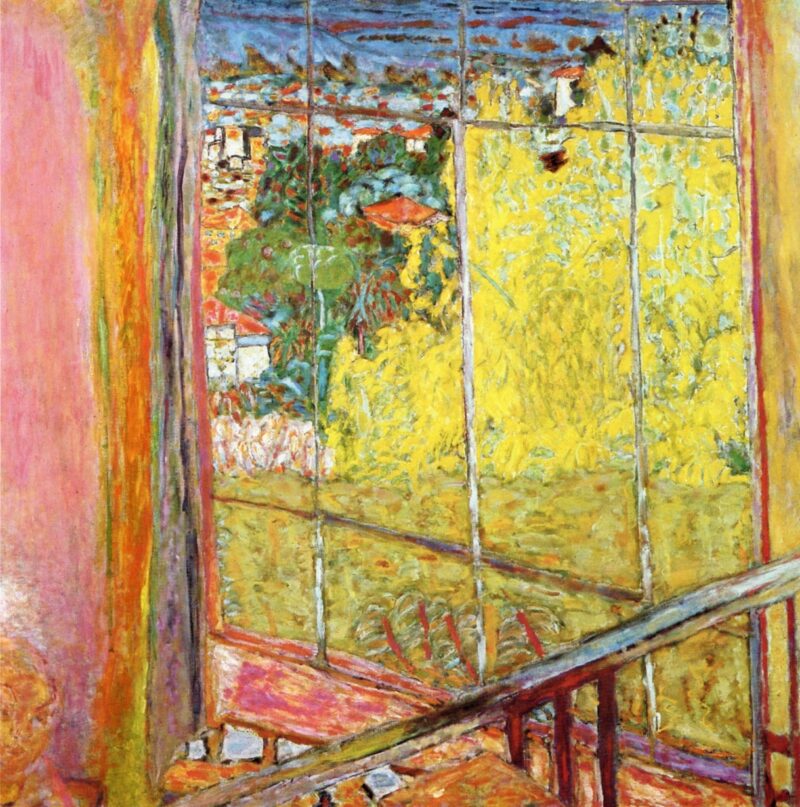
The impact of the mimosa goes beyond gardens to invade the canvases of the masters. Pierre Bonnard (1867–1947), the “painter of happiness,” was literally overwhelmed by this flower upon his move to Le Cannet. For him, the mimosa was not a simple decoration, but a chromatic obsession. In his masterpiece The Terrace at Le Cannet (L’Atelier au mimosa), the flower becomes an invasive force, a light that devours space and submerges the window.
Painting the mimosa represents a colossal technical challenge: how to render the vaporous texture of these thousands of pom-poms without freezing the canvas in a dry pointillism? Bonnard used vibrant yellows, cadmiums, and ochres to capture this “yellow fever” which, in his own words, seemed to make the air vibrate. The mimosa has thus become, in art history, the metaphor for a light that cannot be contained—an explosion of pure joy in the face of the transience of things.
This floral obsession isn’t an isolated case; it’s part of a broader tradition—one also seen in the role of the tulip throughout art history, where the flower evolves into both a motif and a language of its own.
A Gastronomy of Light: From Syrup to Sugar Pearls
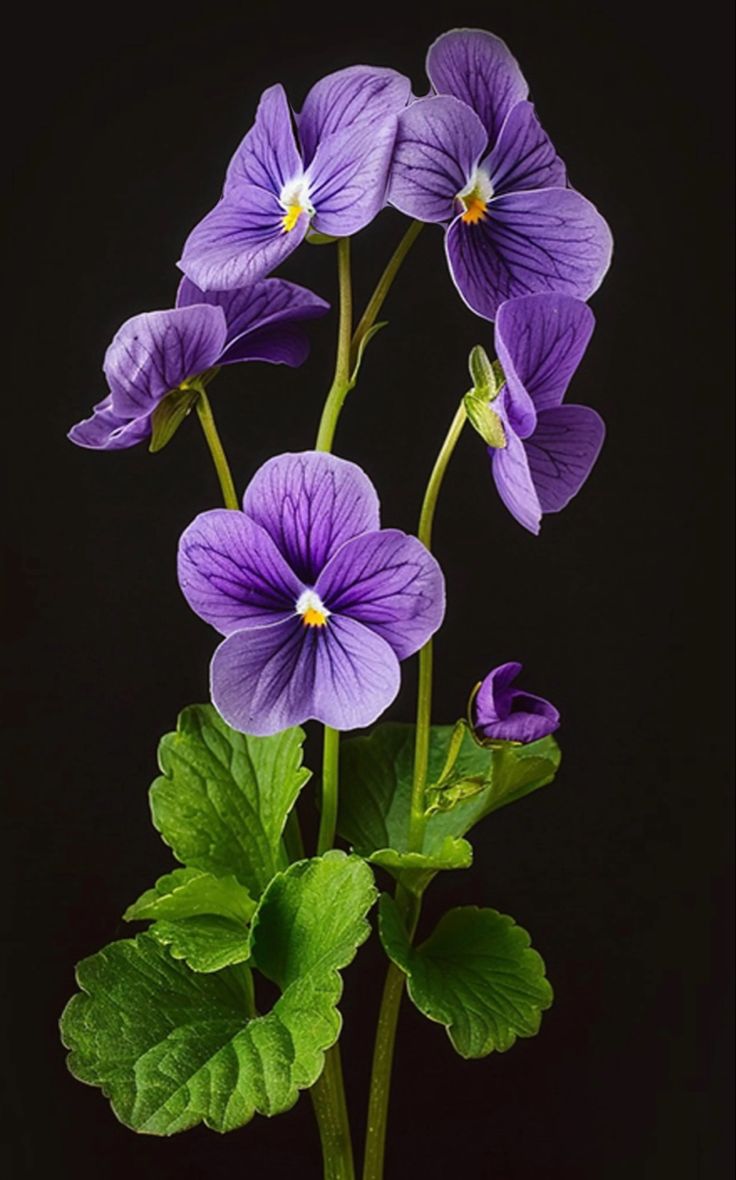
The garden also invites itself to the table, revealing an often-overlooked gourmet side. In Grasse, the perfume capital, the mimosa has turned into a confection. There, golden-hued syrups and sugar-crystallized flowers are crafted, following a tradition reminiscent of the Violets of Toulouse.
The link between these two flowers is actually deeper than it appears. Both share that characteristic “powdery” note. Where Toulouse made its violet a jewel of fine confectionery, southern confectioners learned to tame the mimosa pom-pom. Coated in gum arabic and powdered sugar, the buds become “Mimosettes”—small crunchy pearls that release a powerful floral aroma, blending honey with a hint of wild vanilla. This gastronomy of forgotten flowers transforms the winter bloom into a pleasure for the senses where sight and taste merge in a solar sweetness.
The Incompatibility of the Senses: Powdery Melancholy
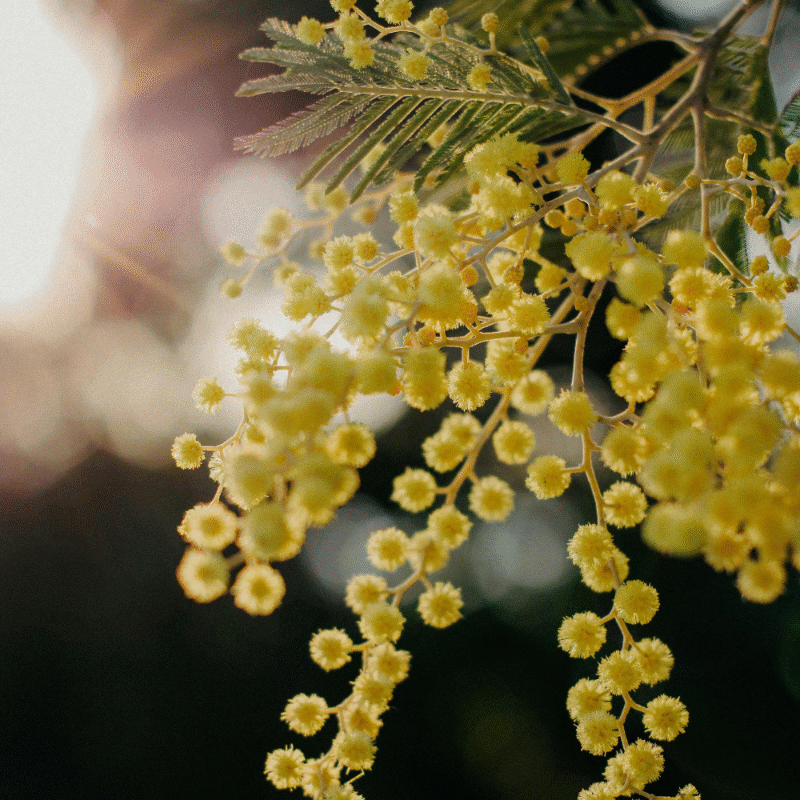
In perfumery, mimosa absolute is a precious raw material obtained by volatile solvent extraction. Its olfactory profile is a sensory paradox: a green and herbaceous head, reminiscent of cucumber or cut grass, which opens onto a powdery heart. This facet is due to the presence of aldehydes and ionones, molecules also found in the iris.
However, despite this apparent sweetness, the scent of the mimosa is complex. At the end of the 19th century, this potency was the subject of notable medical distrust. Mimosa was discouraged in poorly ventilated bedrooms. Doctors spoke of a “yellow intoxication,” fearing that its overly present effluvium would cause headaches or “golden melancholies.” The mimosa is the flower of distance: it needs the mistral wind to dilute its intensity. In the silence of a closed parlor, its genius becomes an almost hypnotic presence—a sensory haunting that still divides the world’s great “noses” today.
The Flip Side of the Coin: The “Green Plague”
A floral historian must also contemplate the shadows. Behind the radiance of the flowers hides a darker ecological reality. In the Maures and Esterel massifs of the French Riviera, the mimosa is now classified as an invasive species. Its lightning-fast growth (up to three feet per year) and its ability to fix nitrogen in the soil radically alter local ecosystems.
By choking out endemic flora—cork oaks, heathers, and rockroses—it creates monoculture zones that deplete biodiversity. Furthermore, its pyrophytic nature, so advantageous for its survival, poses a major problem: the mimosa is a veritable “fire pump.” Rich in essential oils and producing a lot of dead wood, it promotes the spread of forest fires. This is the paradox of the mimosa: a divine adornment for man, but a threat to the balance of native nature.
The Root of the Sacred: The Tree of Osiris
To understand the depth of the mimosa, one must return to the sources of mythology. The acacia, its direct ancestor, was considered by the ancient Egyptians as the Tree of Life. In ancient texts, it is said that Osiris, the god of resurrection, was born under an acacia. His coffin, thrown into the Nile, was stopped by the branches of a giant acacia that wrapped around it to protect it.
This plant thus became the symbol of victory over death and the eternity of knowledge. Long before becoming the florist’s bouquet, the acacia-mimosa was that sacred branch placed on tombs to signify that the soul, like the flower in the heart of winter, never truly dies.
From the Language of Flowers to the Symbol of Revolt
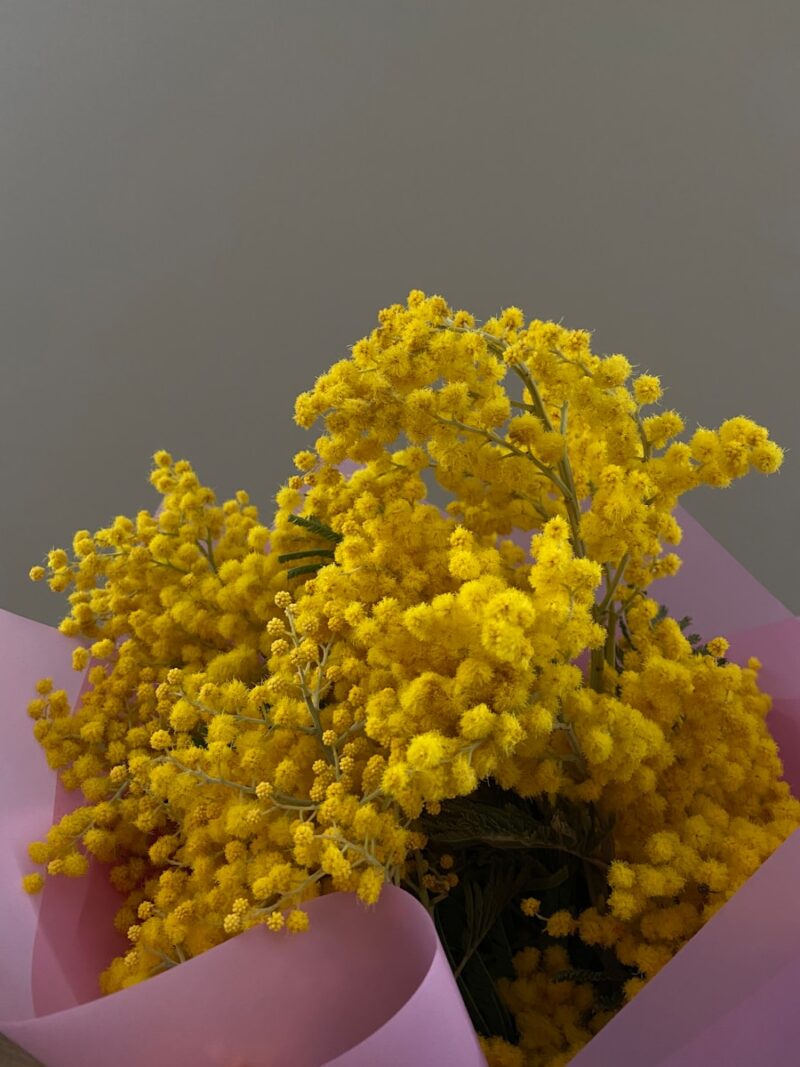
In the silent grammar of the language of flowers, the mimosa carries a message of security and constancy. To offer a mimosa branch is to affirm: “No one loves me as you do.” It is the flower of absolute certainty.
But this symbolism took a major sociopolitical turn in 1946. In Italy, where International Women’s Day is a major floral event, resistance fighter Teresa Mattei chose the mimosa as its emblem. She preferred this wild flower, found for free by the side of the road, over the rose or the orchid, which were deemed too aristocratic. Since then, especially in Southern Europe, this golden branch has been the hieroglyph of a struggle that refuses to wither—a bridge between the raw beauty of nature and the human aspiration for dignity.
The Paradox of Free Gold: Between Social Ideal and Economic Windfall
A fascinating paradox exists in the destiny of the March 8th mimosa. When Teresa Mattei imposed it in 1946, her main argument was its gratuitousness: it is the flower gathered by the wayside, belonging to no one and therefore to everyone. It was the “anti-orchid,” a revolt against the commodification of sentiment. Yet, the success of this symbol has spawned a colossal economic architecture, particularly in Italy.
Every year for this single day, an estimated 12 to 15 million bouquets of mimosa are sold across the Italian border. What was meant to be a wild gift has become a “tax of recognition” worth tens of millions of dollars. This windfall directly irrigates the farms of the French Riviera, because while Italy produces, it also massively imports the most prestigious varieties (such as the Mirandole or the Gaulois) born of French expertise to satisfy this unique peak of consumption.
The “Product-Flower”: A Logistics of the Instant
Economically, the March 8th mimosa is a high-wire act. Unlike the rose, which can be stored in cold rooms, the mimosa is “breathless” living matter. Its value collapses in a matter of hours if it loses its “powder.”
- The Peak of Supply: Wholesale market prices (such as those in San Remo or Nice) skyrocket in the 48 hours leading up to the holiday, mirroring the volatility seen across the global cut-flower market.
- The Social Impact of Sales: A parallel, sometimes informal, economy emerges, where the mimosa becomes an urban currency of exchange.
Here lies history’s irony: the flower chosen for its poverty has become one of the most profitable horticultural products per square foot in the world… provided it is sold before sunset on March 8th. Beyond that, it is worth nothing. This economic fragility echoes the precariousness of the rights it is supposed to defend: a magnificent radiance, but one that requires constant vigilance to avoid turning into dust.
Secrets of the Corolla: Questions Carried on the Breeze
What’s the difference between Mimosa and the Sensitive Plant?
The mix-up is one for the history books: the true Mimosa pudica is a humble plant that folds its leaves at the slightest touch. Our ‘golden trees’ are actually Acacias, which traveled all the way from Australia to conquer our European winters.
Is mimosa actually edible?
Absolutely. Whether crystallized or infused into syrup, the mimosa blossom offers a flavor profile where honey meets violet—a cherished tradition upheld by the master confectioners of Grasse and Nice (on the French Riviera)
Why is the mimosa considered a ‘green menace’?
Though draped in gold, the mimosa is a ruthless conqueror. In the Esterel Massif, its explosive growth chokes out native species, transforming diverse landscapes into monocultures that are dangerously vulnerable to wildfires.
Continue Your Exploration
Immerse yourself in the world of flowers through our various themes and discoveries.
Start ExploringReceive Our Next Discoveries
Subscribe ✉️