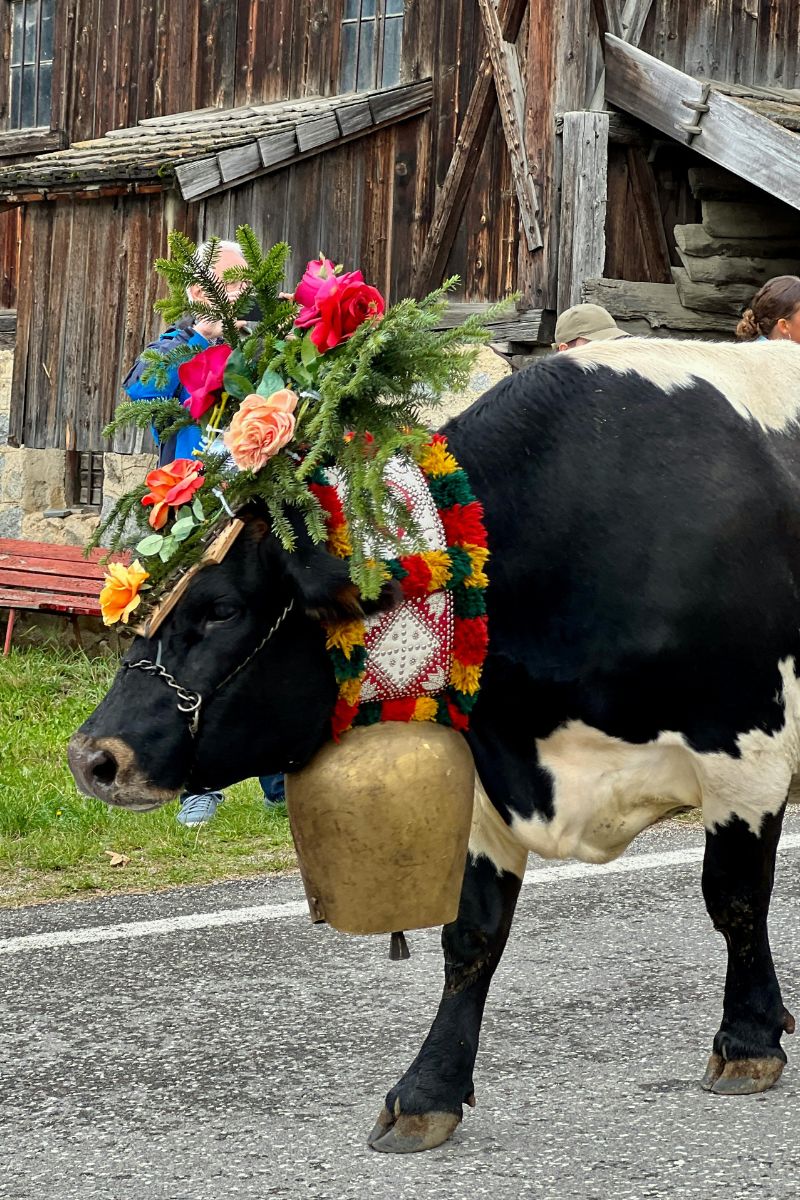
What you will discover in this article:
- Why the cows of the Desalpe wear immense flower crowns… made of crepe paper
- How a 19th-century carnival invention became a sacred symbol of the Alps
- The secret meaning of colors and the number of roses on each crown
- The dozens of hours of labor performed by women, passed down from mother to daughter
The Crowns of the Desalpe: When the High Pastures Descend in Bloom
In late November, the mountains begin to whiten. The great bells around the animals’ necks are no longer worn constantly. The herds descend from the peaks to return to their winter stables. The Désalpe—this spectacular transhumance marking the end of summer in the heights—is far more than a simple movement of livestock.
In old photographs, as in the villagers’ collective memory, something continues to shine: crowns of crepe paper flowers, resilient against the whims of the mountain weather. A 19th-century creation, the paper flower took root and blossomed in the soil of an even older tradition: the descent from the high pastures (alpages), a key moment of the seasonal migration. In French-speaking Switzerland, it is commonly called the “Désalpe,” while elsewhere in the European massifs, it is known as the “descent from the alpage.”
- During the summer in the highlands, each cow wears her bell day and night; the sound helps the cowherds locate them in the alpine mist or the dark of night.
- As soon as the herd returns to the village and the animals are settled in the stable for the winter, the large bells are removed. They remain hanging in the barn until the following spring.
Each region has its own word, its own music, and its precise dates (from mid-September to early November, depending on the altitude). But everywhere, the emotion remains the same: the herd returns, the promise is kept, and the valley once again finds the chime of the bells—melodious and reassuring echoes bouncing off the mountainsides.
Before Crepe: A Solemn Festival, a Promise
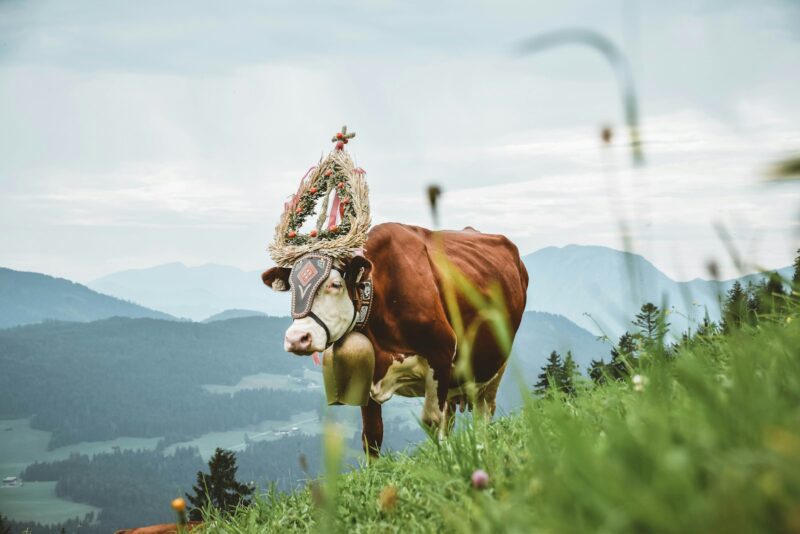
Until the 19th century, cows were decorated with what the mountain gave freely: dried edelweiss, gentians, wool ribbons, and sometimes a wooden crucifix. These natural flowers, though beautiful, often withered during the arduous ten-mile trek down steep, rocky trails. The gesture was first and foremost an act of thanksgiving: gratitude for a summer without accidents, a reintegration into the rhythm of the village, and the beginning of winter labors. One adorned the cattle out of gratitude, not pride.
Across the high ridges of Europe, this sobriety long prevailed: from the Jura mountains bordering Switzerland and the lush Beaufortain in the heart of the French Alps, to the jagged Pyrenees marking the border with Spain, and down to the wild Abruzzi in central Italy. In these pastoral havens, one can still see cows adorned only with a simple wooden cross and a bouquet of dried grass. A silent, rustic elegance that speaks of a time before the artifice of paper.
Paper Arrives and Changes the Light
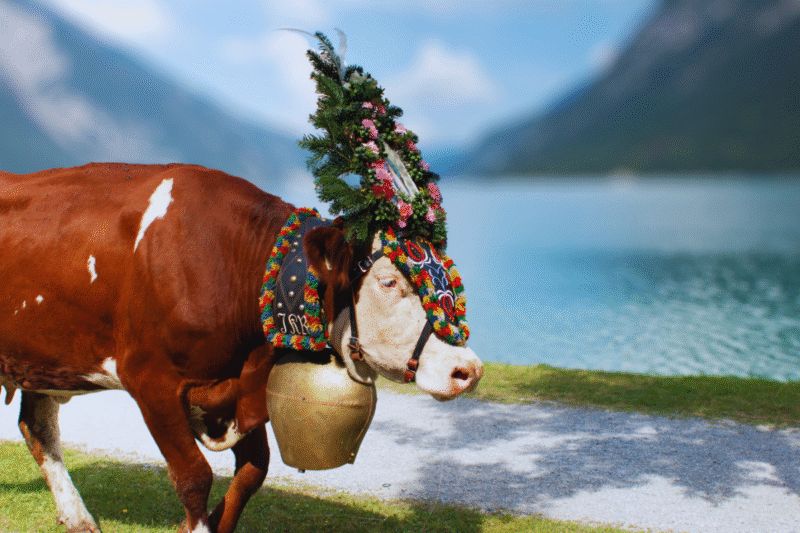
In the middle of the 1800s, crepe paper, invented in Italy, crossed the mountain passes from Lyon and Geneva—originally intended for theaters and carnivals. Very quickly, it found its way into the remote mountain chalets. Light, docile, and brilliant, it held its shape where the natural flower bowed. The practical trick became an art, and the art a friendly competition between families: larger, more colorful, more ingenious. The crown promises, keeps its word, and remembers.
A Grammar of Colors and Numbers
Nothing is left to chance in this floral architecture. Red speaks of strength and joy. The white of the paper edelweiss evokes the purity of the summits. Green represents the summer grass. Three large roses might stand for three generations of farmers who went up to the pastures together. Seven small ones for the seven weeks of the estive (the summer grazing period). And when mourning touches the alpage—if a member of the family has passed—all finery is renounced: no crowns, no ribbons, and the descent is made in a heavy, respectful silence.
A Craft Transmitted in the Evening, Around the Table
The crowns are fashioned by the fine and skillful hands of women. When September arrives, grandmothers, mothers, and daughters gather. The technique flows from needle to needle. In some families, the same cardboard templates for the petals have been used for over a century. A single paper rose requires seven to nine layers. One folds, fringes, and binds. A single crown demands forty, sometimes sixty hours of work. Time itself leaves its glow upon them.
From One Slope to Another, Styles That Breathe
The aesthetics of the descent shift as one crosses the peaks. In the German-speaking regions of the Austrian Tyrol and Bavaria, the celebration is known as the Almabtrieb. Here, the beauty of the paper embraces its own brilliance; crowns are often adorned with small mirrors. These mirrors are not mere ornaments; they are ancient talismans meant to catch the sun and reflect the “evil eye,” protecting the herd from mountain spirits as they pass through the dark forests.
While the Swiss style remains disciplined—with clean lines and paper edelweiss on the queen’s brow—the Bavarian and Tyrolean crowns are a symphony of exuberant silk ribbons and small bells that answer the deeper chime of the cowbells.
In the French massifs (Jura, Beaufortain, Pyrenees), the language of simple things was long preserved: wools, dried flowers, and wooden crosses, with just a touch of crepe here or there. Everywhere, the skill of the women is law; each crown bears the imprint of the one who shaped it.
Sacred Roots, Suspended Memory
Long ago, a ritual promise was made in the spring: if all the animals returned safe and sound from the perils of the peaks, the “Queen” (the dominant cow of the herd) would be adorned. Paper prolongs this ancient vow. In certain alpine chapels, frail crowns still hang as colorful ex-votos. A crucifix is often tucked into the folds of the paper to light the way home.
Measured Modernity, Tenacious Fidelity
The festival has grown crowded with modern tourists, markets, and tastings. Today, a few LED lights venture into the crowns, like on Christmas trees, or perhaps a plastic edelweiss. But the community whispers: “That is not the way.” Crepe persists. It rustles today as it did yesterday, keeping the mark of the fingers that pressed it. As long as the given word endures, the paper flower tells the truth.
The Queen and the Weight of Flowers
It is always the Queen cow—the matriarch—who carries the heaviest burden. The most beautiful cow raises her neck, or sometimes lowers it under the profusion and weight of the decor. Here, the artificial flower reveals its secret: it is not a real flower, and yet it speaks truly. It recounts an entire year: labor, anxiety, joy, and gratitude. As the valley welcomes the bells, a certainty passes between beasts and humans: winter can come. In the spring, the mountain will say once more that it is time to leave, to climb back to the high pastures, to unhook the bells and place them once again around the necks of the cows.
History does not end with this single petal…
A new path now unfolds before you: continue your journey by exploring the destinies of other blossoms that have shaped our world.
Explore our themes through the “Flower Collection” tab, or return to the heart of our world:
GatewayAlpine Echoes: Secrets of the Floral Descent
Is there a hidden meaning behind the mirrors on the cows’ foreheads?
Beyond their sparkle, these mirrors are ancient talismans. In the traditions of the Austrian Tyrol and Bavaria, they are placed at the heart of the paper flowers to reflect the “evil eye” and protect the herd from mountain spirits during the descent. This mystical detail transforms a simple floral ornament into a sacred shield for the “Queen” of the herd.
Why does the Alpine tradition favor paper flowers over natural blooms?
While the Alps overflow with wildflowers, the journey home—the Désalpe or Almabtrieb—is a grueling ten-mile trek. Natural petals would wither or shatter long before reaching the valley. Since the 19th century, crepe paper has been the secret to an “eternal bloom,” allowing the farmers’ gratitude to remain vibrant and unbowed until the very last mile.
What is the “Désalpe,” and how does it differ across the Alps?
It is the soul of the mountains in motion. While French-speaking Switzerland calls it the Désalpe, the Bavarian and Austrian heartlands celebrate the Almabtrieb. Though the names and the exuberance of the ribbons may change from one slope to another, the heartbeat remains the same: a triumphant return where every color and every bell tells the story of a summer spent in the clouds.
How many hours of craftsmanship are hidden in a single crown?
The splendor of a crown is measured in patience: it takes between forty and sixty hours of meticulous hand-work to create these masterpieces. Passed down from mother to daughter, the art of folding seven to nine layers of paper for a single rose is a silent language of devotion, ensuring that the “Flower of History” never truly fades.