Four threads run beneath the surface of this article: the horticultural genius that turned the Flemish begonia into a living pigment; the poetry of the instant, born from the precise gestures of one hundred twenty volunteers; a geography of the ephemeral connecting Brussels to Genzano, Antigua, and Lisse; and finally the carpet as a seismograph of History, where a flower’s corolla becomes a language of diplomacy.
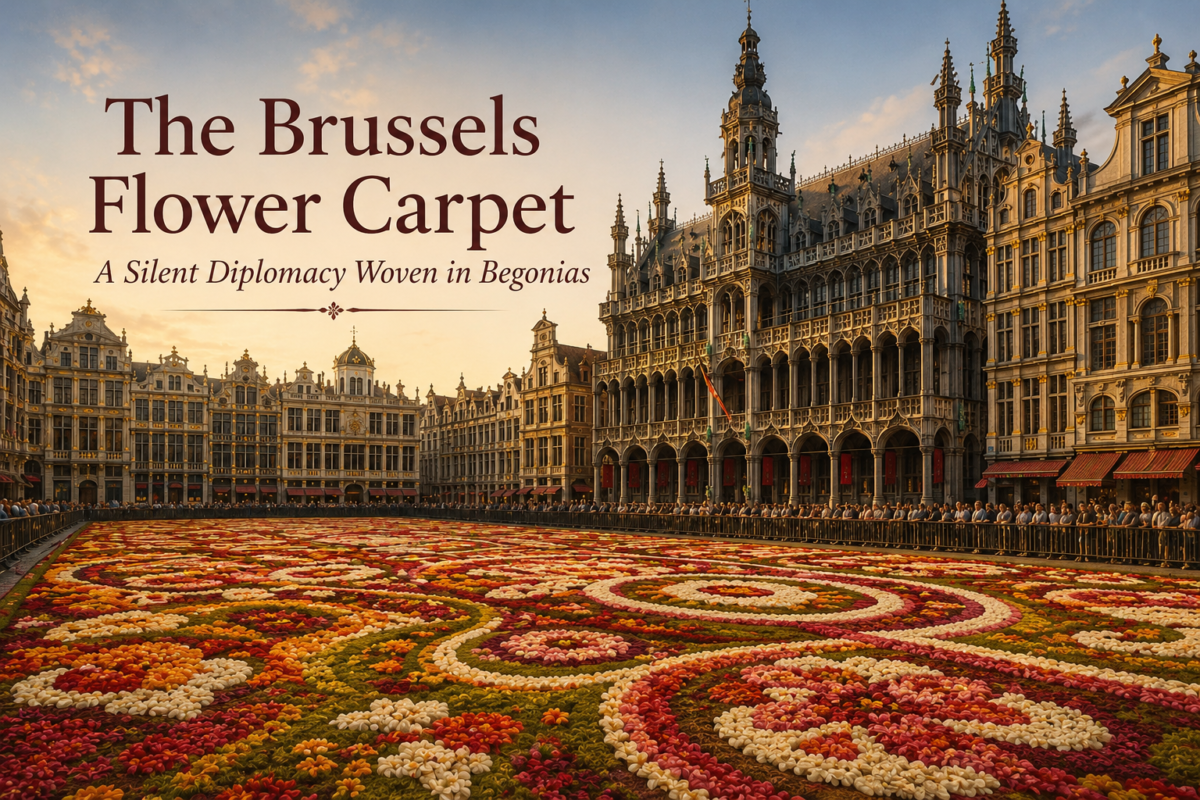
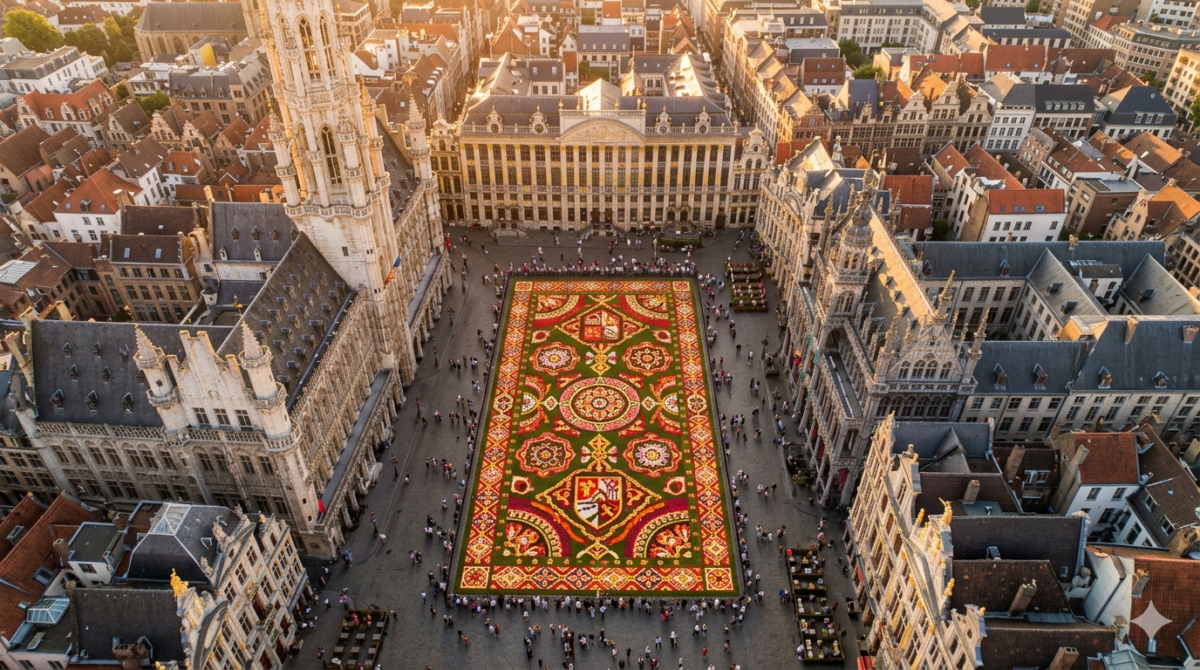
Some forms of beauty draw their power from their very fragility. Every two years, at the height of summer, the Grand-Place in Brussels disappears beneath an immense tapestry of nearly 1,800 square meters — seventy-seven feet wide and over two hundred fifty feet long — composed of five hundred thousand to seven hundred fifty thousand cut flowers. For four days, the ancient cobblestones that endured Villeroy’s cannon fire in 1695 vanish beneath a carpet of begonias and dahlias. Then everything fades away, composted, returned to the earth. This is no accident: it is the very nature of the work.
Born in 1971 from the imagination of Ghent-based landscape designer Étienne Stautemas, the event has become far more than a horticultural feat. Over the course of its many editions, it has grown into a quiet form of cultural diplomacy — a language of flowers shared, unknowingly, by thousands of visitors from around the world.
What you’ll discover in this article:
- The dramatic transformation of an iconic Brussels square into a monumental, fleeting floral masterpiece designed to vanish in just a few days.
- How the humble begonia is elevated to a “living pigment,” showcasing a mastery of horticulture that turns flowers into a true artistic medium.
- The power of collective creation, bringing together volunteers, landscape architects, and months of meticulous planning to weave a one-of-a-kind tapestry right on the cobblestones.
- A global conversation with other floral traditions—from Italy to Guatemala—centered on the beauty of transient, fleeting moments.
- An art form that goes beyond mere decoration to become a cultural language, woven with memory, symbolism, and a subtle form of visual diplomacy.
From the Flemish Bulb to an Ephemeral Masterpiece
The choice of tuberous begonia is far from incidental. Native to the Caribbean and introduced to Europe in the seventeenth century, this plant found its true home in the land around Ghent: by the nineteenth century, Belgium had become the world’s leading exporter. What Flemish weavers accomplished with wool and linen, the Ghent horticulturalists repeated with flowers — an excellence born of slowness, patience, and sheer obstinacy.
Grown today without pesticides, these begonias possess qualities that make them remarkably suited to this purpose: petals that retain their brilliance long after being cut, a resilience to temperature changes, and an exceptionally rich chromatic range spanning from the purest white to the deepest reds. In essence, a living pigment.
The 2024 edition introduced the dahlia of the Campine region, whose geometric forms and intense hues expanded the composition’s graphic vocabulary. This shift toward botanical diversity responds as much to aesthetic considerations as to ecological necessity: reducing the work’s dependence on a single horticultural monoculture.
The flower ceases to be a growing plant and becomes material for drawing — almost a pigment laid upon stone.
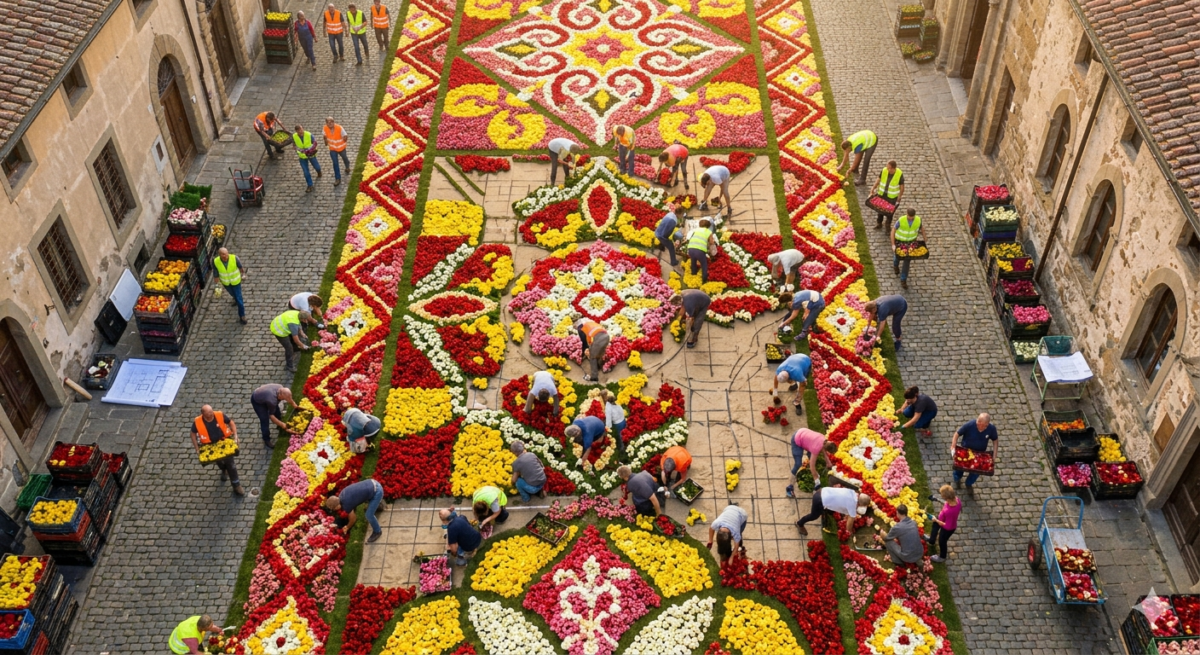
Creating the carpet demands nearly two years of preparation. The design, drawn to full scale, is transferred onto a micro-perforated canvas that serves as a template during installation. In just a few hours, one hundred twenty volunteers assemble the flowers across the cobblestones — packed at a density of three hundred blooms per square meter, they hold together through sheer compression. Reliefs are created using bark or strips of turf, crafting shadows and contours the way a painter works with glazes.
One Tradition Among Many: The Dialogue of Ephemeral Flowers
For those who love the history of plants in human civilization, the Flower Carpet is no isolated curiosity. It belongs to a family of practices in which flowers — or natural materials more broadly — become the medium for collective works destined to disappear.
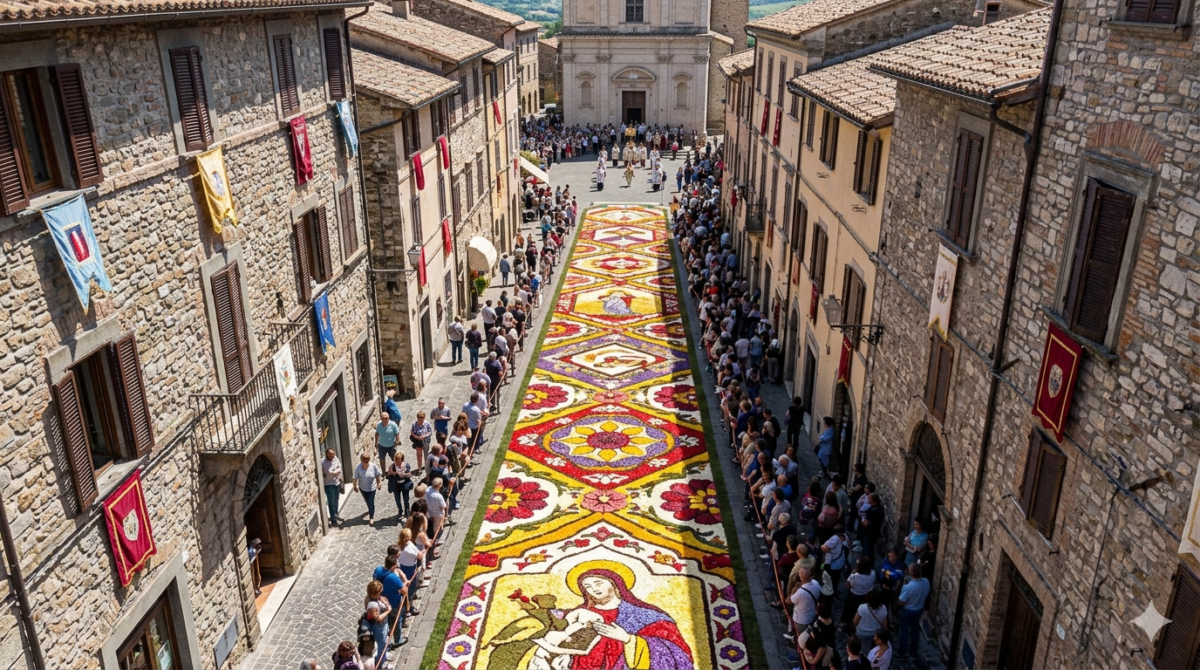
The Italian infiorate offer the oldest parallel. Born in the seventeenth century in circles close to the Vatican, they spread through the towns of Umbria and Sicily — Genzano, Spello, Noto — transforming narrow streets into mosaics of petals for the feast of Corpus Christi.
The technique differs radically from Brussels: where Belgian artisans work with the whole corolla, their Italian counterparts strip each flower petal by petal and lay them one by one, pursuing a fineness of line that working with massed blooms would make impossible. The same impulse, a different hand.
Further still, in Antigua, Guatemala, the alfombras of Holy Week cover the streets with dyed sawdust, ash, pine needles, and wildflowers. Created by entire neighborhoods — men, women, children — over days of careful work, they are walked through and undone within a few hours by the processions of the Passion.
The erasure was part of the rite. The work was not conceived to be seen for long, but to be crossed, the way one walks through a prayer.
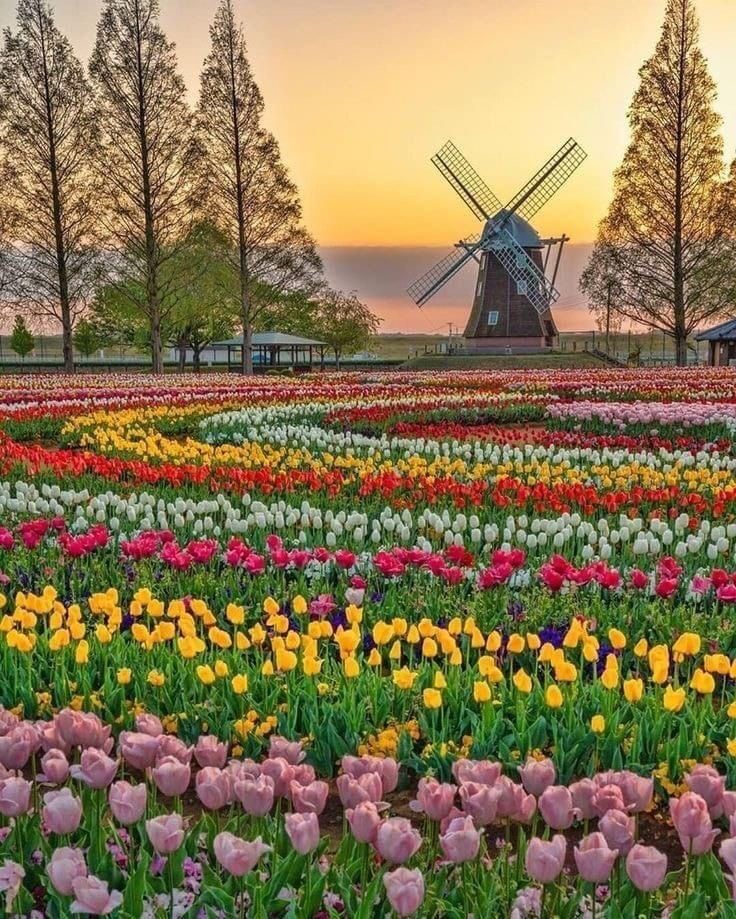
Against these traditions that celebrate the instant and the offering, the Keukenhof garden in the Netherlands represents an almost inverse relationship with time. In Lisse, tulips and hyacinths are planted in open ground and follow the natural cycle of the seasons: nothing is torn from its element, everything moves at the slow rhythm of a bulb swelling, blooming, fading.
Where Keukenhof celebrates growth and continuity, Brussels stakes its claim on rupture and intensity. The cut flower is no longer a plant: it is an act.
When Motifs Tell History
For more than half a century, the themes that cover the Grand-Place have never been mere decoration. They carry memory, pose questions, or celebrate encounters between cultures.
In 1979, for the millennium of Brussels, the carpet drew on the medieval iconography of Saint Michael slaying the dragon — the guardian image of a city that has claimed the archangel as its patron since the twelfth century. In 1990, the bicentennial of Mozart’s death inspired a composition in which the rhythms of color responded to those of music: an attempt to transpose into space what the fugue accomplishes in time.
Other editions have crossed geographic borders entirely. The geometric motifs of Anatolian kilims, the interlacing patterns of folk traditions from Mexico’s Guanajuato region, or the decorative vocabulary of non-European civilizations — all have found new expression in begonias and dahlias, briefly transplanted onto the Brussels cobblestones.
There is something deeply moving in this gesture: one culture pays tribute to another using its own flowers, its own hands, as if beauty could be shared without translation.
The 2024 edition pushed this audacity even further by embracing the visual codes of street art — graffiti lettering, tags, urban compositions — and weaving them into the floral grammar. The contrast between the baroque and Gothic facades of the Grand-Place and the aesthetic of contemporary urban culture caused no scandal; on the contrary, it revealed the remarkable plasticity of a tradition capable of welcoming the present without betraying itself.
It is here that the Campine dahlia truly comes into its own, sealing with its texture and novelty an unexpected alliance between rural horticultural tradition and urban modernity.
The Beauty of the Instant, or Why the Ephemeral Captivates
Listed since 2020 in the inventory of intangible cultural heritage of the Brussels-Capital Region, the Flower Carpet confirmed its status as a foundational event during the global health crisis.
The cancellation of the 2020 edition revealed, through the void it left behind, how deeply this gathering had become a landmark. The return in 2022, which chose to revisit the original 1971 design, carried the weight of a renewed vow — a symbol of resilience whose vegetal rebirth alone bore all the necessary symbolic charge.
One must surely look to this very fragility for the reason these traditions exert such universal fascination. The infiorate, the alfombras, the Brussels carpet share the same implicit lesson: what disappears quickly is looked at more intensely.
The theme of the 2026 edition was not yet known at the time of writing. But the questions of our era — ecological transition, shifting climates, the preservation of horticultural knowledge and craft — perhaps already sketch the outlines of its future motifs.
Whatever story it chooses to tell, the Grand-Place will once again be covered in that colorful silence that compels you to look up, to pause, and to acknowledge that certain beauties can only be truly seen at the cost of a detour. And that this, precisely, is what makes them worth the journey.
This story doesn’t stop at this single petal… it lives on in other narratives where plants, seasons, and time-honored crafts transform places into living experiences. Keep exploring in the Gardens and Markets category
Continue Your Exploration
Immerse yourself in the world of flowers through our various themes and discoveries.
Start ExploringReceive Our Next Discoveries
Subscribe ✉️