Flowers and Trade
The Flower, a Key Player in the Green Economy: Trade, Innovations, and Sustainable Supply Chains
To the articles

If a flower is a poem to the one who receives it, it is an engine for the one who cultivates it. Behind the delicacy of a rose petal lies one of the most dynamic industries on the planet. Ornamental horticulture is not merely a decorative art; it is an economic force worth billions of dollars, connecting continents through invisible yet ceaseless logistical flows.
- The Global Supply Chain: Understanding the race against time from equatorial fields to world capitals.
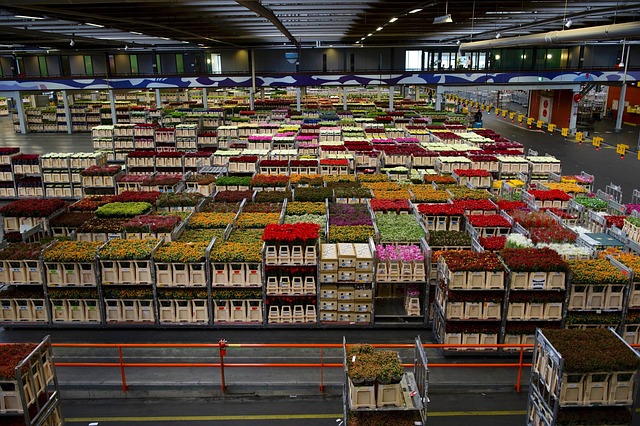
- Market Hubs: Inside the Aalsmeer auctions, where 12 billion stems find their price every year.
- Digital Disruption: How e-commerce and “Slow Flowers” are redefining the grower-to-consumer bond.
- The Sustainability Shift: Geothermal greenhouses and the challenge of the floral carbon footprint.
I. Introduction: The Flower, a Silent Power
The history of the global economy has often been written in sap. One need only recall the Dutch Tulip Mania of the 17th century, when a single bulb could be traded for the price of a merchant’s house. Today, this passion has been industrialized. From small family farms to multinationals, the flower has become a global “commodity”—a perishable product that defies time to arrive fresh upon our tables.
II. Structuring the International Floral Supply Chain
2.1. Production Hubs: A Geography of Color
The Netherlands remains the heart of the system, but new lands have blossomed. Colombia and Ecuador dominate the rose market with constant zenithal light, while Kenya and Ethiopia have become the gardens of Europe, transforming high plateaus into seas of greenhouses that generate vital foreign currency.
2.2. A Race Against Time: The Cold Chain
The flower trade is a feat of refrigerated logistics. From the moment it is cut, a flower begins a race against death. Stems cross oceans in less than 48 hours via “floral cargo planes,” ensuring that “vase life” is maximized for the end consumer.
III. Challenges and Trends in Global Trade
3.1. The Pulse of the Market: Aalsmeer
Imagine a building the size of a city where millions of flowers parade. The Royal FloraHolland auctions utilize a “Dutch auction” system: the clock starts at the highest price and ticks down. It is here that the global price of beauty is set, amidst a tension where every second is worth thousands of dollars.
3.2. The Digital Revolution and “Slow Flowers”
E-commerce now allows direct sales, fostering the rise of “Slow Flowers”: a return to short supply chains and seasonal blooms. This trend restores a sense of terroir and ethics to the act of purchasing, rewarding local craftsmanship.
IV. The Flower at the Heart of the Circular Economy
The luxury of the winter flower carries an ecological cost. The industry is moving toward increased transparency with certifications like Fair Trade and MPS-GAP. Tomorrow’s floriculture is technological: greenhouses heated by geothermal energy, closed-loop irrigation, and biocontrol are transforming the flower into a laboratory for sustainable agriculture.
V. Conclusion: Toward the Floriculture of the Future
The floral economy stands at a crossroads. Between climate challenges and technological innovations, it proves that nature and profit can coexist if guided by respect for the living world. Explore our articles to discover how this industry is reinventing itself for a greener tomorrow.