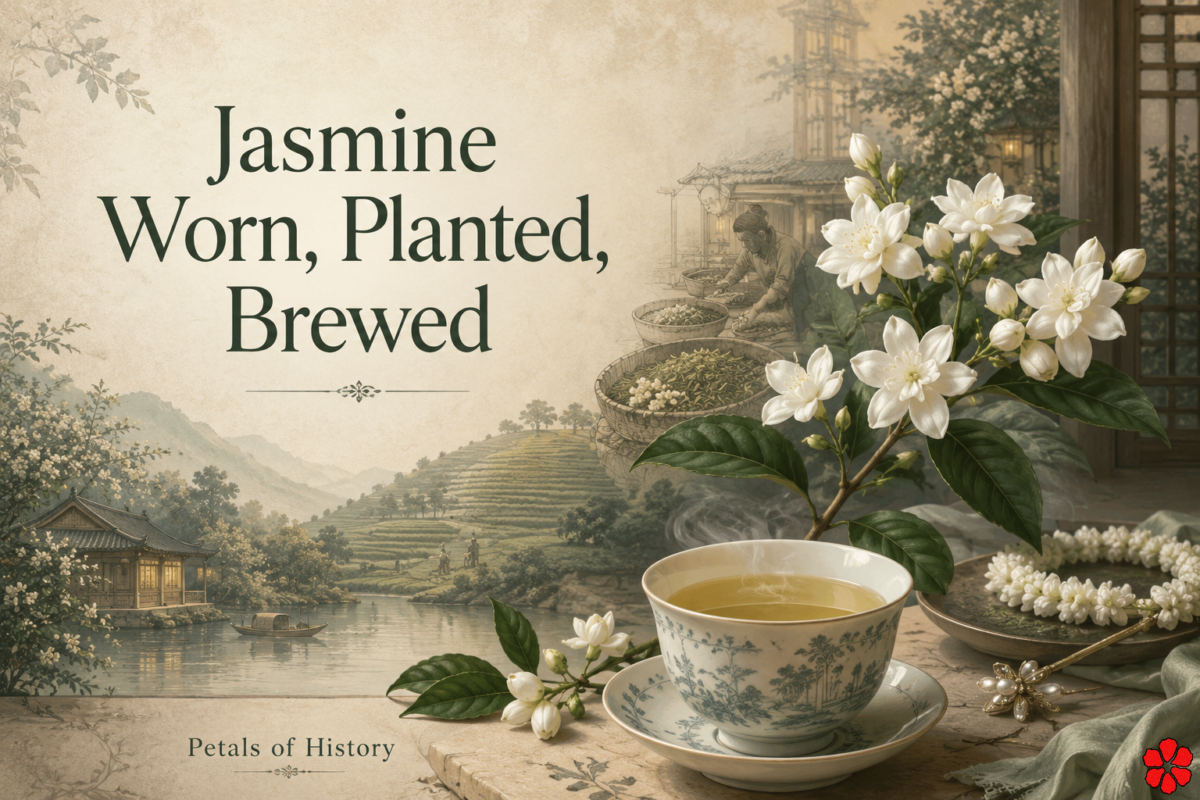
On Pétales d’Histoire, jasmine is approached here as a matter of general culture — a flower that runs through everyday lifestyle, in the garden, on the skin, in the hair, and of course in the cup. This article traces the social uses of jasmine worn, grown, and brewed, with jasmine tea as the connecting thread of a far wider experience: that of a flower which is never content simply to be looked at, but is lived.
Under the warm nights of southern China, as jasmine flowers slowly open, an ancient ritual repeats itself.
Patient hands lay still-closed blossoms over tea leaves. As the night advances, the fragrance is released, seeps in, transforms. Nothing here is immediate: everything unfolds in time, in waiting, in a kind of silence.
But this scene is only one variation among many of a far broader relationship that civilizations have maintained with jasmine. Long before anyone thought to brew a tea leaf, the flower was woven into hair, planted beneath a window so it would scent the evening air, worn on the body like a fleeting piece of jewelry. Drinking jasmine tea is therefore not merely consuming a fragrant beverage: it is extending into the cup a way of life that begins elsewhere — in the garden, on the skin, in the offering.
What you’ll discover in this article
- The thousand-year-old origins of Fuzhou jasmine tea.
- The poetic ritual behind its production.
- The flower worn on the body, between adornment and courtesy.
- Jasmine in gardens and domestic interiors.
- The distinct soul of Chinese and Indian jasmine tea.
- The modern spread of jasmine tea and the preservation of traditional craft.
A drink between daily ritual and hospitality
Jasmine tea occupies an essential place in social practice, particularly in China.
In cities like Fuzhou, serving a guest a cup of jasmine tea follows a precise code. It is not simply about offering a drink, but about expressing a form of respect, of attentiveness, sometimes even of silent consideration. Tea becomes a language — one that passes through the hands as much as through words: the cup is offered with both hands, never one, and custom dictates that tea be served before conversation even begins, as though courtesy must precede speech itself. “Tea first, words after,” as the saying commonly goes in China: hospitality proves itself before it is ever declared.
In daily life, it accompanies simple moments: a pause in the day, a conversation, a moment of rest. Its lightness makes it an accessible drink, woven into ordinary rhythms. Yet the North and South of the country do not experience it in quite the same way. In the northern regions, where a drier climate makes growing tea plants difficult, jasmine tea has long established itself as a favorite — appreciated for its lightness and drunk in full mouthfuls, almost the way one might share a drink among friends. In the South, the birthplace of both jasmine and tea, the tasting is slower and more attentive to nuance: successive infusions of the same leaf are gladly multiplied, each one revealing a different facet of the fragrance.
Unlike certain highly formalized tea ceremonies, jasmine tea belongs to a more diffuse ritual. It imposes no strict framework, but creates an atmosphere. It transforms the moment without freezing it in place.
This relationship between flower and culture is part of a much larger history of jasmine, one you can explore in our article dedicated to its origins and symbolism.
The art of scenting: an aesthetic of slowness
What makes jasmine tea distinctive is its method of production, known as scenting.
Tea leaves are harvested in spring, then stored until summer, when jasmine comes into bloom. The flowers, picked while still closed, are mixed with the tea as night falls. As they open, they release their fragrance, which the leaves absorb. The process can be repeated several times to deepen the aroma without ever letting it dominate — the finest Fuzhou teas call for as many as nine successive scenting rounds, more than eighty cycles of contact between flower and leaf in total, each one carefully controlled for temperature and humidity. The smallest variation is enough to tip the quality of the result.
The flowers are then removed. What remains is not a blend but an imprint — a local saying captures the whole paradox of the process perfectly: “the tea stays visible, the flower becomes invisible.”
This is not a matter of adding flavor, but of an interaction between two elements in which time plays the central role: repetition, precision, patience. Jasmine tea thus becomes the expression of an aesthetic of slowness, where quality is born of the process rather than of immediate intensity.
That same slowness is woven into the very landscape that gave rise to it. Around Fuzhou, tea plants and jasmine do not grow side by side by accident: over the centuries, farmers have shaped a terraced arrangement down the hillside — tea higher up, villages in the middle, jasmine lower down, near the water that irrigates the whole system. Scenting, in the end, is only the last link in a way of life that begins with the shaping of the land itself.
The flower worn on the body: adornment, courtesy, and everyday elegance
Long before it is ever brewed into a cup, jasmine is worn. In India, Thailand, and Indonesia, the fresh flower is woven into garlands that women tie into their hair, around a bun or along a braid. In South India, this adornment even has its own name — the gajra, most often made of jasmine sambac, sometimes mixed with rose or crossandra flowers, worn as readily at a wedding as in everyday dress. The tradition of jasmine flowers worn in the hair is so old that it already appears in the Ramayana, which mentions women wearing jasmine and lotus blossoms in their hair.
This gesture is not purely aesthetic: it belongs to a social code learned early in life, one best not overlooked. Refusing a jasmine garland offered by a hostess at a gathering can, in some parts of South India, be read as a small breach of courtesy — as though one had unwittingly declined a gesture of welcome without recognizing it as such. Here, jasmine does more than perfume: it belongs to the silent language through which a society recognizes and welcomes itself.
This adornment also accompanies the living arts: Kuchipudi and Odissi dancers, brides on their wedding day, young women at a neighborhood festival — all share, to varying degrees, the same reflex of tucking in a sprig of jasmine before stepping out, the way one might choose a piece of jewelry or an outfit. The flower becomes an accessory in its own right, on par with a necklace or a perfume, except that it wilts within hours, and must be rewoven fresh almost every day.
Jasmine in gardens and homes: a presence of the evening
Beyond adornment, jasmine also inhabits living spaces. Planted in a courtyard, along a wall, beneath a window, it shapes the day in an almost invisible way: discreet through the hot hours, then suddenly present at nightfall, as its flowers open and the fragrance begins to spread.
It is precisely this scheduled discretion that makes it such a beloved domestic plant. It is not grown to catch the eye — its flowers are tiny, white, almost unremarkable in daylight — but for that exact moment, come evening, when it turns a terrace or patio into a sensory space. Jasmine then becomes a kind of invisible furniture: unseen, yet known to be there, and the whole household seems to organize itself, almost without thinking, around the hour when it will begin to perfume the air.
This domestic habit finds a more monumental echo in Persian gardens, conceived as foretastes of paradise, where plant life, water, and architecture answer one another — a garden art we explore in more depth in our dedicated article. But on the scale of a simple family courtyard, the logic remains the same: turning nightfall into a small sensory event, with no special arrangement or ceremony, simply by having planted, years earlier, the right flower in the right spot.
Chinese jasmine tea and Indian jasmine tea: two souls, two fragrances
In China, jasmine tea (mòlìhuā chá) is a ritual of patience: fresh petals are paired with green tea, then removed — sometimes as many as seven times — so that only the memory of the fragrance remains. The result is light, almost airy, a caress of the night that soothes the mind and makes the cup shimmer like moonlight.
In India, a “jasmine tea” in the strict sense is rarely prepared. Jasmine (motia or bela) reigns instead over sacred infusions: fresh or dried petals steeped in hot milk with cardamom and sometimes saffron, or slipped into chai for a touch of divine sweetness. Here, jasmine does not whisper — it sings at full voice, generous and warm, like the garlands laid on Krishna’s altar at dawn, the very same garlands that, just hours earlier, may have adorned the hair of a woman on her way to the temple.
One brushes against the soul, the other embraces it: the same flower, two ways of loving.
A historical lens — the birth of a craft between cultures and exchange
Jasmine tea first appears in China, most likely under the Song dynasty (960–1279), a period marked by an evolution in tea-related practices. The introduction of jasmine, brought from South Asia through trade exchanges, opened new possibilities: artisans began experimenting with pairing tea leaves and fragrant flowers.
Under the Ming and Qing dynasties, the technique was refined further. Jasmine tea became a prized product at the imperial court, which in turn popularized a whole range of flower-scented teas — jasmine, osmanthus, cassia, honeysuckle, rose — before they spread more widely.
Fuzhou gradually established itself as a major center of production, thanks to favorable natural conditions: humidity, warmth, and a seasonal alternation that allowed tea and jasmine to be grown together. This development illustrates a broader dynamic — that of cultural exchange, in which plants travel, adapt, and give rise to new practices.
This dynamic eventually received institutional recognition befitting its long history. In 2014, the agricultural system pairing jasmine and tea plants in Fuzhou was inscribed by the FAO among the Globally Important Agricultural Heritage Systems — a rare distinction that protects not just a crop, but an entire landscape shaped by it. In 2022, UNESCO in turn inscribed the full set of traditional Chinese tea-processing techniques, including Fuzhou’s jasmine scenting, on its Representative List of the Intangible Cultural Heritage of Humanity. A craft born nearly a thousand years ago thus found itself celebrated worldwide as a treasure to be preserved.
A sensory experience between balance and perception
Jasmine tea offers a singular sensory experience. Its taste is light, often associated with a certain freshness. Its fragrance, present yet discreet, accompanies the tasting without ever overpowering it. This subtlety reflects an aesthetic in which balance takes precedence over intensity.
The experience is not limited to taste alone: it engages smell, the warmth of the cup, the rhythm of the tasting, and a particular kind of attention — so much so that in the Fuzhou dialect, the expression meaning “to buy tea” is literally the same as the one meaning “to buy medicine.” Drinking, healing, and caring for oneself are part of one and the same gesture, with no real need to separate them.
In certain traditions, this experience is also linked to effects on body and mind: jasmine tea is regarded as soothing, encouraging relaxation and clarity. Without venturing into medical territory, it fits into a way of caring for oneself through simple gestures — a dimension that echoes the representations of jasmine itself, often associated with emotion, gentleness, and balance, and one we explore further in our article on divine jasmine.
Between global spread and the preservation of traditional craft
Today, jasmine tea exists within a multi-layered economy. On one side, it is produced on a large scale and widely distributed — as tea bags, flavored blends, or ready-to-drink beverages; this industrialization broadens access but sometimes alters quality and methods of production. On the other, certain artisanal producers continue to uphold traditional techniques, now protected by the FAO and UNESCO recognitions mentioned above, where scenting remains a long, demanding process, often carried out entirely by hand.
This coexistence between tradition and modernity reflects a tension common to cultural products: how does one preserve a craft while meeting growing demand? Jasmine tea thus becomes, beyond its economic dimension, a genuine matter of heritage.
A cup between tradition and sensation
Jasmine tea occupies a singular place: at once cultural heritage and contemporary practice. It cannot be reduced to either a drink or a symbol. It is an experience — a way of weaving together taste, time, and attention. Through it, jasmine leaves the realm of the visible to enter that of perception. It is no longer something to look at: it is breathed, tasted, lived. Whether it adorns a head of hair, perfumes a courtyard at nightfall, or slowly infuses in a cup, it always obeys the same discreet logic: never imposing itself, and yet never quite letting itself be forgotten.
A conquered imperial court
The story of jasmine tea finds its most unexpected crowning moment under the Qing dynasty: it was at the imperial court itself that this still-young tea — a mere few centuries old, by the standards of Chinese tea history — finally earned its noble standing, alongside other teas scented with osmanthus or rose blossoms. What artisans had spent generations perfecting in the humid air of Fuzhou ended up scenting the cups of emperors themselves — proof, if any were needed, that a discreet flower and stubborn patience can, on their own, rise all the way to the summit of an empire.
This captivating story is part of our comprehensive anthology on civilizations and the symbolism of jasmine. Explore our collection of articles to further discover its impact on human history and world cultures:
Star Jasmine: The Fake Flower That Fooled Everyone: Star jasmine isn’t jasmine at all — discover the botany behind nature’s best impostor, the chemistry of true jasmine, and how it’s extracted into perfume.
Jasmine: How a Flower Became a Symbol of Power: From Catherine de Medici’s perfumed gloves to Tunisia’s jasmine revolution: how this flower became a national symbol in the Philippines, Pakistan, and beyond.
Jasmine: Spiritual Meaning, Myths, and the Sampaguita Legend: The spiritual meaning of jasmine across cultures — from Hindu myths of Kamadeva and Krishna to the Philippine legend of the sampaguita and its sacred gardens.
To verify or explore further
These references support the article’s main historical, agricultural, and cultural points while offering reliable paths for further reading.
| FAO – Jasmine and Tea Culture System of Fuzhou City, China | Supports the long history of jasmine cultivation in Fuzhou, the pairing of jasmine and tea, and the agricultural heritage status of the Fuzhou system. |
| UNESCO Intangible Cultural Heritage – Traditional tea processing techniques and associated social practices in China | Confirms the 2022 inscription of Chinese tea-processing knowledge and social practices, useful for the article’s heritage framing of tea, sharing, and craft. |
| FAO Open Knowledge – Jasmine and Tea Culture System of Fuzhou City | Provides a fuller institutional overview of the Fuzhou jasmine-and-tea system, including landscape, cultivation, post-harvest knowledge, and cultural significance. |
| Mary Lou Heiss and Robert J. Heiss, The Story of Tea: A Cultural History and Drinking Guide, Ten Speed Press | A readable reference work for readers who want broader context on Chinese tea culture, scented teas, production methods, and tea as a social practice. |