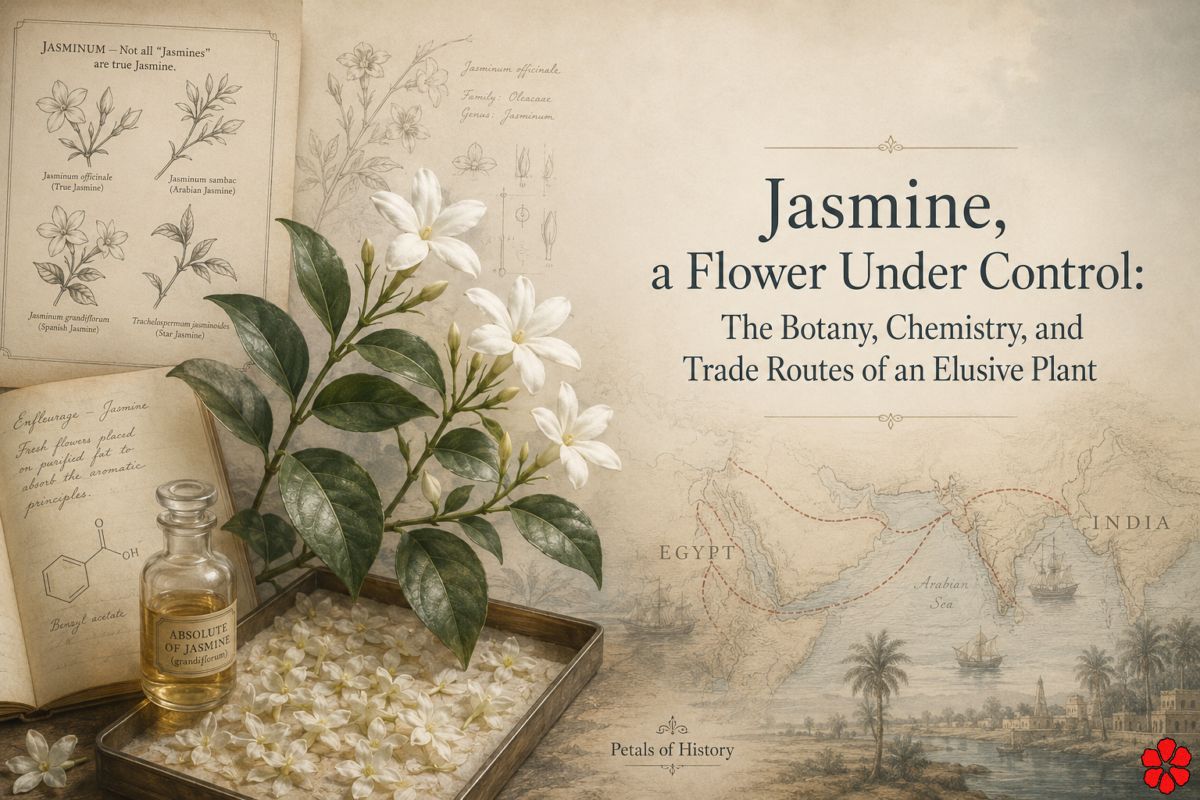
On Pétales d’Histoire, behind the name jasmine hides a family far more deceptive than it appears: some “jasmines” are not jasmine at all, and others are even toxic. Behind the fragrance lies a rigorous discipline — comparative botany, the chemistry of extraction, a finely calibrated trade economy — one that reveals just how much this nocturnal flower has forced humanity into a near-scientific feat of technical ingenuity simply to capture its essence.
It is a mundane story, one that happens to many amateur gardeners. Along a fence or a wall, someone plants what they believe to be jasmine — an evergreen climber with starry white flowers and an intoxicating fragrance on summer evenings. And then, one day, they learn it is not jasmine at all: that the plant which has perfumed the terrace for years belongs to an entirely different botanical family, with no kinship whatsoever to true jasmine. This almost universal misunderstanding says a great deal about the nature of this flower. Beneath a disarmingly simple appearance — five white petals, a nocturnal fragrance — lies a botanical, chemical, and economic reality far more intricate than it lets on.
This article sets out to follow jasmine not as a symbol or a tradition, but as an object of study: from its true botanical identity to the economic trade networks that depend on it today, by way of the laboratories where scientists have tried, without ever fully succeeding, to crack the secret of its fragrance.
What you’ll discover in this article
- Separating fact from fiction: why so many unrelated plants borrow the jasmine name.
- Understanding the diversity of the genus Jasminum and the selection made by human history.
- Discovering the complex chemistry hidden behind an apparently simple fragrance.
- Exploring the extraction techniques invented to capture a fragrance that nothing can naturally fix in place.
- Observing how this biological reality still shapes entire economic trade networks today.
- Grasping what such a fragile flower reveals about our relationship to the scientific mastery of living things.
Not all jasmines are jasmine: a family of look-alikes
Let’s begin, then, with the garden anecdote, since it reveals a far broader phenomenon than it first appears. True jasmine belongs to the genus Jasminum, itself part of the Oleaceae family — the same family as the olive tree and the lilac. But everyday language has never respected this botanical boundary: the moment a climbing plant exhales a heady white fragrance, it gets called “jasmine,” with no regard for its actual lineage.
The most widespread case is undoubtedly that of star jasmine, Trachelospermum jasminoides, native to China and Japan. This climbing plant in fact belongs to the Apocynaceae family — the same family as oleander and milkweed — light-years away from true jasmine on the family tree of the plant kingdom. The British botanist John Lindley first described it in 1846, based on a specimen brought back from Shanghai two years earlier by the plant hunter Robert Fortune. What makes the confusion almost inevitable is that this plant, despite having no botanical kinship with true jasmine whatsoever, shares some of the molecules responsible for its fragrance — indole and jasmone in particular, two compounds also found in jasmine grandiflorum. The human nose is fooled, where botanical classification never is.
Other impostors are more troubling. Carolina jasmine, Gelsemium sempervirens, belongs to the Gelsemiaceae family and likewise has nothing to do with the genus Jasminum. Every part of it — roots, leaves, flowers, nectar — contains a powerfully paralytic alkaloid, gelsemine, which has already caused poisoning in children who simply sucked the nectar from its yellow, trumpet-shaped flowers. As for night-blooming jasmine, Cestrum nocturnum, it is in fact a Solanaceae — the same family as the tomato and the potato — whose entire plant, flowers and berries included, is toxic to most mammals.
This small inventory of look-alikes is not merely an exercise in botanical pedantry. It reveals something essential about true jasmine: its fragrance is so singular, so recognizable, that humanity eventually extended its name to any plant that came close, whether truly related or not. To understand what really sets jasmine apart from its imitators, then, one must return to its family of origin — and discover that, even within it, the diversity is just as dizzying.
One plant family, two stars: the comparative botany of true jasmine
The genus Jasminum comprises around two hundred species, ranging from shrubs to climbing plants, evergreen or deciduous depending on climate. This diversity might have given rise to a multitude of distinct uses. In practice, human history settled on two, and only two, that came to dominate the global market: Jasminum sambac, native to the Himalayan valleys of northern India, which became the basis for scented tea and a host of Asian ritual uses, and Jasminum grandiflorum, which became the benchmark raw material of Western perfumery.
This selection is no botanical accident: it instead tells the story of two centuries of successive uses, trade migrations, and olfactory preferences that ultimately concentrated all human attention on a handful of species, leaving the other one hundred and ninety-eight in relative horticultural obscurity. Science itself took its time settling these classifications: Linnaeus described sambac in 1753 under a name now abandoned, Nyctanthes sambac, before the botanist William Aiton definitively transferred it to the genus Jasminum in 1789. Nearly forty years of taxonomic hesitation, for a species that would go on to become one of the two most cultivated in the world.
A biological trait common to the entire genus, moreover, explains a great deal of what follows: jasmine blooms at night. This adaptation, likely linked to pollination by nocturnal moths, dictates everything else — picking must happen before dawn, while the buds are still closed and the fragrance is at its most concentrated. This seemingly minor biological detail proves decisive at every subsequent stage: from picking to extraction, nothing escapes this floral clock.
A chemistry of rare complexity
If jasmine has fascinated chemists as much as gardeners, it is because its fragrance, far from being a single simple note, results from the assembly of a remarkable number of distinct aromatic molecules — some specialized perfumery analyses cite as many as 259 different compounds identified within its full olfactory profile. Two centuries after the dawn of modern synthetic chemistry, this richness explains why jasmine remains one of the most difficult materials to reproduce in full in a laboratory: its key molecules can be isolated, some of them synthesized, but the overall accord — that precise olfactory signature — continues to partly elude any artificial reconstruction.
This sophistication is not merely a laboratory curiosity, either: several historians of perfumery consider jasmine to be one of the very first plants cultivated by humans purely for its fragrance, with no prior medicinal or culinary use — a singular case in the history of domesticated plants, where olfactory function preceded, by a wide margin, any other usefulness.
And it is this same molecular abundance that explains, in mirror fashion, the success of the fake jasmine mentioned earlier: if Trachelospermum jasminoides manages to fool the human nose despite having zero botanical kinship with true jasmine, it is precisely because it shares some of these same key compounds with it, indole and jasmone chief among them. Nature, here, seems to delight in blurring the very trails that science works so hard to untangle.
This richness also poses some very current challenges. Certain compounds in jasmine sambac, coumarins, prove to be photosensitizing: when exposed to sunlight, they can trigger unwanted skin reactions. The contemporary cosmetics industry must therefore turn to “decoumarinized” fractions of jasmine for certain uses — proof that the chemistry of this flower continues to pose very concrete problems, more than a century after the start of its industrial exploitation.
One question remains, older still and harder to resolve: how does one capture a fragrance this rich and this fragile, without destroying it in the very act of extracting it?
Capturing the fleeting: extraction techniques, from enfleurage to absolute
For a long time, the answer came down to a single word: impossible, or nearly so. Classical distillation, an effective method for a great many flowers, fails with jasmine, whose most precious aromatic compounds degrade under heat — rendering this otherwise universal technique entirely unsuited to this particular material.
Faced with this dead end, eighteenth-century perfumers invented cold enfleurage, a method as patient as it is ingenious: freshly picked flowers are laid over a thin layer of fat, which gradually absorbs their fragrant molecules without ever exposing them to heat. The process is slow, repeated flower after flower over several days, but it preserves the full aromatic profile that distillation would have destroyed. Other noble and equally delicate flowers, tuberose and orange blossom among them, would go on to benefit from the same technique, born directly out of the chemical fragility of jasmine and its kin.
Today, traditional enfleurage has largely given way to more industrial methods: extraction using volatile solvents first yields a “concrete,” a concentrated waxy paste, which is itself further refined to produce an “absolute,” the purest and most sought-after form of jasmine extract. But the fundamental principle has not changed in three centuries: it is always about working around heat, never confronting it head-on.
This extreme delicacy translates into figures that give a sense of the challenge: roughly eight thousand jasmine flowers are needed to obtain a single kilogram of raw material usable in perfumery. This yield is not merely an economic figure — it is, above all, the direct trace of a chemical reality: each flower contains only a minute quantity of aromatic compounds, and only a fraction of that quantity survives the extraction process, whichever technique is used.
And the harvest itself obeys a strict clock that allows for no negotiation: the flowers must be picked before dawn, while still closed, or risk losing part of their aromatic load to simple evaporation on contact with daylight and the day’s heat. However far science has advanced, it still has to bend to the flower’s own biological rhythm, never the reverse.
The same equation, two answers: India and Egypt facing the same challenge
This difficulty of extraction, and the nighttime harvest it demands, did not remain a mere laboratory problem: they shaped, on a global scale, the very organization of today’s production networks. Two regions of the world, with no direct connection between them, developed strikingly similar answers to the very same botanical puzzle.
In India, around Madurai, in Tamil Nadu, thousands of small family farms grow jasmine sambac following a logic we have already detailed in our pages devoted to this city’s flower market: slightly sandy soil, warm climate, nighttime humidity — conditions that concentrate aromatic compounds in a way other terroirs do not reproduce as faithfully. Readers curious about the daily workings of that market, its nighttime logistics, and its living economy will find, in our dedicated article, a far fuller picture than we could offer here.
The other great global hub lies thousands of kilometers away, in the Nile Delta in Egypt, around villages such as Shubra Balula. According to the sector’s leading processors, Egypt today produces close to half of the world’s jasmine concrete — a colossal volume, resting on a striking climatic convergence with that of Madurai: intense daytime heat, humid nights, conditions that likewise favor a high concentration of indole, one of the key compounds in jasmine’s aromatic profile. Two continents, two distinct agricultural civilizations, thus arrived, without ever consulting one another, at the very same technical conclusion: it is the precise alternation between daytime heat and humid nighttime coolness that produces the finest jasmine.
This convergence, however, is today facing a troubling challenge. In Egypt, jasmine concrete production, which reached eleven tons annually in the 1970s, has fallen to six and a half tons according to industry figures — a decline directly linked to climate change, which disrupts flowering, weakens essential oil concentration, and introduces a stress that producers are only beginning to measure. Some pickers report seeing their daily harvest cut in half, or even by two-thirds, within just a few years. Jasmine, which had already imposed its own biological timeline on humanity — blooming at night, picked at dawn, degrading in heat — now seems to be adding a new demand to that already long list: a climate that no longer quite suits it.
A flower that continues to elude us
From its botanical genus to its deceptive look-alikes, from its complex molecule to its patient extraction process, from the laboratory to the global trade network: at every stage of this inquiry, jasmine has imposed its own rules, and humanity has, in the end, only managed to adapt to them with ever-growing ingenuity. It has never fully managed to master it.
The most telling sign of this partial defeat may lie in our own language. Unable to fully unlock jasmine’s chemical secret, unable to synthesize it identically, humans eventually extended its name to anything that came close enough to fool the nose — whether a Chinese climbing plant with no kinship to it whatsoever, or a toxic plant one would have been wiser to treat with caution. This persistent misunderstanding, far from being a simple error of vocabulary, says something profound about our relationship to the living world: we classify, we analyze, we synthesize — and yet certain flowers continue to elude us just enough that their name alone becomes, through a curious slippage, more coveted than the plant itself.
This captivating story is part of our comprehensive anthology on civilizations and the symbolism of jasmine. Explore our collection of articles to further discover its impact on human history and world cultures:
Jasmine: How a Flower Became a Symbol of Power: From Catherine de Medici’s perfumed gloves to Tunisia’s jasmine revolution: how this flower became a national symbol in the Philippines, Pakistan, and beyond.
Jasmine: Spiritual Meaning, Myths, and the Sampaguita Legend: The spiritual meaning of jasmine across cultures — from Hindu myths of Kamadeva and Krishna to the Philippine legend of the sampaguita and its sacred gardens.
Jasmine Tea: History and Tradition, from China to India: The history of jasmine tea, from China’s scenting ritual to India’s spiced chai — and the rituals of hospitality and beauty that surround this fragrant flower.
To verify or explore further
These references support the article’s scientific axis: taxonomy, false jasmines, extraction, fragrance chemistry, and modern production networks.
| Royal Botanic Gardens, Kew – Plants of the World Online: Jasminum L. and Jasminum sambac | Provides authoritative taxonomy for true jasmine, the genus Jasminum, the Oleaceae family, accepted names, synonyms, and distribution. |
| Royal Botanic Gardens, Kew – Plants of the World Online: Trachelospermum jasminoides, Gelsemium sempervirens, and Cestrum nocturnum | Documents the principal “false jasmines” as plants belonging to different botanical families, useful for the article’s classification argument. |
| Charles S. Sell, The Chemistry of Fragrances: From Perfumer to Consumer, Royal Society of Chemistry | A technical but accessible book for fragrance chemistry, aroma molecules, naturals, synthetics, and the limits of olfactory reconstruction. |