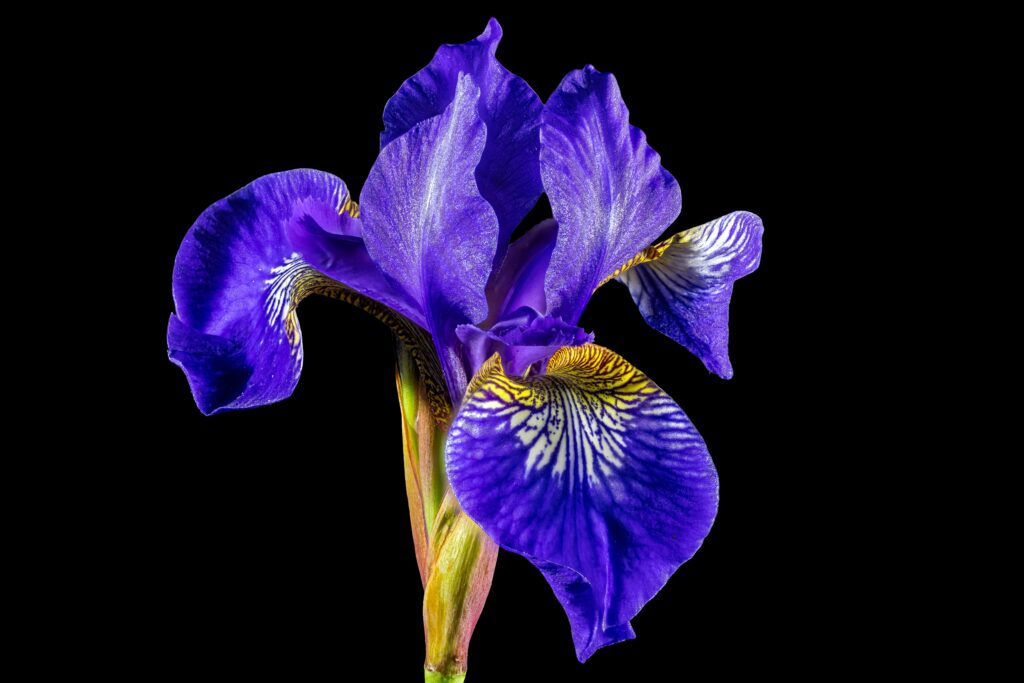
Under a slate sky or a shy sun, the iris raises its petals like fragile sails, capturing the light with a discreet grace. Named after the Greek goddess of the rainbow, this flower never sought glory. Yet, from the iris of the Middle Ages to the flags of Quebec and the swirling curves of Art Nouveau, it weaves a story where the ordinary becomes sublime. At Pétales d’Histoire, we follow its roots—from ancestral villages to purified rivers—to listen to the echoes of a plant that has conquered the centuries.
The Rainbow Unveiled: What the Roots of the Iris Reveal
- Mythology: Named after Iris, the Greek goddess and messenger between heaven and earth, hence its rainbow-like colors.
- The Middle Ages: Iris rhizomes (I. germanica) were utilized as remedies for coughs and toothaches, and to delicately scent linens.
- Perfumery: Once dried, the rhizome becomes Orris—one of the world’s most costly raw materials, prized for its powdery, violet-like notes.
- Heraldry and Legend: The secret of the Fleur-de-lis and the legend of the Brussels Iris, which guided medieval armies through treacherous marshes.
- Identity: Why the Iris versicolor became the official emblem of Quebec, rightfully reclaiming its place from the white lily.
- Art Nouveau: The Iris served as a paramount muse for artists like Mucha and Tiffany, embodying the natural curves and organic elegance of the era.
- Ecology (Phytoremediation): Iris pseudacorus acts as a powerful decontaminating agent for heavy metals and nitrates in wetlands, serving as a silent sentinel for the environment.
The Roots of the Rainbow: Between Myth and Medicine
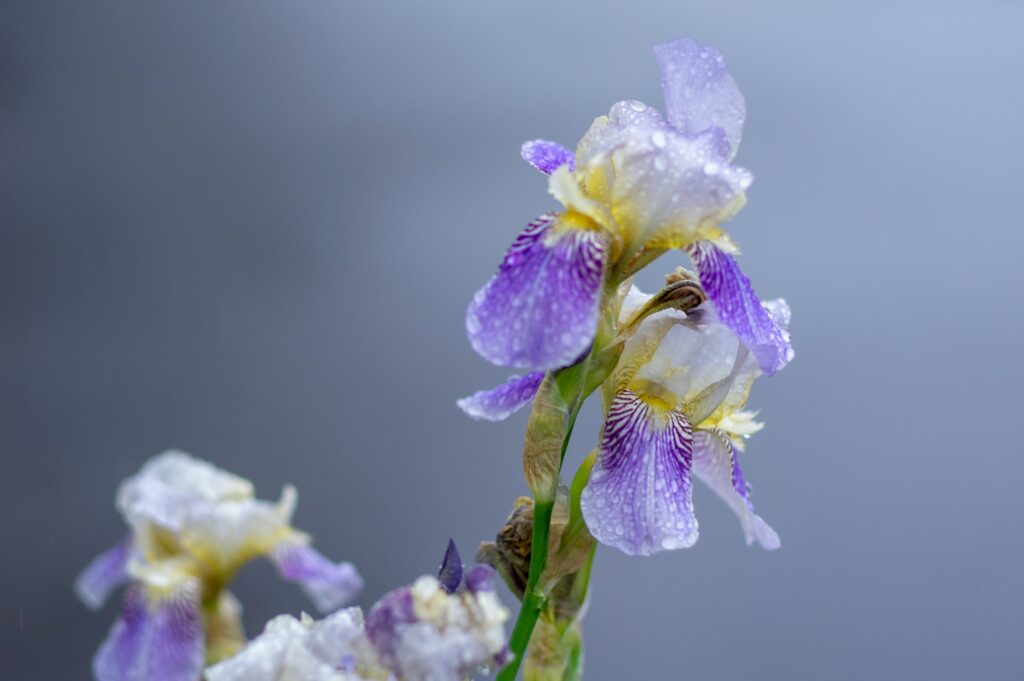
In the villages, where mud clung to clogs, the iris in the Middle Ages was not a flower for troubadours, but an ally of the humble. The rhizomes of Iris germanica, as knotted as secrets, were a treasure of daily life. Peasants unearthed them to create medicinal remedies. A pinch of powder, drawn from these dried roots, soothed toothaches, while a bitter infusion calmed the raspy coughs of winter. Healers, ever cautious, warned: too much iris could poison, but just enough could heal.
In the cottages, women ground these rhizomes with herbs, fashioning a scented powder to perfume linens or freshen breath—a breath of sweetness in a harsh world. At the markets, where voices intertwined like songs, “iris roots” sat alongside cabbages and turnips. Less expensive than a peppercorn, they offered an accessible luxury, a spark in a life of labor.
Near the rivers, Iris pseudacorus, with its yellow petals dancing in the wind, lined the banks. Nicknamed the “water gladiolus,” it drove its roots into the silt, holding the earth like a silent guardian. In monastic gardens, where monks cultivated silence as much as plants, the iris grew unpretentiously, offering its virtues to those who knew how to perceive its benefits.
This flower, as discreet as a prayer, wove an invisible thread between ordinary days and tenuous hopes.
Orris: The Fragrant Root, Jewel of Tuscany
This knotted root, however, conquered a far more precious throne: that of perfumery. The Iris rhizome, dried over many years, becomes Orris (or Iris of Florence), one of the most expensive raw materials in the world, rivaling sandalwood.
Its fragrance, subtly earthy, powdery, and soft, evokes violet and fresh linen. Far from the rustic medieval remedies, this Orris is today the “soul-fixer” of the greatest perfumes, a note of divine persistence that anchors olfactory compositions. It is proof that this root, a humble ally of the cottages, holds an essence capable of traversing centuries to offer us a breath of eternity.
The Iris, from the Emblem of Quebec to the Legend of Brussels
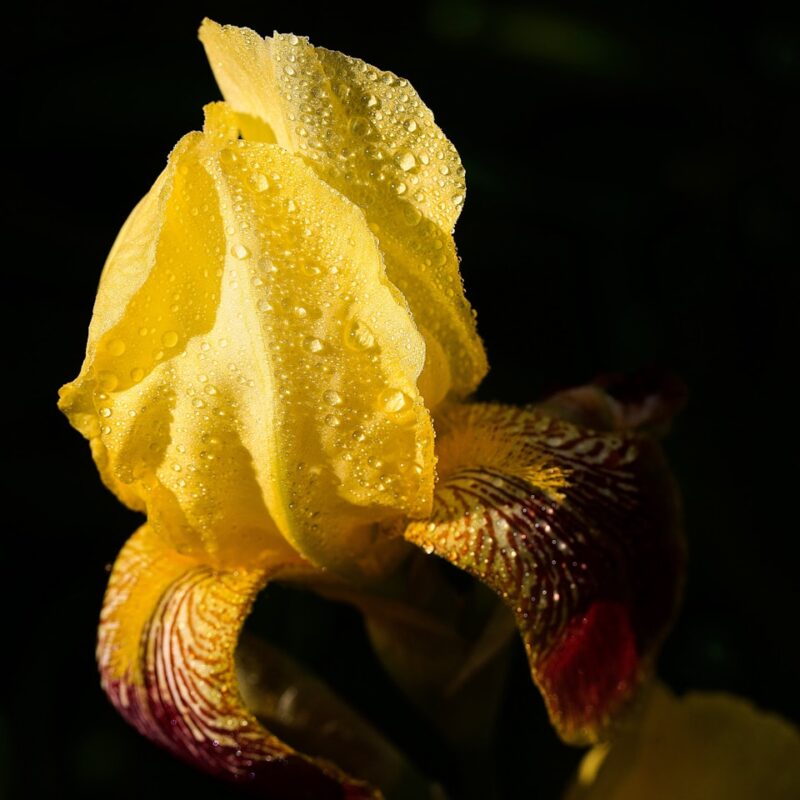
The iris, far from fading away, has taken root in modern cultures as a symbol of resistance and identity. In Quebec, Iris versicolor unfurls its violet-blue petals like a banner. Since 1999, this iris, the emblem of Quebec, has replaced the white lily, which was seen as too foreign. On the Quebec flag, the fleur-de-lis, a heritage of French settlers, evokes its link with this native iris, a symbol of resilience and the Francophonie.
But it is on the other side of the Atlantic, in the heart of Europe, that the iris tells its greatest military epic. The iris is the emblem of Brussels, the Belgian capital, where it flourishes in its yellow form (Iris pseudacorus). A medieval legend links the survival of the city to this flower: during a decisive battle in the marshy plains surrounding the city, the Duke of Brabant’s troops managed to defeat their enemies by observing the irises. Knowing that this plant only grows where the water is shallow, the soldiers crossed the marshes without getting bogged down, while their opponents, ignorant of this secret code of nature, sank into the mud.
Today, from Brussels to Quebec, the iris remains this sentinel of the wetlands, a flower that does not merely adorn landscapes but points the way to freedom and survival.
The Iris and Art Nouveau: Muse of Curves and Light
If the iris conquered flags, it also invaded artists’ studios. At the end of the 19th century, the iris in Art Nouveau became a muse, carried by a movement celebrating the curves of nature. Its graceful petals inspired artists from Paris to Vienna. Alphonse Mucha painted them in his posters, where they danced alongside feminine figures, their violet-blue shades capturing the soul of an era.
Louis Comfort Tiffany, master of stained glass, immortalized them in glass panels, where their iridescent colors trapped the light. The iris adorned jewelry, furniture, and wallpaper, a symbol of organic elegance in the face of industrial rigidity. In Brussels or Nancy, its Art Nouveau floral motifs meandered through ironwork and mosaics, transforming a marsh flower into an icon of artistic renewal.
The Fleur-de-lis: The Iris Hidden Behind the Heraldic Veil
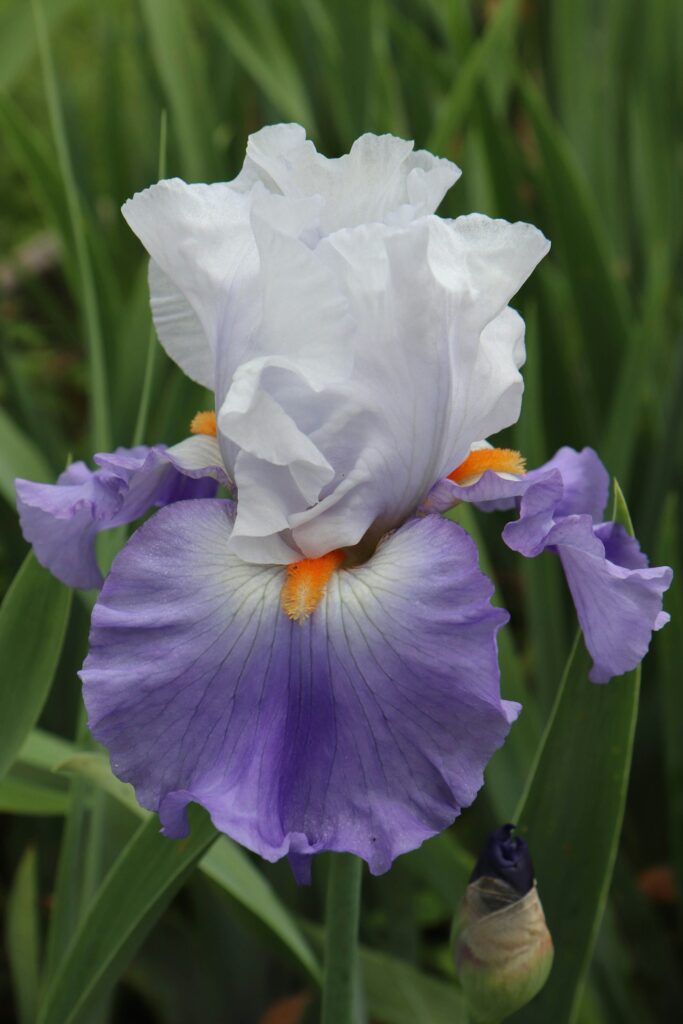
Beyond Art Nouveau and the Quebec emblem, the Iris lies at the heart of a thousand-year-old heraldic enigma: the Fleur-de-lis debate. Is it a Lily (Lilium) or a stylized Iris? History whispers a preference for the latter. The first Carolingian drawings of the royal motif evoke a flower with three pointed petals, closer to the shape of the Yellow Flag iris (Iris pseudacorus) which abounds near French rivers, notably in the Loire region.
Its presence is also attested in the coat of arms of Florence—the Giglio—which is almost certainly a white Iris. It was only with time and simplification that the motif moved away from its watery source, adopting the evocative name of Lily. Thus, the symbol of the French monarchy might well be, not the immaculate Lily, but the combatant Iris, a flower of the riverbanks and messenger of the gods, embodying the alliance of strength and celestial beauty.
The Iris in Phytoremediation: A Decontaminating Flower for Rivers
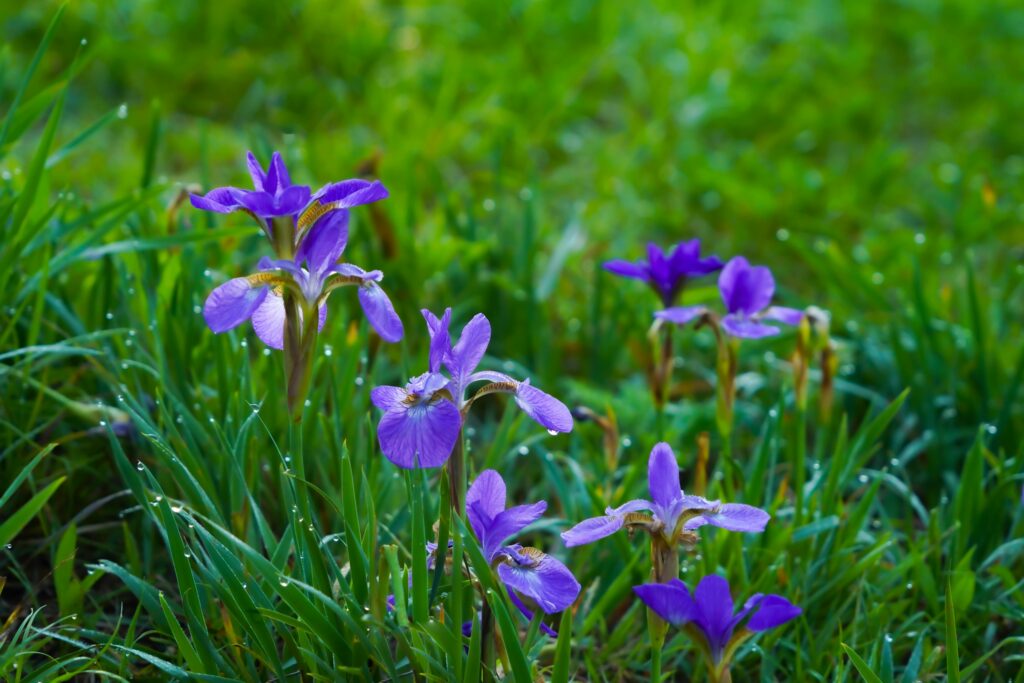
Today, the iris in phytoremediation shines as a silent guardian. The rhizomes of Iris pseudacorus, once used to hold medieval riverbanks, are now ecological heroes. In Europe and North America, these decontaminating plants for rivers stabilize soils, their roots weaving a rampart against erosion. They absorb pollutants, such as nitrates and heavy metals, purifying murky waters like modern alchemists.
In wetlands, where their petals catch the sun, irises share their mission with other floral sentinels. The sunflower, with its golden corollas, extracts metals from arid lands, while Indian mustard sucks up lead, and the four o’clock flower degrades hydrocarbons at twilight. Together, these flowers for phytoremediation form a green alliance, the iris reigning over the marshes, the others over dry soils.
Decontamination projects, from France to Canada, make the iris a symbol of hope, a graceful sentinel that heals the earth as it once healed the villagers of old. Link: INRA, research on phytoremediation.
In the marshes where its petals dance, the iris seems to say: “I am here, as always.” From the mud of medieval villages to Quebec flags, from Art Nouveau floral motifs to rivers purified by phytoremediation, this flower weaves a tapestry where the ordinary meets the eternal.
Its roots carry the memory of peasants, artists, and guardians of nature, alongside the sunflower and its flowery sisters. On Pétales d’Histoire, we cherish these stories where flowers, like the iris, trace bridges between the ages. The next time you come across an iris, bow slightly: its petals, born in the silt, sing an ode to life, fragile but tenacious, which blooms again and again.
A Note from the Curator: The American Passion for the Iris
While the Iris finds its mythic origins in the Mediterranean and its heraldic glory in the courts of Europe, it has found a second home in the vast landscapes of North America. Since its founding in 1920, the American Iris Society (AIS) has transformed this “messenger of the gods” into a true icon of American gardening.
Beyond the wild beauty of the Iris versicolor (the Blue Flag) that guards our northern wetlands, American hybridizers have spent over a century sculpting the “Bearded Iris” into a living palette of impossible colors. From the sun-drenched valleys of Oregon—often called the iris capital of the world—to the historic gardens of the East Coast, the Iris is more than a flower; it is a shared heritage.
Whether it is the focus of a local competition or a silent participant in a “Rain Garden” project, the Iris continues to weave its rainbow thread through the American soil, proving that beauty and utility are but two petals of the same flower.
Explore our themes through the “Flower Collection” tab, or return to the heart of our world:
Floral guideWhispers of the Iris: Insights for the Curious Mind
Is the Iris root used in modern medicine as it was in the Middle Ages?
While modern science recognizes certain properties, its use is now primarily restricted to the world of fine fragrance (Orris). In traditional herbalism, it requires extreme caution due to its potency. In the U.S., it is strictly categorized as a botanical curiosity rather than a domestic remedy.
Why is Orris root one of the most expensive ingredients in American perfumery?
The secret lies in patience. It takes three years of growth and another three years of drying for the rhizome to develop its divine “irone” molecules. For luxury fragrance houses from New York to Paris, it is a scent literally distilled by time, often costing more than its weight in gold.
Can I use the Blue Flag Iris (Iris versicolor) for water purification in my own pond?
Yes, the native North American Blue Flag is an exceptional worker in phytoremediation. It is widely used in “rain gardens” across the States to filter runoff. However, ensure you are planting native species to support local biodiversity and avoid invasive varieties.
Is the Iris safe for my pets?
According to the ASPCA, the Iris contains compounds (primarily in the rhizomes) that can be toxic to dogs and cats if ingested. It is best to admire their “rainbow sails” from a distance if you have curious four-legged companions.
What is the difference between the “Fleur-de-lis” and the Irises in my garden?
The Fleur-de-lis is a stylized heraldic symbol. While it bears the name “Lily,” it is botanically inspired by the Yellow Flag Iris (Iris pseudacorus). The irises in your garden are their sophisticated cousins, bred over centuries for their spectacular colors.