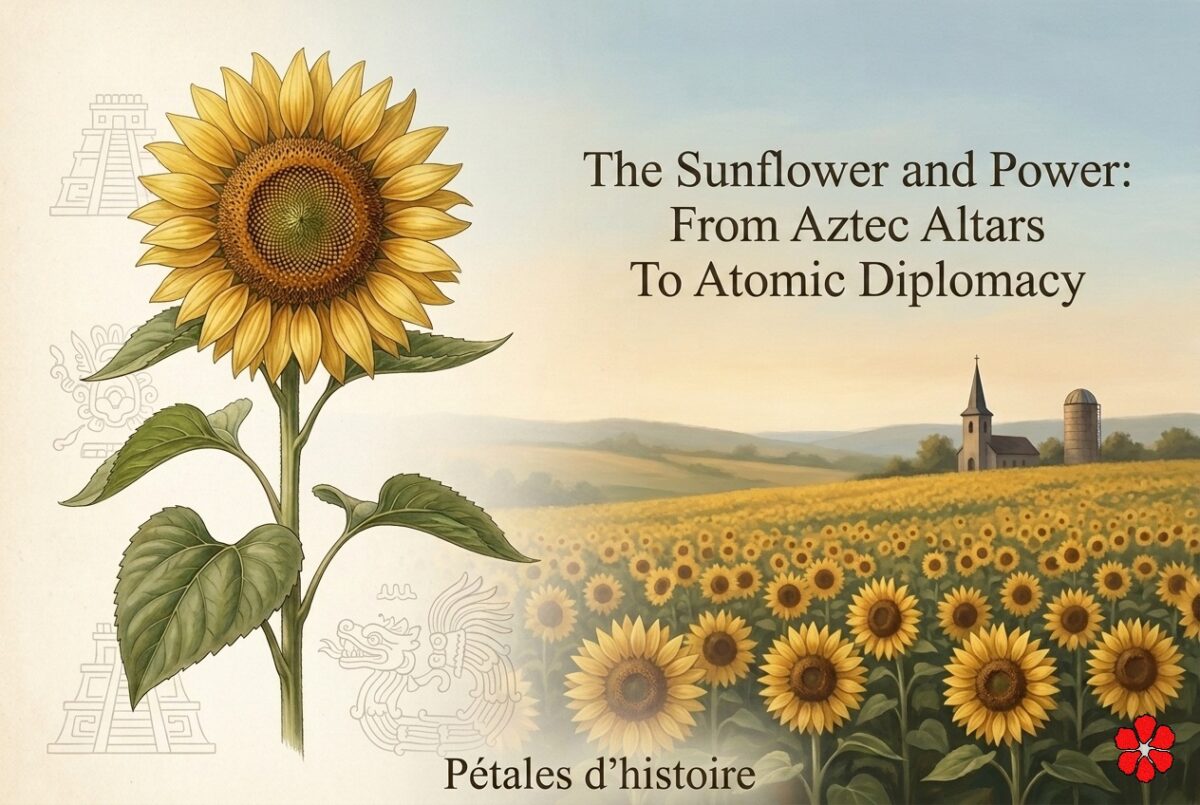
FROM THE GOLD OF AZTEC ALTARS TO THE PLAINS OF UKRAINE, THE SUNFLOWER HAS TRAVELED THROUGH THE CENTURIES, CLINGING TO THE COATTAILS OF POWER. FAR FROM BEING A MERE SILHOUETTE OF OUR SUMMERS, THIS UNUSUAL FLOWER HAS TOPPLED EMPIRES, INSPIRED KINGS, AND PLAYED THE SPY HIDDEN IN COAT LININGS, BEFORE BECOMING ONE OF THE GREATEST SYMBOLS OF WORLD PEACE. DISCOVER THE INCREDIBLE GEOPOLITICAL SAGA OF A BOTANICAL GIANT.
The Untold Journey of the Sunflower
- How a sacred flower beat corn to feed the First Nations of America.
- The secret suppression by Spanish conquistadors to erase the solar gods.
- The theological sleight of hand that transformed the sunflower into the queen of Russian winters.
- The clandestine odyssey of exiled women farmers and their rag dolls, ready to feed a new continent.
- The historic day when Ministers of Defense planted seeds on nuclear missile silos.
The sunflower (Helianthus annuus) is far more than a familiar silhouette of our summer landscapes. This flower conceals a singular geopolitical trajectory, shaped by the ambitions of empires, religious decrees, and international treaties.
From its early domestication in the Americas to its pivotal role in post–Cold War diplomacy, the history of the sunflower reads like a chronicle of power, migration, and the transformation of our civilizations.
The Earth-Sun: An Attribute of Amerindian Theocracies
A Domestication Older Than Corn
Long before the arrival of European caravels, the sunflower was already shaping the social, agricultural, and religious organization of the New World. Archaeobotanical research reveals that it was one of the very first plants domesticated in North America, nearly 3,000 years before our era.
In the Mississippi Valley and on the plateaus of Mexico, its cultivation even preceded that of corn, challenging the common assumption that corn alone triggered the settling of Amerindian peoples.
The seeds were then meticulously ground by Indigenous populations to produce a nourishing flour, used to make breads and rustic cakes that marked the daily life of the earliest settled communities.
The Flower of the God of War
For the peoples of these regions, particularly the Pueblo, Hopi, and Navajo communities, this “Great Golden Flower” went far beyond a simple food source; it was woven into their pharmacopoeia, their crafts, and their rituals. It was the earthly reflection of the sun, a botanical embodiment of life force and fertility.
Among the Aztecs, the sunflower took on a political and martial dimension: it became one of the principal attributes of Huitzilopochtli, the god of the sun and of war. During the great state ceremonies, priestesses walked crowned with these flowers, and massive offerings were laid at the heart of the solar temples.
To wear or offer the sunflower was an act of allegiance to theocratic power, binding the community to its leaders and its gods.
In the temples of Tenochtitlan, the sunflower was not mere adornment: it was the botanical embodiment of celestial fire, a priestly attribute offered to the deities of war and sun.
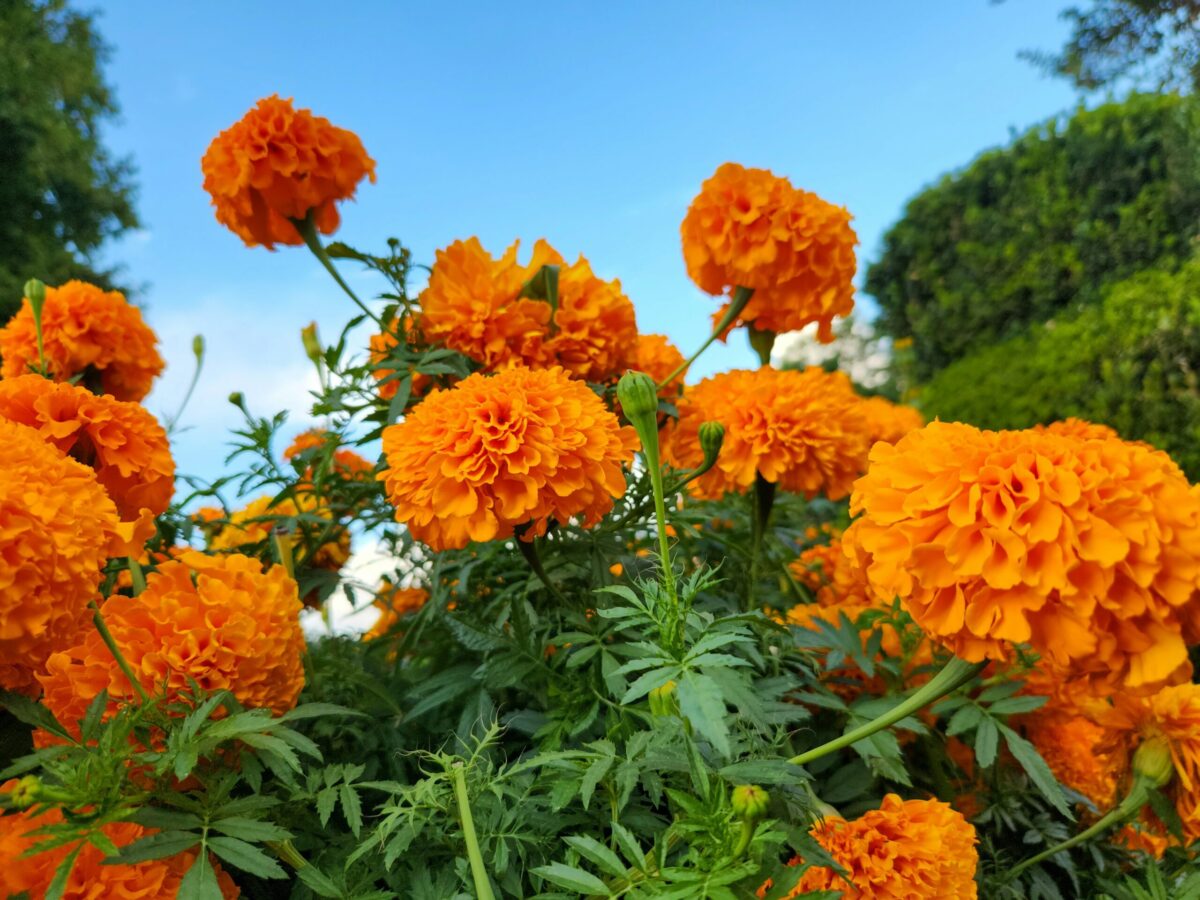
This sacred status among Amerindian peoples was not an isolated case; alongside it, the marigold (the well-known Cempasúchil) also served as a spiritual guide, tracing a path of light for souls.
Colonial and Religious Repression
This sacred charge would prove to be the flower’s undoing during the Spanish conquest. Determined to assert their dominance and forcibly convert local populations, the conquistadors and Franciscan missionaries saw in sunflower worship a manifestation of pagan idolatry closely tied to warrior rituals.
Colonial authorities systematically tried to eradicate its cultivation in Mexico, confiscating harvests and banning the consumption of its seeds. Breaking the symbolic bond that united Indigenous peoples to their flower of light was a colonization technique aimed at dismantling the identity of the conquered.
The Colonial Trophy and the European Anachronism
From the Aztec Altar to the Parks of Madrid
Despite this attempt at destruction, the plant survived and crossed the Atlantic. In the early 16th century, Spanish navigators brought back the surviving seeds as botanical curiosities.
By 1510, the sunflower was already blooming in the royal botanical gardens of Madrid. At that time, the flower held no commercial value in the eyes of the West: it was displayed as a colonial trophy, an exotic rarity embodying the power of the Spanish Crown and the vast extent of its new overseas possessions.
For the Aztecs and the peoples of the New World, this seed was not merely an agricultural product, but a concentration of life, energy, and the sacred. By boarding Spanish galleons in the 16th century, the sunflower seed was about to change continents — and also its destiny.
It alone illustrates the singular way in which a simple seed has, over the centuries, shaped civilizations and empires. In moving from Amerindian rituals to European kitchens, the sunflower began its own odyssey, becoming an invisible cog in major economic and societal upheavals.
The “Sun of Peru” at the Royal Court
As it settled into the courts of Europe, the sunflower underwent a process of cultural appropriation. Renaissance Europe chose to erase its Amerindian origins in order to absorb it into its own intellectual and mythological heritage.
In France, scholars such as Olivier de Serres, the father of French agronomy, observed the plant with respect on their estates and marveled at what they then called the “Sun of Peru.”
To the French mind of that era, it was not yet seen as a livelihood or a resource, but as a botanical wonder, an earthly mirror of the royal star, and a living metaphor for the power of the sovereign who, like the sun, radiated over the known world.
Rewriting the Myth of Clytie
At the same time, scholars projected onto it the ancient myth of Clytie, the nymph from Ovid’s Metamorphoses who, consumed by love for the sun god Helios, was transformed into a flower forever condemned to follow her beloved’s path across the sky.
Although ancient Greece could never have known the sunflower, the West forged a poetic fusion between this classical tale and the heliotropism of the American plant. The Aztec symbol of war and fertility was thus rewritten, becoming, in the verses of poets and within the gardens of the Loire Valley châteaux, a Christian allegory of piety, fidelity, and the soul’s spiritual devotion to God.
The Great Russian Detour: When Dogma Creates Power
Peter the Great’s Modernizing Drive
Yet it was thousands of miles from its birthplace that the sunflower’s destiny would decisively shift into the realm of great political history, driven by Tsar Peter the Great.
At the end of the 17th century, during his Grand Embassy to Western Europe, the monarch — passionate about science and naval architecture — observed the plant in Dutch parks. Seizing the opportunity to enrich and modernize his country’s agricultural landscape, he filled his pockets with seeds and ordered their immediate cultivation on Russian imperial estates.
Collective Cunning Against Orthodox Lent
The plant’s true rise began with a direct tension between popular devotion and Orthodox religious authority.In the 18th century, the Church imposed extremely strict dietary restrictions during the forty days of Lent, banning the consumption of nearly all animal fats and traditional vegetable oils, such as olive or flax oil.However, since the sunflower was a recent introduction to the Empire, it appeared in no sacred text nor in any ecclesiastical decree.
Monasteries as Industrial Empires
This legal void turned into a major societal opportunity. The faithful and the peasantry seized upon the exempted flower to extract its oil, allowing them to work around the strictness of the fast without breaking the canons of the Church.
Recognizing the immense fortune to be made, the great Orthodox monasteries — which at the time held the largest landed estates in Russia — paradoxically became the leading promoters of this crop.
This theological loophole triggered an unprecedented production boom. The smell of roasted sunflower oil filled the markets and became the olfactory signature of the imperial winters.
The sunflower was no longer a mere ornamental flower; it became a pillar of a people’s subsistence and a strategic national resource, carried into the 19th century by the technical innovations of pioneers such as Daniil Bokarev, who designed the first industrial press in 1829.
The Migratory Odyssey and the Flower of Modern Treaties
The Clandestine Seeds of Mennonite Women
The following century would complete a perfect geopolitical and human circle. Over the course of the 19th century, political and religious tensions intensified within the Russian Empire, driving pacifist minorities — particularly Mennonite farming communities — into exile.
Choosing to emigrate to the great plains of the United States and Canada, these families refused to settle on unknown land empty-handed. A true clandestine odyssey took shape: to save their botanical heritage and their identity, Mennonite women carefully sewed the best and largest sunflower seeds selected in Russia into the linings of their heavy winter coats, or hid them in the stuffing of their children’s rag dolls, in order to slip past the watchful eyes of Tsarist customs officers.
In this way, the sunflower returned to its native land after three centuries of exile, reintroduced by these minorities in the form of an agricultural giant capable of permanently transforming the economy and landscape of the American plains.
The Pervomaisk Protocol (1996)
At the dawn of the 21st century, the plant left the agricultural fields behind for good to take its seat at the table of the most critical international negotiations. In June 1996, the military base at Pervomaisk, Ukraine, marked a historic turning point: the complete destruction and dismantling of the intercontinental nuclear missile silos inherited from the Cold War.
To celebrate this armistice and give physical form to the disarmament treaty, the defense ministers of Ukraine, Russia, and the United States gathered at the site. Together, they turned over the soil where weapons of apocalypse once lay, to sow sunflower seeds.
The Dawn of Civilizations at Peace
Through this highly symbolic diplomatic gesture, the flower completed its odyssey. Much like its mature flower head, which eventually stops chasing the sun and settles permanently facing east, embracing the dawn to warm the world, the sunflower stands as the universal icon of the transition from a world of destruction toward an era of reconstruction and peace among civilizations.
Keep reading
This captivating story is part of our complete anthology on the civilizations and symbolism of the sunflower. Explore our collection of articles to deepen your discovery of its impact on human history and world cultures:
The sunflower in art: explore the unique imprint of the sun flower across the history of painting, from the Renaissance to modern masterpieces.
The sunflower between ecology and economy: discover how this botanical giant shapes world markets and stands as a major ally of biodiversity and the sustainable transition.
Continue Your Exploration
Immerse yourself in the world of flowers through our various themes and discoveries.
Start ExploringReceive Our Next Discoveries
Subscribe ✉️