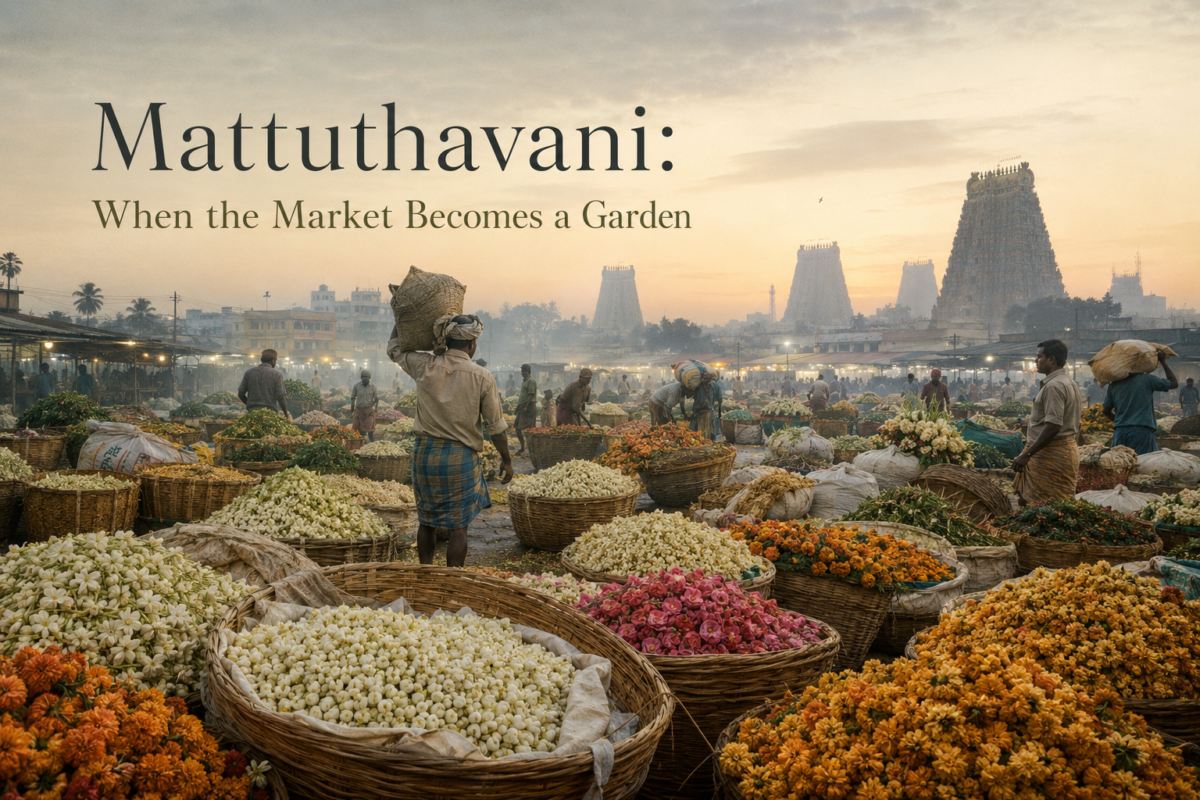
Each night, at the gates of one of India’s most ancient cities, the most vibrant horticultural theater in Tamil Nadu comes alive: the Mattuthavani market. In this sensory crossroads, growers from the surrounding countryside unload tons of jasmine buds, roses, and marigolds, feeding a floral trade that irrigates the entire city — from the wholesale halls to the street vendors who line the temple approaches. Through the lens of gardens and markets, here is how this trading space — born of devotion and terroir — stages the harvesting, the life, and the commerce of the Madurai flower, before the first light of dawn.
Inside this article
- A market that stirs before dawn, caught between commercial fervor and the fragrance of jasmine
- An ecosystem where the city, its temples, and the surrounding countryside form a single floral network
- A flower that has become a cultural, identity-bearing, and economic symbol of southern India
- Ancient weaving gestures passed down as a living form of knowledge
- An unexpected global journey, from Tamil Nadu to the perfume houses of the world
Madurai is still sleeping. In the alleyways of the old city, the warm night air holds the lingering scents of the day — cooled incense, spices, stone dust. Yet just a few kilometers from the historic center, the neon lights of the Mattuthavani market are already cutting through the darkness.
Silhouettes move with purpose, baskets knock together, and in this in-between hour of the world floats a white, insistent, almost sacred fragrance — that of jasmine, announcing that here, the day has never waited for the sun.
This wholesale market is the logistical hub of a far larger system. Around the Meenakshi Temple and along the commercial streets of the city center, other vendors settle in at dawn: seated on the ground, leaning against the walls of sacred alleyways, they wait for the first pilgrims. Together, these two spaces form Madurai’s true floral market — an ecosystem whose roots reach back to the Sangam period, those foundational centuries when classical Tamil literature already celebrated jasmine as a presence inseparable from human life. For here, flowers do not simply change hands: each bud is at once an offering, an adornment, a social symbol, and an economic resource.
From the sacred alleyways of the Meenakshi Temple to the modern halls of Mattuthavani, the long spatial metamorphosis of a two-thousand-year-old trade unfolds. The invisible journey begins in nighttime gardens and ends on the bustling counters of the wholesalers — all before sunrise.
A night at auction: the morning choreography of the merchants, between baskets overflowing with jasmine and prices set to the rhythm of the Hindu calendar, unfolds its feverish, fragrant spectacle.
Here one witnesses the weaving artery, where the market’s alleys transform into workshops of a craft handed down since the Tamil royal courts; and from the baskets of Mattuthavani to perfume flacons sold the world over, how a local market became a planetary horticultural crossroads.
I. From Street to Hub: The Historical Geography of the Madurai Market
To understand what the floral trade of Madurai truly is, one must walk the walls of the Meenakshi Amman Temple. This colossal sanctuary, whose gopurams — those pyramidal towers encrusted with sculpted divinities — have dominated the city for centuries, is the original engine of everything that follows.
Since Tamil antiquity, the temple has demanded daily, unceasing floral offerings. This sacred requirement organized around itself an entire network of growers, vendors, and intermediaries — and the alleyways adjoining the temple still carry that living memory today, with their ground-level sellers offering garlands and jasmine buds to worshippers from the earliest hours of morning.
Jasmine, “a gift from God”: discover the most beautiful love myths (Kamadeva, Princess Yasmin, tears of a goddess) and its unique spiritual power that opens the heart. Read more in the article The Divine Jasmine: From Myths of Love to Sacred Symbolism and Spiritual Legacy
Then the city grew. The twentieth century made it impossible to concentrate this trade within the narrow lanes of the historic center. From this constraint was born the Mattuthavani wholesale market, designed at the city’s edge to centralize high-volume transactions, leaving the street markets their role of retail redistribution.
A spatial rupture, then — but a profound continuity: the two spaces today form the two faces of a single system, inherited from more than two millennia of floral exchange. Travelers who pass through Madurai at dawn always tell the same story — a spectacle in two acts: the fever of the Mattuthavani halls on one side, and on the other, approaching the temple, vendors in the half-darkness of sacred alleyways, their baskets of jasmine at their feet. This two-part awakening is the most eloquent testimony to the historical depth of this trade.
II. Gardens of the Terroir: The Peasant Origins of the Madurai Malli
To understand what stirs each night on the market stalls, one must leave the city and follow the roads that wind into the surrounding countryside. The market begins long before the halls.
The jasmine cultivated here bears a name that amounts almost to a declaration of belonging: the Madurai Malli. This variety is the product of a gradual selection shaped by centuries of cultivation in this particular terroir.
The soil — slightly sandy and well-drained — combined with a warm climate and nocturnal humidity, concentrates the aromatic compounds in a way that other producing regions have never managed to replicate.
Thicker petals, lasting whiteness, a fragrance of rare intensity: logistics have shaped this flower just as much as the perfumer has. A flower that bruises or loses its scent within hours cannot survive the journey from farm to temple.
The harvest takes place at night, when the buds are still closed and the fragrance is concentrated like something held in a jewel box. Thousands of families practice this cultivation around the city, feeding night after night the streams of merchandise that converge on Mattuthavani.
This bond between land and flower was formally recognized in 2013 by the Protected Geographical Indication — crystallizing in law what had long existed in gesture and memory. Ancient Tamil culture had intuited this dimension long before any institution did.
A celebrated narrative tradition recounts that King Pari once halted his royal chariot so that a climbing vine — associated by tradition with jasmine — could lean against it for support. This story, repeated across centuries, says something essential: the plant is not a mere object of exploitation, it is a presence worthy of respect. In the gardens surrounding Madurai, that devotion has simply been transmuted into expertise.
III. The Opera of Dawn: Stagecraft and Daily Life at Mattuthavani
It is three in the morning. Trucks arrive in convoy, laden with burlap sacks swollen with jasmine buds. Within minutes, the stalls are covered in white mountains, orange carpets of marigolds, pink sheaves of roses. The air becomes saturated with fragrance.
The wholesale market can begin. The traders circulate, handle, negotiate. Their most revealing gesture is almost imperceptible: between thumb and forefinger, they gently press each bud. Firm and resilient, it signals absolute freshness — the fragrance still imprisoned, intact. Too soft, and the flower has already begun its final day. This simple gesture, passed from generation to generation, condenses the entire logic of a market where value is measured in hours.
Price-setting, for its part, does not follow simple economic logic: it obeys the Hindu calendar, religious festivals, and wedding seasons. During Pongal or Diwali, demand surges and prices soar with it — in some years, a kilogram of jasmine fetching several thousand rupees. Mattuthavani is a true barometer of the religious and social life of all Tamil Nadu: to observe its prices over the course of a year is to read, in negative, the spiritual agenda of an entire region.
Travelers always return to the same contrast: the absolute delicacy of the flowers, their almost unreal whiteness beneath the neon lights, set against the warm chaos of porters crossing paths and merchants calling out to one another. Beauty here is not contemplated — it is weighed, shouted, sold. And this apparent vulgarity takes nothing from its grace.
An inside look at the Aalsmeer global flower hub, orchestrating the journey of blossoms and defying time to preserve fleeting beauty. Read more in The Aalsmeer Flower Market: A Global Powerhouse.
IV. The Craft Alleyways: Floral Weaving at the Heart of the Stalls
As the wholesale transactions draw to a close, another life begins — in the alleyways of Mattuthavani and around the temples of the city center. Women’s hands transform jasmine buds into gajra in a matter of minutes: those delicate garlands destined to adorn women’s hair. Ever-present in daily life as much as in ceremony, gajra embody an accessible beauty that has never broken its connection with the sacred: to wear jasmine in one’s hair here is a quiet way of remaining in touch with something that transcends the everyday.
Other hands — men’s this time — create compositions of an altogether different scale. The great garlands destined for temples or weddings, some of them several meters long, demand a physical strength that their weight naturally imposes.
At weddings, they give tangible form to the solemn exchange between the spouses; in temples, they dress the divinities according to precise visual codes that all the players in this market know well.
This division of labor reflects the sophistication of a craft whose techniques have not changed since the Tamil royal courts. The market has organized itself into an internal geography faithful to this diversity: alleyways devoted to hair ornaments, sectors for monumental garlands, spaces dedicated to bridal adornments.
In a single walk, one passes through several layers of Tamil social and religious life. The people of Madurai speak of it with the same pride as they do of the architecture of Meenakshi: floral weaving is not simply a trade among others — it is a living heritage of which they consider themselves the guardians.
V. Beyond the Halls: The Madurai Market Connected to the World
By mid-morning, when the stalls of Mattuthavani are emptying out, the flowers are already on their way — having first irrigated the alleyways, the neighborhood retailers, and the vendors posted at the temple gates.
It is this original need — the sacred and daily demand of the temple — that remains the backbone of Madurai’s entire floral economy. But the network then extends far beyond.
From Madurai’s airport, cargoes of fresh jasmine take flight each night toward the Middle East and Southeast Asia, where Indian diaspora communities maintain a constant demand for flowers from their homeland.
A bud harvested at midnight in a Tamil garden may find itself, just a few hours later, in the hands of an Indian family in Dubai, enacting the same ritual gestures as in Madurai.
International perfumery constitutes a third sphere of influence. It takes colossal quantities of fresh flowers to produce an infinitesimal amount of essential oil — tons of Madurai Malli to fill a handful of bottles sold at steep prices in Paris or Milan. And at the end of the day, unsold flowers are not discarded: bought back at a fixed price by the perfume industry, they find one final purpose in the extraction circuits.
This mechanism guarantees farmers a floor income and makes the system one of the most resource-efficient imaginable. Here, even the flower at the end of its cycle is never truly lost.
The Madurai flower market reveals what economic history too often overlooks: great trading systems are built not only around resources and profits, but around the deepest human needs — devotion, beauty, ritual, identity.
In Madurai, the flower has never been a simple agricultural product. Since the Sangam era, it has been a mediator between human beings and the sacred, between the land and the temple, between past and present.
What unfolds each night in this network of markets — from the halls of Mattuthavani to the temple alleyways — is the renewal of a very ancient compact between a civilization and its garden. And perhaps that is the true miracle of Madurai: that in one of the most dynamic economies of the contemporary world, there still exists a city where time organizes itself around the fragility of a jasmine bud.
This story doesn’t end with this single petal. Explore more stories about gardens and markets.
Continue Your Exploration
Immerse yourself in the world of flowers through our various themes and discoveries.
Start ExploringReceive Our Next Discoveries
Subscribe ✉️