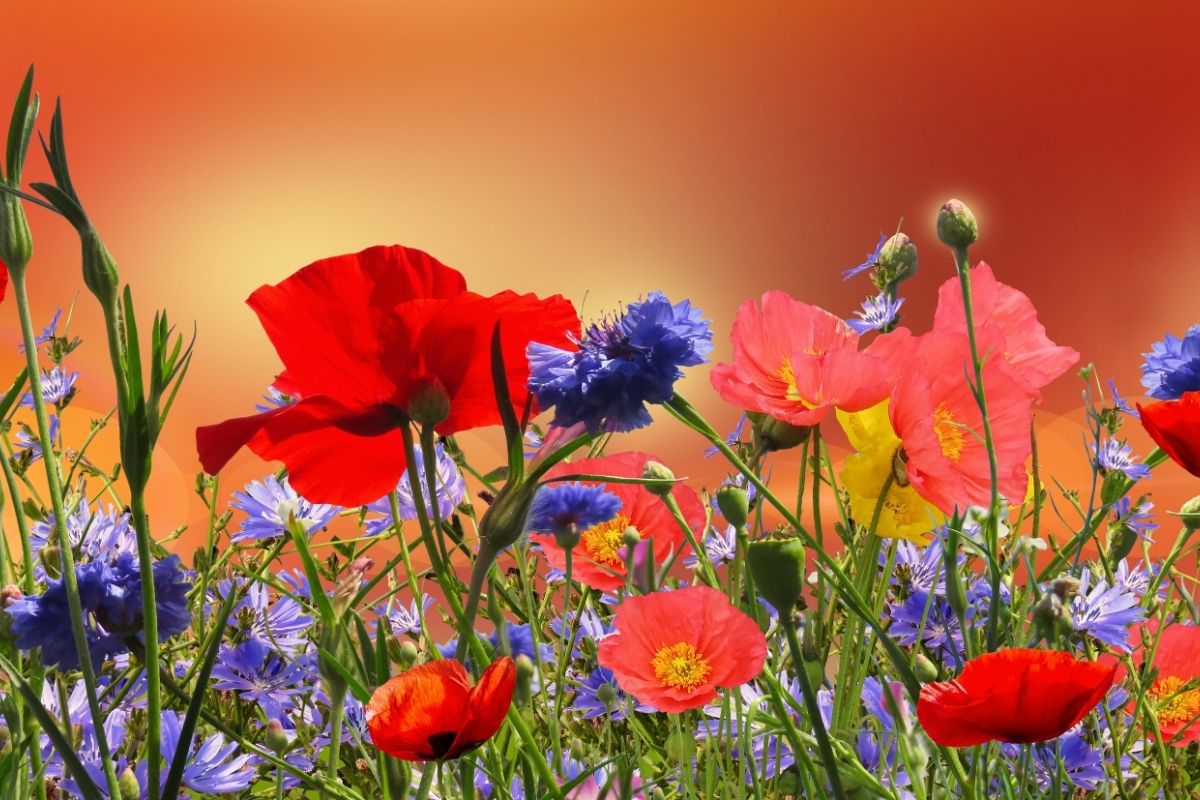
In the fields ravaged by the First World War, two fragile flowers rose as powerful symbols of memory and resilience: the cornflower and the poppy. Linked to the remembrance of soldiers fallen in battle, these blooms carry a moving history and continue to embody hope and reflection. In this article, we explore the history, symbolism, and cultural significance of cornflowers and poppies, while paying tribute to their role in commemorating the Great War. The choice of these flowers is not arbitrary; it relies on a symbolic and secret language of flowers.
In this Floral Chronicle:
- The Alchemy of the Trenches: How the churning of war-torn soil awakened dormant seeds, transforming devastated fields into a sea of scarlet poppies.
- The Blue Horizon of Resilience: The moving history of the Bleuet de France, from the “Horizon Blue” uniforms of the young recruits to the healing workshops of the Invalides.
- The Crown of a Queen: The secret legend of Queen Louise of Prussia and how a simple field flower became a symbol of national survival in the German heart.
- A Botanical Bridge of Peace: How these fragile corollas, once symbols of opposing nations, have evolved into a shared language of reconciliation and universal memory.
The Poppy: The Red Flower of Remembrance
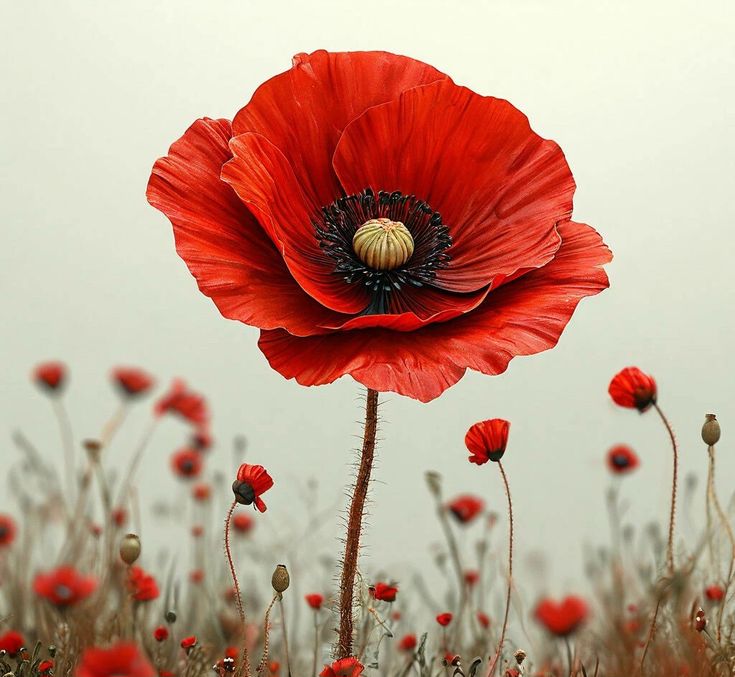
The poppy, with its delicate, vibrant red petals, has become one of the most universally recognized symbols of the First World War, particularly in English-speaking countries. This flower owes its fame to the poem In Flanders Fields (1915), written by the Canadian military doctor John McCrae. In this poignant text, poppies are described as growing among the soldiers’ graves in the fields of Flanders, a region hard-hit by the fighting.
Beyond the poetic elegy, the triumph of the poppy stems from an almost mystical subterranean alchemy. The Papaver rhoeas possesses a fascinating biological trait: its seeds can lie dormant for decades in the darkness of the earth. Under the brutal kiss of the shells, the soil of Flanders was churned as never before, releasing a massive concentration of nitrates. This upheaval, combined with the sudden exposure of buried seeds to the light, triggered a spontaneous and spectacular flowering. Where iron had sown death, the chemistry of the earth offered a crimson shroud, as if the land itself were attempting to heal its wounds through an eruption of life.
But why the poppy? This flower, able to thrive in soil churned up by shells, symbolizes life reborn amid destruction. After the battles, the devastated fields would blanket themselves in poppies, as if to remind us that beauty can emerge even in the darkest hours. In Commonwealth countries, the poppy is worn as a badge or pin on Remembrance Day (November 11), the anniversary of the Armistice. This gesture honors not only the soldiers of the Great War but also those from all conflicts. In France, although the cornflower remains the primary symbol, the poppy is gaining popularity, particularly due to its universal appeal.
The Cornflower: France’s Emblem of Memory
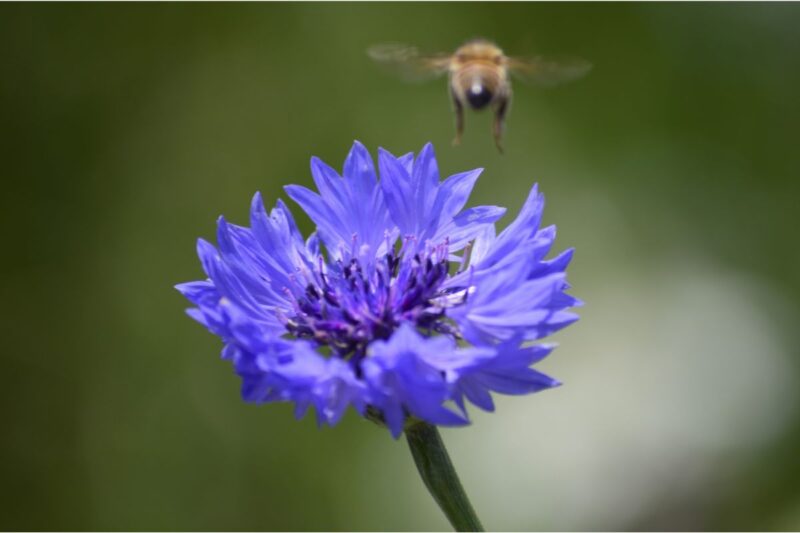
In France, the cornflower is the emblematic flower of the First World War. Its story is every bit as moving as that of the poppy. The cornflower takes its name from the bleu horizon (horizon blue) color of French soldiers’ uniforms—those nicknamed the poilus (“hairy ones”). Like the poppy, it grew in the battle-ravaged fields, often side by side with its red cousin. The association of the cornflower with soldiers’ memory was formalized after the war by two nurses. It is worn during commemorations, particularly on November 11, and supports the Œuvre Nationale du Bleuet de France. The cornflower embodies not only the memory of sacrifices but also the resilience and hope of a nation rebuilding itself after the horror.
The history of the cornflower is intimately bound to the ‘Gueules Cassées’ (the disfigured survivors). In 1925, two devoted nurses, Charlotte Malleterre and Suzanne Leenhardt, established a workshop within the Institution Nationale des Invalides. There, mutilated soldiers—whose hands were often the only limbs spared by the horror—crafted cornflowers from fabric and paper. This delicate craftsmanship was not merely a source of income for the wounded; it served as a poignant form of early art therapy, restoring dignity through creative gesture to those shattered by war. To wear the cornflower today is to honor this resilience of the human hand in the face of chaos.
The Mirror Across the Rhine: Germany’s Blue Jewel
The National Flower of Prussia
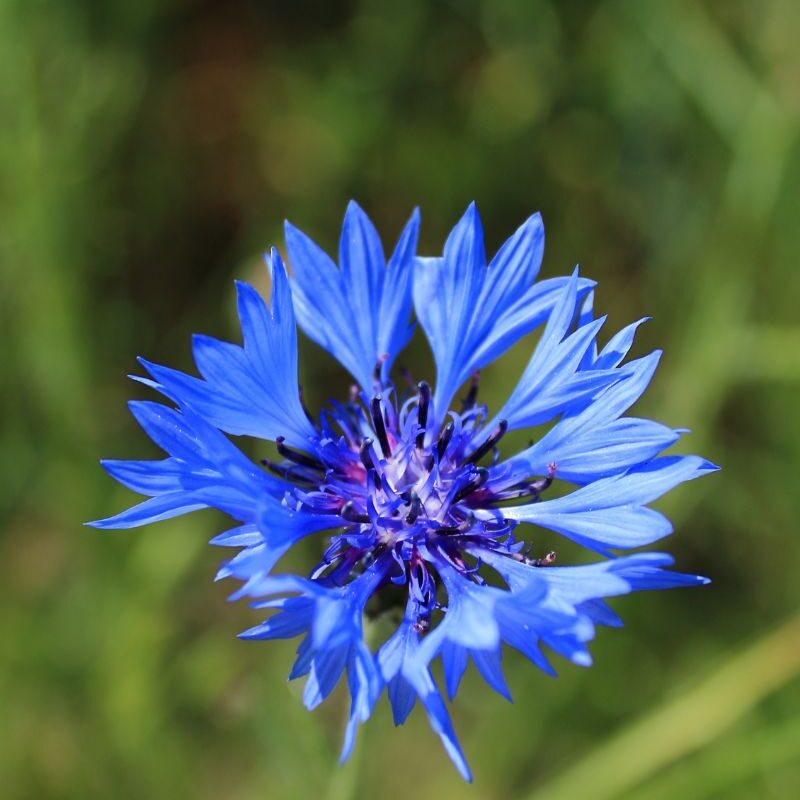
While the cornflower is the herald of French memory, it also holds a sacred, ancestral place across the Rhine as the Kornblume. In the 19th century, it became the quintessential symbol of Prussia and, subsequently, of the German Empire. Its deep azure hue—recalling the famous ‘Prussian Blue’—was more than a mere aesthetic choice; it embodied the romantic ideals of fidelity, rural purity, and a profound connection to the soil. For Emperor William I, it was the ‘Kaiserblume’ (the Emperor’s flower), a personal favorite that he helped elevate to a national emblem, weaving it into the very fabric of German identity.
The Legend of Queen Louise’s Crown
The soul of this devotion lies in a poignant legend born during the Napoleonic Wars of 1806. It is told that Queen Louise of Prussia, fleeing Berlin to escape the advancing French troops, found refuge in a golden field of grain with her children. To soothe her young sons’ fears during their long hours of hiding, the Queen wove crowns from the brilliant blue cornflowers growing amongst the wheat. One of those children, the future Emperor William I, never forgot this gesture of maternal grace amidst the chaos of war. For him and for generations to come, the cornflower became a symbol of national survival and the resilience of the heart when faced with overwhelming odds.
A Shared Witness: From Conflict to Reconciliation
In our modern era, the presence of the cornflower in both French and German traditions has evolved from a mark of division into a powerful bridge of reconciliation. Today, these blue petals—whether called Bleuet or Kornblume—serve as a silent, shared witness to a common European sorrow. No longer just symbols of separate nations, they have become emblems of a ‘memory beyond borders.’ In recent years, they have been seen side by side at international commemorations, reminding us that nature does not recognize the trenches of men, and that beauty and grief are languages spoken by all humanity.
Shared Symbolism: Memory and Resilience
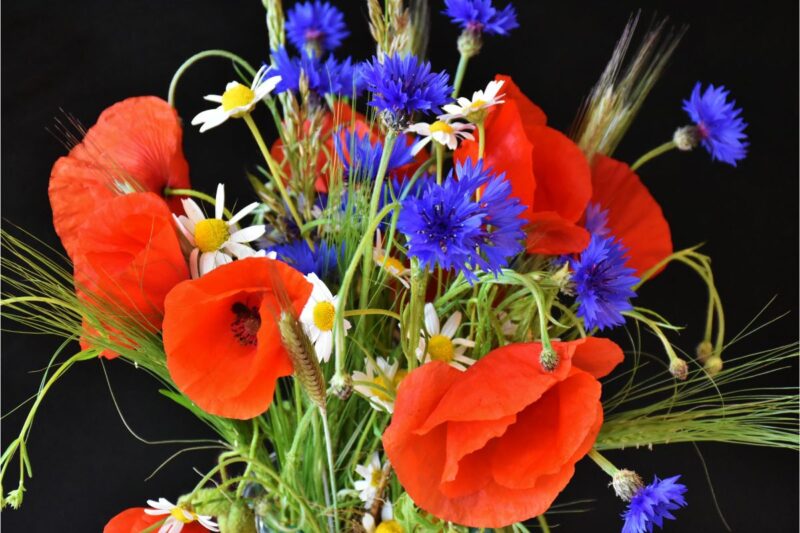
Although the poppy and the cornflower are linked to different nations, they share a common symbolism: that of memory, resilience, and hope. These seemingly fragile flowers managed to thrive in extreme conditions, just as the soldiers endured the hell of the trenches. Their presence in the devastated fields also symbolizes nature’s ability to regenerate—a powerful metaphor for societies scarred by war. Today, these flowers continue to remind us of the importance of never forgetting the sacrifices of the past while looking toward a future of peace.
Petals to Remember
Cornflowers and poppies are far more than mere flowers. They are the guardians of collective memory, symbols of hope and resilience born in the devastated fields of the First World War. In France and abroad, they invite us to remember the soldiers’ sacrifices while celebrating life that endures despite everything. This tribute is part of a long-standing tradition of rites and the symbolism of offerings.
History does not end with this single petal…
A new path now unfolds before you: continue your journey by exploring the destinies of other blossoms that have shaped our world.
Explore our themes through the “Flower Collection” tab, or return to the heart of our world:
GatewayFrequently Asked Questions: A Deeper Look into Floral Heritage
Why is the poppy specifically linked to the soil of the Great War?
Beyond its poetic beauty, the poppy is a botanical opportunist. The heavy shelling of the First World War released high levels of nitrates into the earth, creating the perfect conditions for poppy seeds—which can lie dormant for eighty years—to bloom in a spectacular, almost miraculous, red tide.
Is the German “Kornblume” the same species as the French “Bleuet”?
Yes, both are the Centaurea cyanus. While their botanical identity is identical, their symbolic paths diverged: one mirroring the French soldier’s uniform and the other embodying Prussian romanticism and the legend of Queen Louise’s maternal courage.
How do these flowers contribute to modern reconciliation?
Today, the poppy and the cornflower are no longer markers of enmity. In international ceremonies, they are often worn together, symbolizing a “memory beyond borders.” They remind us that the earth knows no victory, only the cycle of life that persists despite the scars of history.