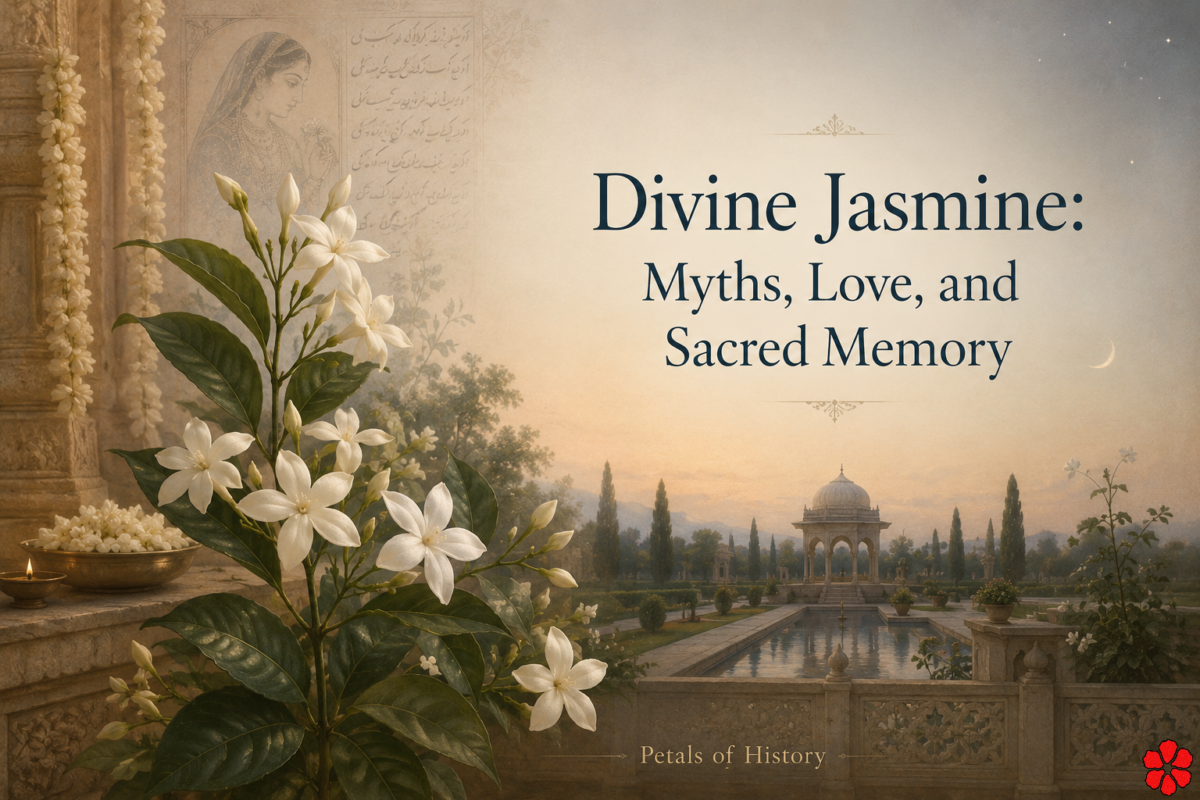
On Pétales d’Histoire, divine jasmine is explored here as a matter of general culture, as a flower tied to spiritual traditions, mythological tales, and ritual practices across history. This article traces its role in ancient beliefs, its meaning across the ages, its symbolism within cultural heritage, and its place in representations of the sacred. Through these dimensions, jasmine emerges as a flower of memory, standing at the crossing point of the symbolic and the spiritual.
There are flowers that do not content themselves with simply blooming: they travel through the centuries like living stories.
When night falls over the gardens of Asia or the Middle East, jasmine opens in silence. Its fragrance never imposes itself; it spreads slowly, like a presence. It accompanies ritual gestures, murmured prayers, stories passed down from one generation to the next.
In myths as in traditions, jasmine always appears at the threshold: between love and the sacred, between the visible and the invisible. It does not symbolize purity or beauty alone — it evokes a relationship, a memory, a bond.
To explore jasmine, then, is not merely to observe a flower: it is to step into a world of beliefs, stories, and practices in which the plant becomes a vessel of meaning.
What you’ll discover in this article
- Understanding jasmine’s symbolism across civilizations and spiritual traditions.
- Exploring jasmine’s myths and its role in stories of love and the sacred.
- Discovering jasmine as a spiritual flower, between the divine, memory, and transmission.
- Examining jasmine’s ritual uses in cultural and religious practice.
- Tracing jasmine’s history and its place within humanity’s intangible heritage.
- Observing jasmine as a universal cultural symbol, between love, purity, and the invisible.
A heritage and traditions lens: a sacred flower
A sacred flower passed down through civilizations
Jasmine occupies a singular place in the intangible heritage of many cultures. It is not simply a plant prized for its fragrance, but an element deeply woven into traditions, rituals, and the gestures of everyday life.
Its name, drawn from the Persian yasmin — “gift from God” — carries a sacred meaning from the outset. In ancient societies, naming a flower this way amounts to acknowledging its symbolic and spiritual value. Jasmine is thus perceived as a natural offering, a manifestation of the divine within the plant world — a meaning that has rarely wavered across the centuries, whichever culture takes it up. There is something remarkable in this stability: few flowers have preserved, across such a vast territory and for such a long span of time, so constant a symbolic charge.
In India, this dimension is especially visible. Jasmine flowers are woven into garlands meant for deities, used in temples or during ceremonies. They accompany life’s important moments: births, weddings, religious festivals. Offering jasmine is never a casual gesture — it belongs to a tradition handed down, repeated, absorbed, one that requires neither sacred text nor religious authority to endure: only the memory of gestures passed on by elders. In Madurai, in Tamil Nadu, this sacred dimension intertwines with a very living reality: the local jasmine, the Madurai Malli, has been grown there since antiquity and continues, every morning, to supply one of the country’s most bustling flower markets — a place we have already explored in detail in our pages, where the sacred and the commercial cross paths without ever truly parting. In Thailand, jasmine is associated with purity and maternal love; it is used during family celebrations and rituals honoring one’s elders. This continuity of use reinforces its role as a cultural marker across the Asian continent.
In the Middle East, jasmine inhabits gardens just as much as domestic interiors. Its fragrance, released in the evening, accompanies daily life and moments of quiet reflection, becoming a familiar, almost intimate presence. As early as the High Middle Ages, this intimacy found a more scholarly form: in ninth-century Baghdad, the philosopher and scholar Al-Kindi recorded, in his treatises, formulas for attars and incense in which jasmine held a place of honor. The sacred flower thus also became an object of science, translated into precise proportions, reproducible gestures, a true art of composition. The sacred and knowledge meet here without contradiction — one gives meaning to the other, the other gives it form. This double movement, from garden to laboratory and from laboratory to prayer, speaks to jasmine’s deeper nature: a flower that has never had to choose between rigor and mystery.
In this way, jasmine acts as a thread linking generations to one another. It is not merely cultivated: it is passed down, absorbed, lived.
Rituals, offerings, and spiritual practices
Jasmine lies at the heart of many ritual practices, which extend and renew ancient stories.
In India, jasmine garlands offered to deities in temples or during ceremonies symbolize devotion, purity, and a relationship to the sacred. The gesture of offering is simple, yet charged with meaning: it requires neither wealth nor elaborate ceremony, only a flower and an intention.
In certain traditions, jasmine continues its life as incense: burned, it releases its fragrance into the air and creates an atmosphere conducive to meditation or prayer. This passage from flower to fragrance reinforces its immaterial dimension — as though, in being consumed, the plant completed its transformation into pure breath.
It also appears in rites of passage: weddings, celebrations, tributes. It accompanies moments of transition, marking life’s milestones, always within that same discreet register that defines it: the flower never imposes itself, it simply accompanies.
These practices endure today, sometimes in transformed shapes. Jasmine tea, for instance, extends this relationship between flower and ritual, weaving fragrance into an everyday experience.
This living dimension is explored further in our article on jasmine tea.
Jasmine in ancient tales and religious traditions
Like a small piece of paradise fallen to earth, as the Persian poets used to say
Beyond ritual practice, jasmine is deeply rooted in ancient narratives. It appears in myths, legends, and religious texts that contribute to its symbolic construction.
Hindu tradition associates it with Kamadeva, the god of love, without making it his sole attribute. His bow of sugarcane carries five arrows, each tipped with a different flower, each capable of awakening a distinct shade of desire; jasmine is one of them, alongside the lotus, the mango blossom, and the ashoka flower. It is precisely this plurality that makes Kamadeva such a singular figure: in Hindu thought, love is never reduced to a single sensory register, and jasmine appears there only as one of the possible shades of romantic longing — perhaps the one that speaks most directly to the senses, through a fragrance capable of filling an entire room from a single branch. According to one legend, he attempted, with these arrows, to disturb Shiva in meditation — a story that illustrates the force of love against even the most unyielding asceticism.
Jasmine holds an equally vivid place in the stories surrounding Krishna. At Vrindavan, the garden where his divine play with Radha and the gopis unfolds, jasmine garlands belong to the scenery of love as much as to that of the sacred: statues are adorned with them, necklaces are woven from them, their fragrance is breathed in as one might breathe in a presence. This dual role — adorning the god and inspiring desire — speaks to jasmine’s particular place in the Krishnaite imagination: a flower of purity that never excludes sensuality, an offering that is also a caress. Jasmine thus becomes an element of the spiritual setting, a symbol of beauty and of the relationship between the divine and the human — one of those details that tradition never quite theorizes, but renews season after season, like a quiet, self-evident truth.
Persian culture, for its part, weaves jasmine into even more poetic tales: the legend of the princess transformed into a flower to preserve her purity reflects a worldview in which plant metamorphosis becomes an act of protection and transcendence. Jasmine is here associated with grace, with preserved beauty, with a form of eternity. These stories should not be read as simple tales: they form structures of thought, ways of interpreting the world. Jasmine plays the role of a mediator within them, linking story to experience, myth to daily life.
A flower between divine love and the invisible world
The promise of a flower, a Philippine legend
Jasmine’s richness also lies in its capacity to gather multiple meanings while preserving a symbolic coherence — and nowhere is this more visible than in the Philippine legend of the sampaguita, whose very name carries the imprint of a promise of love.
The story tells of the love between Princess Lakambini and the warrior Lakan Galing. Before leaving for battle, the young man is said to have sworn he would return; she waited faithfully for him, year after year, until she finally accepted, heartbroken, that he would never come back. From her grief, a small white flower is said to have been born, growing on the hill where the two lovers had once exchanged their promise. The villagers, moved by such unwavering faithfulness, are said to have named the flower sampaguita — a popular distortion of the phrase sumpa kita, “I promise you.” This legend, still told to Filipino children today, explains why jasmine sambac became, centuries later, the national emblem of a devotion that does not die with absence. There is, in this story, something that echoes what one finds elsewhere in Asia: the flower is never mere decoration — it is born directly from the emotion it ultimately comes to embody.
In many cultures, jasmine is associated with love — but a love of a particular nature, one that goes beyond mere human feeling to become a force that connects, that unites, that knows no borders.
Its whiteness evokes purity, a gentle purity rather than an austere one. Its fragrance plays an equally essential role: invisible yet present, it becomes a metaphor for that which cannot be seen but can be felt.
In the Middle East, certain traditions regard jasmine as a flower capable of drawing in benevolent presences. Released at night, its fragrance is associated with an opening toward the invisible world — reinforcing its role as a mediator between planes of existence.
A constant emerges: jasmine is never a flower of rupture. It is a flower of passage, of transition, of connection.
Sacred gardens and representations of paradise
Jasmine also belongs to spaces conceived as extensions of the sacred.
Persian gardens stand as the most accomplished example. Designed as a staging of paradise, organized around water, symmetry, and coolness, these spaces are conceived as places of contemplation in which jasmine, through its fragrance and discreet blooming, plays an essential sensory role: it is planted there less for the eye than for that precise moment, as night falls, when its fragrance is released and completes the garden’s transformation into a place of quiet reflection. We have devoted an entire article to these gardens, exploring how this sacred architecture has, for centuries, shaped a certain idea of paradise on earth.
This is not a matter of aesthetics alone: these gardens express a worldview in which nature becomes a reflection of divine order. Jasmine embodies, within them, a form of harmony, a gentle presence that accompanies the experience of the place.
Other cultures have developed similar logics: spaces planted with jasmine become places of rest, meditation, or gathering, where plant, fragrance, and architecture answer one another — none of these traditions ever needing to draw on the others to arrive, almost naturally, at the same intuition.
A memory of the sacred
Through stories, rituals, and landscapes, jasmine emerges as a flower of memory. It does not merely symbolize the sacred: it constitutes a living trace of it, passed down through the generations.
This spiritual dimension of the plant world is also found in other symbolic flowers, such as the lotus, a flower of spiritual awakening.
Discreet yet deeply present, jasmine embodies a form of continuity — a bond between cultures, between eras, between the human and what lies beyond it. Its spirituality rests on no single doctrine: it lives instead in the repetition of a single gesture — offering, perfuming, passing on — renewed without interruption for millennia, across continents that never needed to consult one another to agree on what a small white flower could mean.
This captivating story is part of our comprehensive anthology on civilizations and the symbolism of jasmine. Explore our collection of articles to further discover its impact on human history and world cultures:
Star Jasmine: The Fake Flower That Fooled Everyone: Star jasmine isn’t jasmine at all — discover the botany behind nature’s best impostor, the chemistry of true jasmine, and how it’s extracted into perfume.
Jasmine: How a Flower Became a Symbol of Power: From Catherine de Medici’s perfumed gloves to Tunisia’s jasmine revolution: how this flower became a national symbol in the Philippines, Pakistan, and beyond.
Jasmine Tea: History and Tradition, from China to India: The history of jasmine tea, from China’s scenting ritual to India’s spiced chai — and the rituals of hospitality and beauty that surround this fragrant flower.
To verify or explore further
These references document the article’s sacred, mythological, and heritage dimensions without reducing jasmine to a single religious tradition.
| National Museum of the Philippines – Philippine National Flower: Sampaguita | Confirms Sampaguita as the national flower of the Philippines and explains its associations with purity, fidelity, hope, garlands, and perfumery. |
| Damiana L. Eugenio, Philippine Folk Literature: The Legends, University of the Philippines Press | A scholarly collection for the Philippine legendary background around Sampaguita and the motif of promise, love, and memory. |
| W. G. Archer, The Loves of Krishna in Indian Painting and Poetry, George Allen & Unwin / Dover Publications | Gives cultural and iconographic context for Krishna, Radha, the gopis, and the union of devotion, beauty, and love in Indian art and poetry. |