This general-interest article takes us in the footsteps of today’s botanical adventurers. At the crossroads of pharmaceutical science and the global economy, we explore how the search for rare compounds—now enhanced by artificial intelligence—is transforming our natural heritage into a strategic resource. It’s a fascinating journey, from field expeditions deep in primary forests to cutting-edge algorithms.
The Quest for Medicinal Green: Between Botanical Exploration and Therapeutic Research
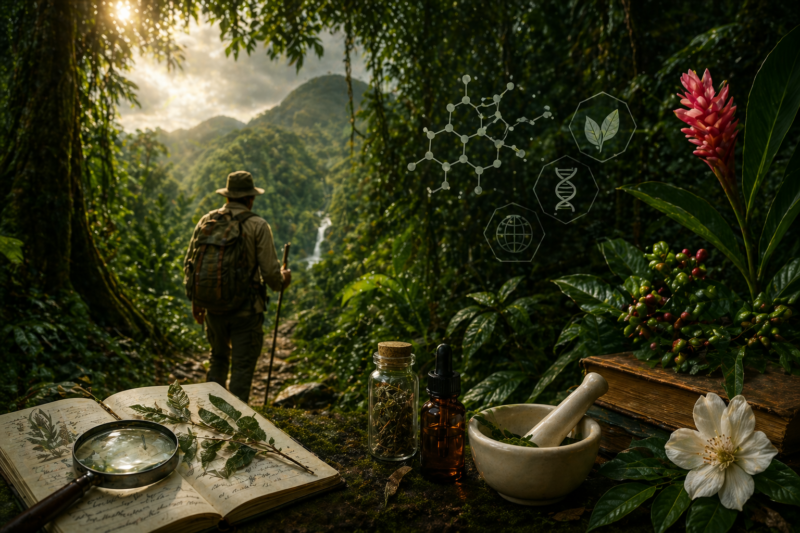
The silence of a primary forest is never complete. Beneath the canopy, amid heavy humidity and the irregular calls of birds, a few figures move slowly, focused on what the untrained eye would miss. They are not searching for gold or timber. Their attention is drawn to a leaf, a vein, an unusual bloom.
What they are pursuing is not always visible—nor is it ever certain. It’s a lead, sometimes fragile, that must be confirmed, analyzed, and understood.
These researchers are carrying on an age-old tradition: that of explorer-botanists. But the nature of their work has changed. Where once specimens were collected for gardens or curiosity cabinets, today the goal is to identify plant compounds that could unlock new therapeutic pathways. The forest is no longer just a place to document—it has become a field of hypotheses.
Curiosity Checklist
- The legacy of traveling botanists: from the Age of Enlightenment to modern-day drones
- Forest alchemy: how a simple flower becomes a life-saving drug
- AI meets chlorophyll: the new digital instinct guiding researchers
- The shadow of biopiracy: conflict between industrial patents and ancestral knowledge
- The fate of ethnobotanists: scientists bridging tradition and futurism
From Naturalists to Scientific Explorers
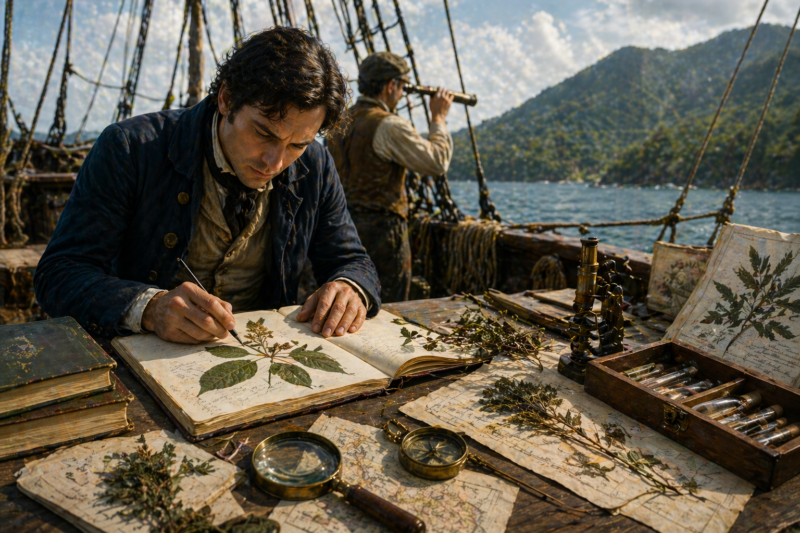
Botanical exploration truly began to take shape during the 18th century. Naturalists like Joseph de Jussieu and Philibert Commerson joined long, perilous expeditions where the study of the living world was driven by both scientific curiosity and economic ambition.
Plants weren’t just studied for their own sake. They were circulated, traded, and acclimated across the globe—take the iris, for example, which had already been used for its medicinal properties since the Middle Ages. From spices to new crops and vital resources, botany became part of broader networks where knowledge went hand-in-hand with commerce. On board ships, it also met more immediate needs, such as the desperate search for a cure for scurvy.
Some introductions would go on to have a lasting impact. Cinchona bark, which gradually spread across Europe, played a key role in the fight against malaria. These movements—at times tentative—were already beginning to shape the foundations of applied science.
Today, the landscape has changed, but the core process remains the same: collecting, comparing, and interpreting. The difference is that this work is now supported by tools that expand our vision, from genetic analysis and chemical profiling to massive digital databases. Exploration is no longer at odds with the laboratory; it is an extension of it.
The Chemical Diversity of Life: From Natural Mechanisms to Medical Applications
While modern chemistry allows us to synthesize a vast number of molecules, it still draws constant inspiration from the natural world. This is because organisms—plants in particular—develop incredibly complex chemical structures, shaped by their ongoing interaction with their environment.
Since plants can’t just get up and move, they respond to challenges like insects, pathogens, and climate shifts through sophisticated chemical strategies. Some of these substances, originally produced for survival, possess properties that can be repurposed for therapeutic use.
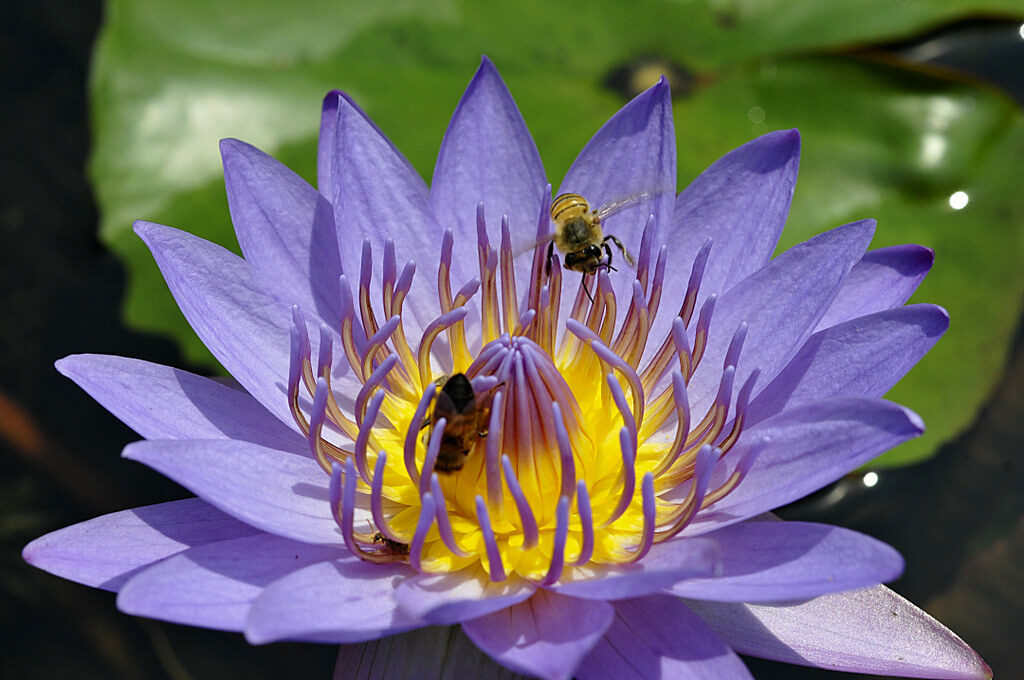
The Madagascar periwinkle provides a perfect example of this, joining the ranks of other small blue flowers whose properties were observed for ages before being scientifically studied. In the 1950s, the identification of specific alkaloids within the plant paved the way for treatments against certain types of leukemia. It’s a long road from the initial observation to a medical application, but it almost always starts with that first discovery.
Even today, a great deal of research conducted at institutions like the Pasteur Institute continues to draw inspiration from molecules found in nature.
Sweet Wormwood: Between Traditional Knowledge and Scientific Validation
Research doesn’t just advance through brand-new discoveries. It also revisits existing knowledge—sometimes subtle, sometimes fragmented—handed down through history, particularly from medieval gardens where plants were grown for their medicinal virtues.
The work of Tu Youyou is a testament to this. By studying ancient texts of traditional Chinese medicine, she highlighted the use of sweet wormwood (Artemisia annua). This ancient starting point wasn’t enough on its own, however. It still had to be understood, isolated, and stabilized.
The isolation of artemisinin, made possible by specialized extraction methods, allows for the transformation of an empirical practice into an effective treatment for malaria. This transition is more than just a simple validation; it is a total transformation. It requires a dialogue between different forms of knowledge that don’t always perfectly overlap.
Technology and AI: Guiding Pharmacological Research Without Replacing Fieldwork
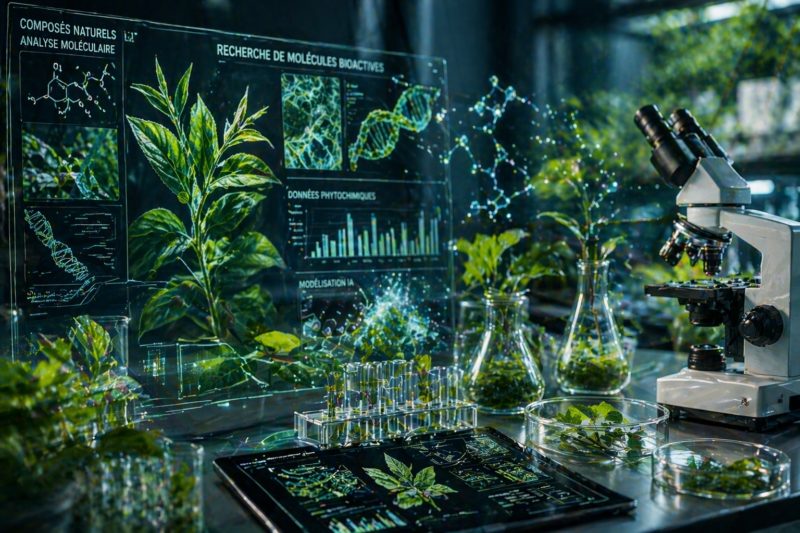
With digital tools, research is reaching a whole new scale. Artificial intelligence makes it possible to explore datasets that human analysis simply couldn’t navigate alone.
Virtual screening is a prime example. Using known chemical structures, simulations test thousands of potential interactions with biological targets. Processes that once required years of experimentation can now be pre-screened ahead of time.
In the same way, certain programs analyze collections of traditional medicine texts. By identifying patterns in how plants are used across distant regions, they suggest new leads for investigation. It’s not about replacing fieldwork, but about making it less of a shot in the dark and more targeted.
Who Owns the Living World? Legal Issues and Biopiracy
As soon as a molecule shows potential, the question of its valuation arises. Who can claim the right to its use? The territory where it was harvested, the communities that passed down the knowledge, or the organizations responsible for its development?
The Nagoya Protocol attempts to provide a framework for these situations by establishing a principle of benefit-sharing. However, putting it into practice remains complex, as every case involves different histories, traditions, and interests.
The example of the neem tree in India brought these tensions into the spotlight. Long used for its properties, the tree became the subject of contested patents. The mobilization of key figures, including Vandana Shiva, helped push for changes in how things are done. More importantly, it highlighted a persistent challenge: how to recognize and integrate scattered knowledge into formalized legal frameworks?
Portrait: Ethnobotanists Today, Between Science and Cultural Transmission
At the intersection of multiple disciplines, ethnobotanists occupy a unique position. Their work requires them to navigate between vastly different worlds: isolated field sites, exchanges with local communities, and specialized laboratories.
They record traditional uses, observe practices, and establish connections. Their role isn’t just about collecting data, but about building bridges—linking ancient techniques to modern analysis, and observations to hypotheses.
In a context where certain environments are rapidly changing, their work also takes on a dimension of conservation. This isn’t meant in the sense of a frozen archive, but rather as an effort to preserve the continuity of knowledge.
Conclusion: The Search for the Unknown in the Scientific Exploration of Life
Exploring the plant world today means moving forward with powerful tools, but without any guarantee of results. Every lead can hit a dead end; every observation can spark a discovery.
What’s happening here isn’t just about science or economics. It is a way of questioning the living world and acknowledging its complexity without stripping away its mystery.
In the end, it always comes back to that simple act: stopping in front of a plant, looking at it through a different lens, and accepting that you don’t yet know what secrets it might hold.
FAQ – Everything You Need to Know About Plant Hunters and Medicinal Plants
What exactly is a plant hunter today?
Today’s plant hunters are researchers—often botanists or ethnobotanists—who explore biodiversity in search of natural compounds that could inspire new medications.
Are medicinal plants still used in modern research?
Yes, a great deal of research still relies on the properties of medicinal plants. Many molecules used in pharmaceuticals today are either derived directly from the plant world or are synthetic versions inspired by them.
Comment une plante devient-elle un médicament ?
The process is extensive: it involves observation, compound identification, laboratory analysis, and clinical trials. In this way, after years of rigorous research, a single plant can be transformed into a recognized medical treatment.
What is the role of artificial intelligence in drug discovery?
Artificial intelligence makes it possible to rapidly analyze vast amounts of data and identify promising leads, thereby facilitating the search for new plant-derived molecules.
Continue Your Exploration
Immerse yourself in the world of flowers through our various themes and discoveries.
Start ExploringReceive Our Next Discoveries
Subscribe ✉️