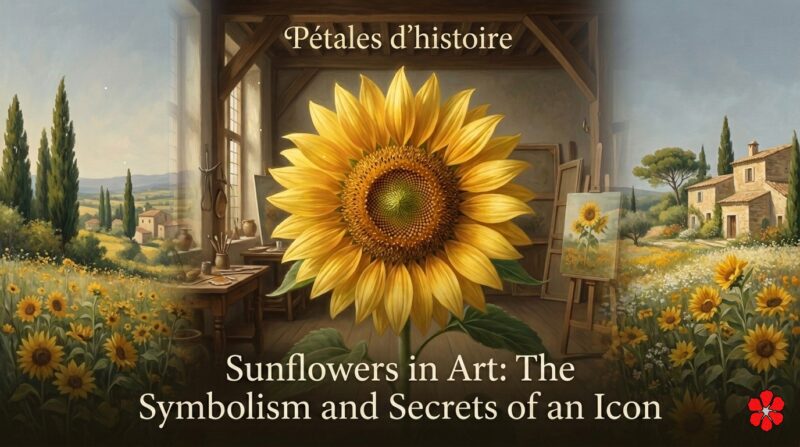
IN THIS GENERAL-CULTURE ARTICLE, DISCOVER HOW THE SUNFLOWER BECAME ONE OF THE MOST FASCINATING FLOWERS IN THE HISTORY OF ART. FROM FLEMISH WORKSHOPS TO VAN GOGH’S BLAZING CANVASES, THIS SOLAR FLOWER TRAVELED ACROSS CENTURIES TO BECOME AN ICON CAPABLE OF EMBODYING, ALL AT ONCE, LIGHT, THE PASSAGE OF TIME, AND THE EMOTIONAL POWER OF COLOR.
Some flowers belong to nature. Others, rarer, end up belonging to history. The sunflower is one of these. Its radiant silhouette, its immense disc reaching toward the sky, the deep warmth of its golden petals — everything about this flower seems made to hold light and command the gaze. Few plants have exerted a comparable fascination on European artists since the day they first discovered it.
And yet, its rise to glory did not happen overnight. For a long time, the sunflower was no more than a distinguished extra in the great European floral compositions — appreciated, laden with meaning, but rarely the protagonist. It would take until the end of the 19th century, the blinding light of Provence, and the tormented genius of Vincent van Gogh for this flower from the Americas to finally rise to the rank of universal symbol.
How did a bouquet become one of the most recognized images in the history of art? Why does the sunflower today seem inextricably linked to the very idea of light? This is the singular journey we will retrace, from the first Flemish workshops to the walls of the world’s greatest museums.
What the Flower Says to Art
- How a flower from the New World captured the imagination of European artists as early as the 16th century.
- What Flemish painters knew how to read in the sunflower that others could not yet see.
- From still life to emblem: the sunflower as a bearer of complex symbolic meaning.
- Van Gogh’s arrival in Arles and the birth of one of the boldest chromatic experiments of the 19th century.
- Why Van Gogh’s Sunflowers speak as much of the human soul as of botanical beauty.
- The transformation of a pictorial motif into a universal visual language.
A Flower Born of the Sun
When the sunflower made its entrance into European gardens in the 16th century, it created an immediate sense of displacement. Its outsized scale, its deep yellow disc, its petals that seem to absorb light rather than reflect it — nothing about it resembled the familiar flowers of aristocratic flowerbeds.
Long before reaching European gardens, certain civilizations of the New World had already linked it to the image of the sun; in Europe, this solar dimension became the starting point for a fascination that would only keep growing.
Collectors of rare plants, botanists, curious minds of every kind — all seized upon this strange creature from the Americas. But it was among painters that its destiny would truly be decided. For the sunflower possesses a rare quality: it organizes the space around it. In any composition, its immense face acts as a natural focal point, drawing the eye with quiet authority. This ability to dominate a scene without ever seeming forced explains why artists would gradually reserve a place of honor for it. It was not yet a symbol. But it was already a presence.
The Age of the Flemish Painters
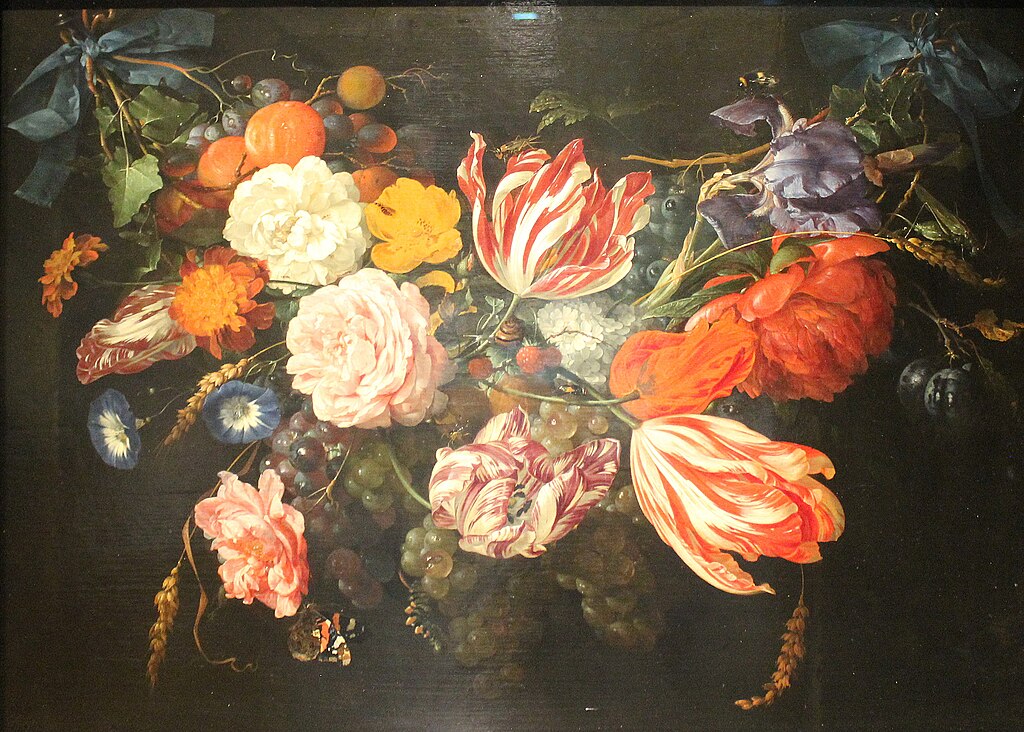
In the 17th century, the Flemish and Dutch workshops experienced a true golden age of floral painting. Artists displayed a bewildering virtuosity: flowers that never bloom in the same season were brought together in impossible bouquets, painted from memory or assembled from successive studies.
Among them, tulips often appeared, having become true objects of fascination in the United Provinces of Holland. We have devoted an entire article to this other muse of European painting: tulips in art.
One flower has just opened; another is beginning to droop; a third is already losing its petals. The whole bouquet becomes a silent allegory of the fragility of all things — what the Flemish called vanitas, which today might be translated as the unavoidable awareness of time passing.
Within this richly symbolic world, the sunflower occupies a singular position: larger than the others, naturally turned toward the light, it concentrates interpretation upon itself. It is credited with fidelity, constancy, a form of devotion that surpasses the simple plant kingdom.
Anthony van Dyck makes this experience tangible in one of his famous self-portraits, where an immense sunflower accompanies his own image. The flower is not mere ornament here: it fully participates in the visual discourse of the work, weaving an implicit link between the artist and the solar body, between the creator and his source of inspiration. By this point, the sunflower was already a symbol. It was not yet a legend.
When a Flower Stops Being a Detail
For more than two centuries after these Flemish golden ages, the sunflower remained a secondary player in European painting. It enriched bouquets, punctuated decor, took its place within symbolic systems — but it rarely became the central subject of a work.
This situation shifted radically at the end of the 19th century, when a Dutch painter in search of an entirely new pictorial language arrived in the south of France intent on reinventing everything.
When Vincent van Gogh landed in Arles in 1888, the light of Provence struck him like a revelation. The sky seemed vaster to him, the colors more intense, the contrasts almost violent. In his letters to his brother Theo, he tried to describe this upheaval: the goal was no longer to imitate reality with precision, but to paint what light makes one feel. Within this ambitious and fragile project, the sunflower would find its leading role.
Arles, or the Dream of Light
Van Gogh was then nurturing a unifying project: turning the Yellow House into a community of artists capable of renewing modern painting. To convince Paul Gauguin to join him, he carefully prepared the room meant for his friend. It was in this gesture of welcome, almost domestic in its generosity, that the Sunflowers were born.
These paintings are not mere wall decorations. They represent an artistic declaration. In painting them, Van Gogh was not seeking to faithfully reproduce a still life: he wanted to embody his vision of painting, one in which color is no longer a tool of representation but a vehicle for direct emotion. To achieve this, he deliberately narrowed his palette to an almost monochrome world of yellows — lemon, gold, chrome, ochre — each shade becoming a different way of capturing the sun.
This pursuit of yellow as an expression of light did not stop with Van Gogh, either. A few decades later, Pierre Bonnard would in turn develop an almost obsessive relationship with solar tones, notably through the mimosas of the Midi, whose luminous blooms would nourish some of his most vibrant works.
In certain versions, the vase, the flowers, and the background seem to merge into a single radiance. Outlines blur, materials dissolve into one another. The sunflower ceases to be a botanical motif and becomes an instrument — a machine for manufacturing light on canvas. Rarely has an artist pushed so far the will to translate the sun through the sheer power of color alone.
The Bouquet as Mirror of the Soul
Bold as this chromatic gamble may be, the Sunflowers cannot be reduced to a purely aesthetic pursuit. They carry a far more intimate dimension. Across the different bouquets Van Gogh painted, some flowers are young and radiant, others already leaning toward decline, still others nearly withered. The entire cycle of existence — birth, blossoming, decline, disappearance — unfolds before the viewer’s eyes within a single frame, with no hierarchy and no commentary.
Many art historians have seen in this coexistence a form of indirect self-portrait. Van Gogh was not painting flowers alone: he was laying down his hopes and his anxieties, his acute awareness of time passing.
The bouquet becomes the silent reflection of an inner life that words — even in his infinitely eloquent letters — sometimes struggled to capture. This may be the secret of their lasting resonance: we go looking for an emotion, and we find a human being.
Gauguin and the Birth of the Myth
By the time Paul Gauguin finally joined Van Gogh in Arles, the Sunflowers already held a central place in the painter’s world. A few weeks after his arrival, Gauguin produced a portrait showing his friend painting his favorite flowers. The image is pivotal: it fixes forever, in collective memory, the association between the artist and his signature motif.
From then on, Van Gogh was no longer simply the painter of sunflowers — he became, almost, their living embodiment. This fusion was so powerful that he wrote to Theo, with an almost childlike conviction: “The sunflower is mine.” Few artists in history have managed such a lasting claim of ownership.
Even today, simply mentioning a painted sunflower is enough to summon his name instantly — even before the Latin name of the genus Helianthus.
When the Flower Becomes an Icon
After the painter’s death in 1890, the Sunflowers began their ascent toward legend. Exhibitions multiplied, reproductions circulated, and museums presented them as foundational milestones of modern art.
Over the course of the 20th century, these bouquets painted in Arles during the creative fever of the summer of 1888 became one of the most recognized images in the world — present in schoolbooks, posters, documentaries, and international exhibitions.
The phenomenon goes far beyond the boundaries of art history. The sunflower acquired the status of a universal visual language, capable of evoking light, creation, and hope all at once. This is one of the most striking singularities of this story: a flower turned an artist into a myth, and that artist turned the flower into a symbol. The cycle is complete, and shows no sign of ending.
A Timeless Muse
From Flemish workshops to the walls of the world’s greatest museums, the sunflower has traveled a singular path. A distinguished extra in 17th-century floral compositions, an emblem laden with symbolic meaning, it became, under Van Gogh’s brush, an image capable of embodying, on its own, light, intensity of gaze, and the fragility of existence. Its story reveals something essential about the relationship between art and the natural world: artists do not represent reality — they transform it.
The sunflower existed long before Van Gogh. But since Van Gogh, we no longer look at the sunflower the same way. And perhaps this is the truest definition of what a masterpiece can achieve: not to reproduce reality, but to re-enchant it for good.
Keep reading
This captivating story is part of our complete anthology on the civilizations and symbolism of the sunflower. Explore our collection of articles to deepen your discovery of its impact on human history and world cultures:
The millennia-long history of the sunflower: follow the great historical and sociological saga of this plant compass, from its Amerindian origins to the far reaches of Tsarist Russia.
The sunflower between ecology and economy: discover how this botanical giant shapes world markets and stands as a major ally of biodiversity and the sustainable transition.
Continue Your Exploration
Immerse yourself in the world of flowers through our various themes and discoveries.
Start ExploringReceive Our Next Discoveries
Subscribe ✉️