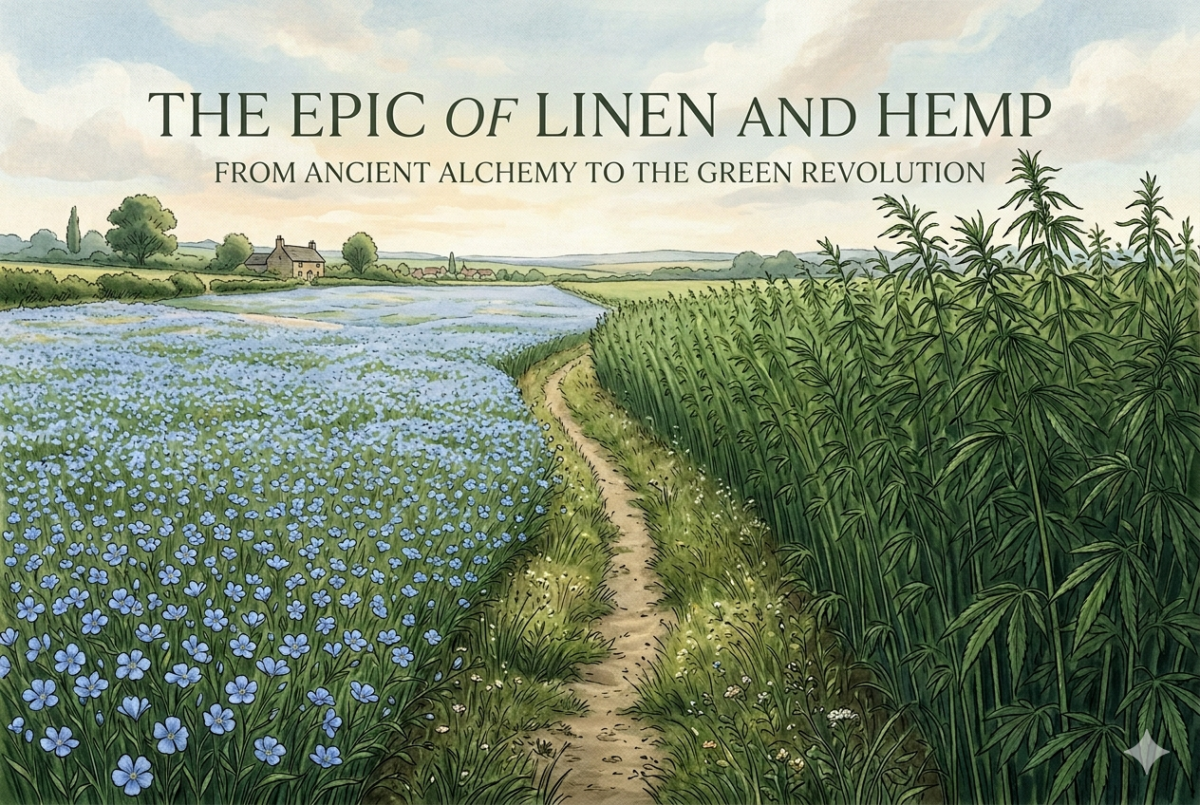
Article on the history of flax and hemp, two major plant fibers from antiquity to the present day.
The text explores their historical, maritime, and industrial uses, as well as their role in green chemistry and soil phytoremediation.
It also covers modern applications in the bio-based industry, construction, food, and cosmetics.
A complete overview linking heritage, ecological innovation, and the sustainable transformation of plant materials.
Imagine slender stalks dancing in the wind, like brushes sketching the contours of a world of softness. Hemp and linen, those refined botanical silhouettes emerging from the earth, carry the silent echoes of millennial secrets.
Far beyond green chemistry—that modern alchemy transforming their fibers into environmental healers—they bear within them the echoes of forgotten tales, ancient civilizations, and the promise of a healthier future.
On Pétales d’Histoire, let us explore their poetic universe, where robustness intertwines with grace, and where Humanity reunites with nature and reason.
The Heart of the Story: A Glimpse into the Journey
- The Breath of the Ancients: From the moonlit veils of Egypt to the sovereign riggings of the Royal Navy, discover how these fibers have woven the very history of humanity.
- Alchemy and Healing: The unsung role of linen and hemp as “doctors of the earth,” capable of purifying soils through the miracle of phytoremediation.
- The Awakening of Green Chemistry: How the molecular structure of these plants is replacing plastic and steel in cutting-edge industries today.
- Economic Symphony: An exploration of France’s position as a global leader at the heart of a sector where ecology transforms into sustainable prosperity.
- Daily Companion: From Haute Couture to the nutritional benefits of their seeds, the art of living viewed through the prism of these exceptional botanicals.
Deep Roots: A Chronicle of Fibers Through the Ages
The Linen of Pharaons: A Veil of Eternity on the Nile.
Picture Ancient Egypt, where linen, as delicate as a moonlit veil, dressed pharaohs and embalmed mummies for eternity. Its fibers, drawn from the blue stalks of the Nile, were a divine treasure, offered by the goddess Isis herself according to myth.
In the lands of France, particularly upon the plateaus of Normandy, linen has long been dubbed “the blue of the earth.” This poetry veils a singular biological reality: the flax flower is of extreme modesty. It blooms for but a few hours, a fleeting morning’s grace, transforming the landscape into an ephemeral mirror of the sky. As soon as the sun reaches its zenith, the corolla folds and falls, entrusting its destiny to the seed. (For our American readers: This Norman “Terroir” is to linen what Bordeaux is to wine—a unique geological signature that no synthetic process can duplicate.)
This fleeting spectacle reminds us that the beauty of this fiber is a conquest over time, a patience that 17th-century peasants already celebrated as a divine gift.
This chromatic nobility of linen—the true “blue gold” of the Norman Terroir—contrasts historically with the darker destiny of its sister. For if linen dresses the light, hemp was long wedded to the depths. To protect the fibers from the onslaught of spray and salt, the ropes of the Royal Navy were impregnated with Norwegian tar, cloaking the riggings in an austere “rope black.” This botanical chiaroscuro tells the duality of our fibers: one seeking the brilliance of finery, the other the resilience at the heart of the storm.
Sovereign Hemp: From Colbert’s Hemp Fields to Maritime Conquests.
Hemp, an intrepid traveler native to Central Asia, sailed the ancient seas: the ropes of Phoenician ships, the sails of Viking explorers, and even the very first paper invented in China over two thousand years ago. Imagine imperial scribes tracing ideograms upon hemp sheets.
This alliance between fiber and spirit reached its zenith at a major turning point in our collective consciousness. When Johannes Gutenberg birthed the printing press in Europe, it was not upon wood pulp, but upon hemp paper that the first movable types were pressed. The Gutenberg Bible, a monument of our intellectual heritage, owes its longevity to the robust fibers of the hemp field, proving that hemp served not only to conquer oceans but also to anchor human thought in the eternity of paper.
This robustness made hemp the sinew of war and exploration. Under the impetus of Colbert, Louis XIV’s Royal Navy elevated this plant to a state priority. A single first-rate ship required dozens of miles of rope and thousands of square yards of sailcloth, all born from hemp stalks. (Note for our American readers: These very French sails once crossed the Atlantic to support the quest for Independence, weaving a historical bond between our shores and the American spirit of liberty.)
Throughout the centuries, they have inspired artists and poets alike. Van Gogh captured the shimmering light over the linen fields of Provence, while folk tales whisper of magical spinners transforming hemp into spun gold.
Today, these historical roots remind us that hemp and linen are not merely crops: they are living chronicles, bridging our ancestral past with our modern quest for harmony.
The Dance of Green Chemistry: When Science Heals the Earth
In the context of green chemistry, where we seek to draw pollutants from the soil, hemp and linen work with undeniable elegance.
Phytoremediation: Botanical Genius Serving Bruised Soils.
Their metabolism extracts heavy metals with gentle naturality. The retting of linen—immersion in calm waters or exposure to the morning dew—releases its fibers without wounding the planet.
This purifying virtue is no mere flight of fancy. Hemp acts as a true “doctor of the earth” through the process of phytoremediation. Its power is such that it was chosen to heal the scarred soils around the Chernobyl power plant.
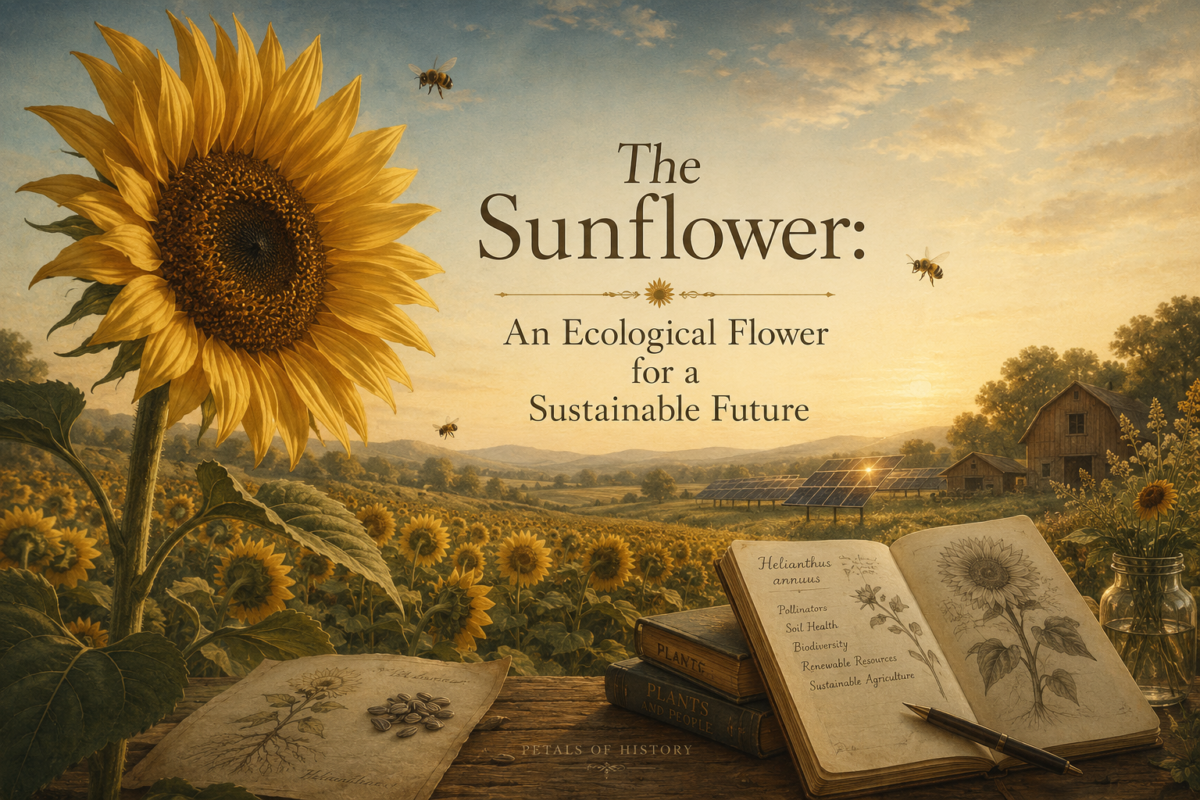
In this same approach to soil decontamination, sunflowers used in phytoremediation of polluted soils also play a key role in absorbing contaminants present in the ground.
Linen, though more delicate, participates in this alchemy by restructuring soil porosity, proving that these fibers, before clothing our bodies, have the primary mission of healing humanity’s nurturing cradle.
For hemp, natural enzymes or ultrasonic waves accelerate the magic, saving water and energy. In France, the cradle of these innovations, local factories produce recycled treasures through a circular economy.
Other species, such as iris for soil regeneration and stabilization, also play a role in the natural restoration of depleted land.
The Alchemy of the Petal: From Bio-sourced Polymers to Cutting-edge Industry
These fibers transform into bio-sourced materials. In the automotive and aerospace industries, linen reinforces composites that lighten vehicles, reducing the energy needed for travel and thus lowering pollutant emissions. Hemp, with grace and strength, creates rigid panels for vehicles.
In construction, hempcrete—a union of shives and lime—creates breathable walls, guardians of moisture and heat, while linen mats provide thermal and acoustic insulation for roofs.*
Hemp shiv (or hurd) refers to the woody and fibrous part of the hemp stalk, located inside the bark after the outer fibers have been removed. It is a light, porous material rich in cellulose, often used as natural insulation in green building.
In Vendée, a factory already offers these industrial secrets, transforming construction sites into ecological works of art.
A Renaissance Economy: France, Garden of Innovation
The Green Gold of the Territories: Global Leader and Local Sovereignty.
In Europe, France leads the dance: the world leader in linen and third in hemp. In Normandy and Vendée, factories and farmers create green jobs, reshoring industry. Projects like France 2030 fund these dreams with grants for natural geotextiles.
Challenges and Bright Horizons.
Yet, clouds loom: climate variability, high costs. But the future shines. With record-breaking cultivated areas in 2025, these plants offer a radiant future to the bioeconomy.
Nourishment for Soul and Body: A Holistic Art of Living
Flavors and Health: The Golden Pearls of Plant Nutrition.
Hemp and linen do not merely build our dwellings; they nourish our vital forces. Flaxseeds, golden pearls rich in Omega-3, bring a note of sovereign health to our tables, acting as a healing balm against inflammation. Hemp, with its protein-rich seeds and emerald-tinted oils, inspires modern vegetarian cuisine, from velvety milks to energetic nectars.
The Alchemy of Care: Cosmetics and Traditional Medicine
In the secret of the boudoir, these plants become beauty elixirs. Flaxseed oil, rich and penetrating, hydrates thirsty skin, while hemp oil soothes the most delicate epidermises. This wisdom is not new: ancient Greek physicians already used linen to dress wounds. Today, science is rediscovering the soothing virtues of industrial hemp extracts for the nervous system, offering profound calm without the torments of psychotropics.
Sustainable Elegance: Linen in the Wake of Haute Couture.
Culturally, these fibers weave social bonds and self-expression. Linen, noble and breathable, inspires the masters of Haute Couture. French stylists are now rediscovering the grace of its fluid drapes, proving that one can clothe the body in a fabric that respects the skin as much as the earth. (The “noble wrinkle” of French linen is a mark of prestige—a sophisticated nonchalance that sets it apart from the rigid perfection of synthetic fibers.)
Gifts to Nature: Fixers of Dreams and Carbon.
These plants are environmental magicians. One hectare of hemp fixes up to 15 tons of CO₂ per year. They drink little water—far less than thirsty cotton—and repel pesticides, leaving soils fertile and bees free to pollinate. In crop rotation, they regenerate the earth, fighting erosion like roots anchored in hope.
In bio-sourced chemistry, they offer biomolecules: green epoxy resins from hemp for biodegradable packaging, or lignin from linen for toxin-free paints. Projects like SSUCHY in 2025 are working on structural composites, while the European Alliance for Flax and Hemp, at JEC World, unveils automotive innovations. In France, France 2030 funds these dreams with grants for natural geotextiles.
Poetic Comparison: Two Complementary Souls
Hemp, a swift and sturdy giant, grows in varied soils, offering fibers for industrial challenges. Linen, more delicate, blooms in temperate climates, such as Brittany, offering its strong and light fiber to textiles and fine composites. Together, they compose a harmonious duo: little water, zero pesticides, with hemp sequestering more carbon and linen dominating the markets. No rivalry, but an alliance, like earth and sky united.
The story doesn’t end with this petal…
A new path now opens before you: one that expands the theme of flowers into science, technology, and economics.
Continue Your Exploration
Immerse yourself in the world of flowers through our various themes and discoveries.
Start ExploringReceive Our Next Discoveries
Subscribe ✉️