
There are fragrances that refuse to be tamed. The scent of the violet is a mystery that plays with our senses: no sooner have we inhaled it than it seems to vanish, leaving behind only a trail of pensive nostalgia. This small mauve corolla, which bows its head with a feigned modesty, is nevertheless a giant of history. It has financed industries, marked the rise and fall of empires, and healed generations. Welcome to the universe of Viola odorata—a flower whose discretion is but a mask for an unsuspected power.
The Essential Harvest:
- Biological Enigma: A flower that “anesthetizes” the sense of smell through ionone to ensure it remains a constant object of desire.
- Imperial Emblem: The secret rallying sign of Napoleon Bonaparte and the intimate garden of Empress Joséphine.
- Mauve Gold: A 19th-century economic powerhouse, driven by the legendary “Violet Train” and the fields of Toulouse.
- Transatlantic Muse: From the “Violet Capital” of Rhinebeck, NY, to the soul of the iconic Aviation Cocktail.
- Language of Flowers: The universal ambassador of modesty, fidelity, and secret devotions.
- Art de Vivre: From the apothecary’s jar to the tables of kings, a flower of a thousand gastronomic and cosmetic virtues.
The Enigma of the Senses: When Science Explains the Mystery
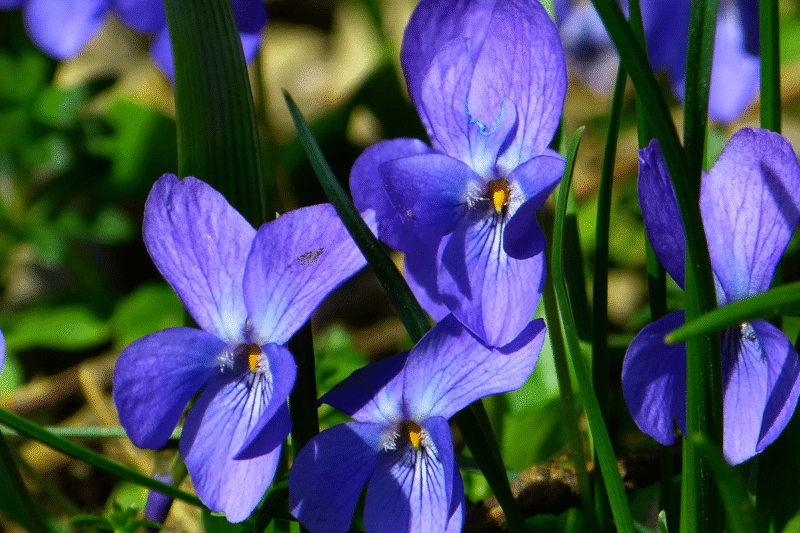
Before it was a symbol, the violet was a biological marvel. If you lift a bouquet to your nose, you will smell a burst of powdered paradise, then… nothing. It is not the flower that ceases to scent; it is your brain that no longer perceives it.
Science has lifted the veil on this phenomenon: the violet contains ionone. This molecule possesses the fascinating property of instantly saturating our olfactory receptors. It momentarily numbs the sense of smell. Thus, the violet is the only flower that offers itself intermittently, forcing us to long for it in order to rediscover it. It is a lesson in patience written into its very chemistry.
But its genius does not stop there. To ensure its survival, it developed a strategy botanists call cleistogamy. In the spring, it offers colored flowers to attract insects. But in the summer, it produces, in the secrecy of the soil, “closed” flowers that self-fertilize without ever seeing the light. The violet is prudent: it does not entrust its entire destiny to the whims of the wind or the bees.
The Breath of Olympus: A Sacred Birth
If science explains its perfume, mythology sings of its origin. In the garden of ancient legends, the violet is often born from a metamorphosis or a divine stir. The Greeks told of the nymph Ianthe, who, to escape the burning advances of the god Apollo, was changed by Diana into a small, discreet flower hidden in the shadows of the thickets. She thus became the symbol of virtue retreating from a light too harsh.
Another legend, more tender, links the flower to Ion, the mythical founder of Athens. To nourish him, nymphs were said to have caused violets to spring from the earth—the Greek name (ion) still paying homage to this royal lineage. In Athens, the “violet-crowned city,” the flower was sacred, adorning altars and banquets.
The Romans, heirs to this cult, believed its fragrance could dispel the vapors of intoxication. Drinking violet wine was not merely a gourmet pleasure, but a ritual to keep the mind clear—anchoring the flower in an art de vivre where the sacred and the profane mingled under the sign of temperance.
The Epic of Mauve Gold: A Forgotten Economic Power
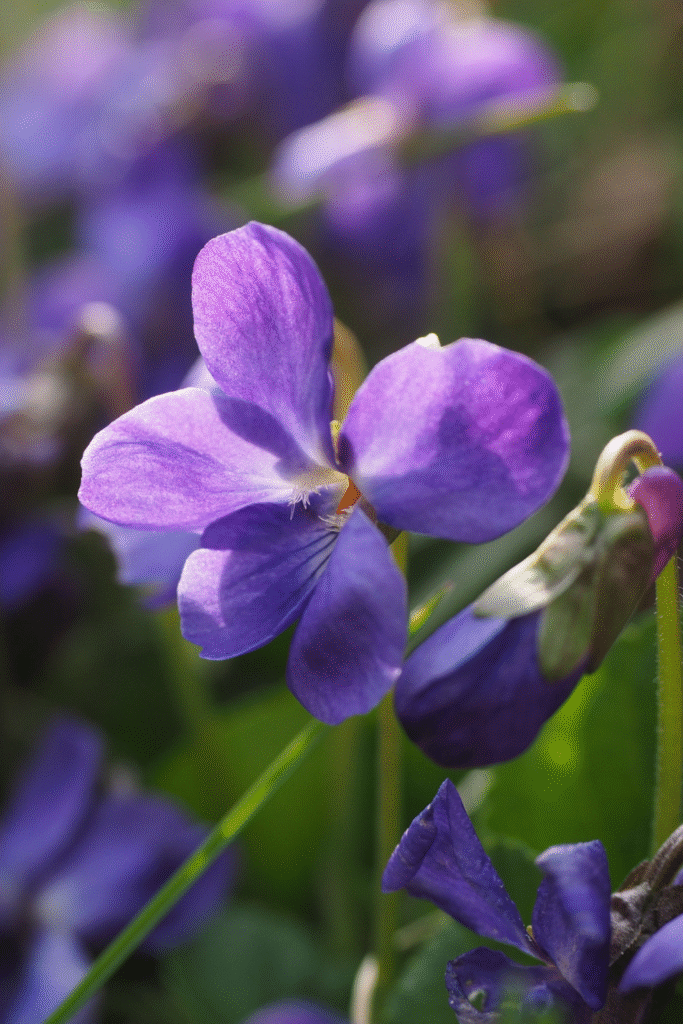
Though we might pick it today at the bend of a path, the violet was, at the end of the 19th century, the engine of a flourishing economy. It was not a mere gardener’s hobby, but “mauve gold” that sustained entire regions.
In Toulouse, the “Parma Violet,” introduced under Napoleon III, became a prestige industry. There were no fewer than 600 producers in the city’s market-gardening zone. Every morning, the “Violet Train” departed for Paris, London, or Berlin, carrying thousands of small round bouquets, carefully protected by a leaf of ivy. This heritage is still celebrated today during the Fête de la Violette de Toulouse, where living history meets horticultural tradition.
Across the Atlantic, this French passion sparked an American obsession. At the turn of the century, Rhinebeck, New York, became the “Violet Capital of the World,” shipping millions of blooms to New York City’s elite during the Gilded Age—a true “French Touch” in the buttonholes of the Astors and Vanderbilts.
In the South of France, in Hyères or Tourrettes-sur-Loup, the harvest—strenuous and meticulous—was primarily the work of women. This “economy of delicacy” forged the identity of the Midi, creating a unique expertise in transforming the flower into confectionery or perfume. Today, violet leaf absolute remains one of the most expensive ingredients in high perfumery, providing that “earthy green” note to iconic fragrances such as Dior’s Fahrenheit.
The violet was the emblematic perfume from the end of the 19th century until the 1940s-1950s, corresponding to the generation of our great-grandmothers or grandmothers.
A Scent of “Bon Genre”
At the Belle Époque, the violet was the pinnacle of refinement. Unlike musk or amber, judged too carnal or “scandalous,” the violet symbolized modesty, humility, and shyness. It was the fragrance of the “proper” woman: discreet, powdery, and floral.
In collective memory, grandmothers are often associated with this scent. Jean Patou occupies a special place in this nostalgia, using the violet not as a simple pleasure, but as an element of high sophistication. When we think of Patou and the violet, we immediately think of his 1972 masterpiece: “1000.” Others have used it with genius, such as Roger & Gallet (Violette de Parme, Vera Violetta 1892) and Yardley (April Violets).
The Emperor’s Flower: The Destiny of Napoleon
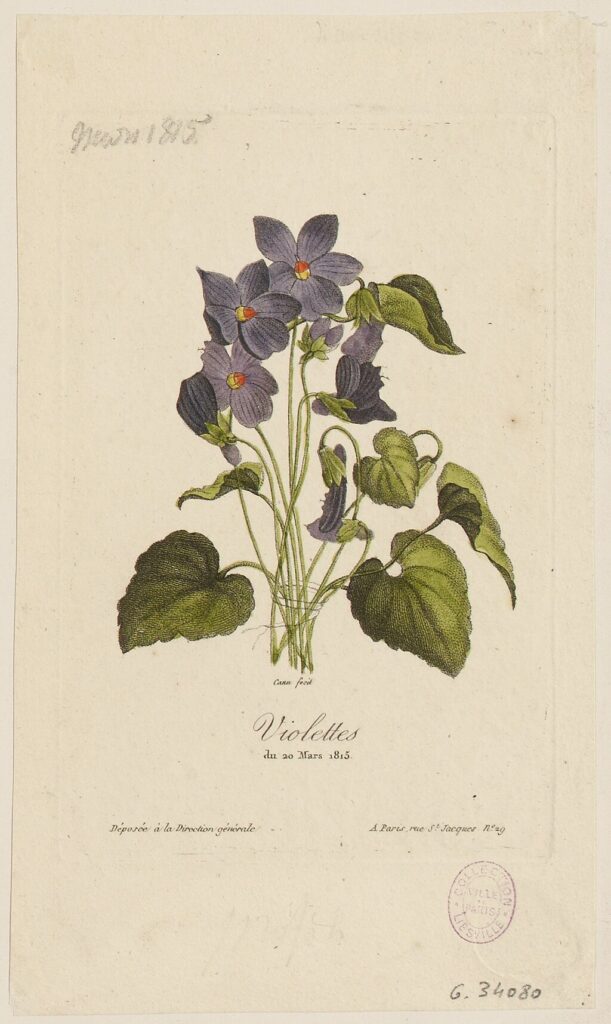
The history of the violet is engraved in the marble of the Empire. For Napoleon Bonaparte, it was more than a flower: it was a political rallying cry.
In 1814, as he departed for exile on the Island of Elba, he promised his supporters he would return “with the violets.” From then on, the flower became the secret code of the Bonapartists. Wearing a violet in one’s buttonhole under the Restoration was an act of sedition—a silent message of resistance. The Emperor was nicknamed “Le Père La Violette” (Father Violet).
This passion was shared by Joséphine de Beauharnais. In her gardens at Malmaison, she cultivated rare varieties, making the violet the fragrance of her intimacy. It is said that Napoleon, at his death on St. Helena, wore a locket containing a few dried violets picked from the grave of his beloved Empress. The flower, a symbol of fidelity, thus closed the cycle of a love broken by reasons of State.
The Language of Flowers: The Code of the Heart
In the hushed salons of the 19th century, one did not speak of love aloud; one flowered it. The violet was the cornerstone of this silent dictionary of sentiments. Offering a violet is an admission of profound modesty; it is the flower of the one who steps back.
- The Secret Lover: Tucked into a letter or a glove, it allowed for the declaration of a flame that social conventions would have smothered. It is the murmur of noble sentiments that do not need glitter to exist.
- The Blue Violet: The symbol of eternal fidelity. It says: “I will always be there, in the shadow of your days.”
- The White Violet: Evokes joyful innocence, a pure and candid happiness.
A Muse of Art and Poetry
Poetry is to the violet what dew is to the petal: a setting that magnifies its beauty. Poets have always seen in it the mirror of the human soul, oscillating between fragility and resilience.
In France, Marceline Desbordes-Valmore, the tender voice of Romanticism, often used the violet as a metaphor for “sweet pain.” In her verses, the flower becomes a confidant for tears shed in secret. The English poet William Wordsworth celebrated it as “A violet by a mossy stone / Half hidden from the eye! / —Fair as a star, when only one / Is shining in the sky.”
In visual arts, the violet is inseparable from the Belle Époque. It adorns the posters of Mucha and is embroidered onto the bodices of Renoir’s elegant subjects. It embodies a reaction of finesse against the burgeoning brutality of the industrial age.
“The violet, deep in the woods, hides its sweet scent, its voice; but its silence is a mystery that speaks to the heart and penetrates it.” — Marceline Desbordes-Valmore
« La violette, au fond des bois,Cache son doux parfum, sa voix ;Mais son silence est un mystèreQui parle au cœur et le pénètre. »— Marceline Desbordes-Valmore
Art de Vivre: From the Apothecary to the Table
The violet does not merely flatter the soul; it tends to the body. Since antiquity, it has been a precious “simple” in the apothecary’s garden.
- The Healer: Rich in mucilage, it soothes irritated throats. Its syrup is an ancestral remedy for dry coughs. Rich in salicylic acid, it was long used to calm migraines.
- The Gourmet: The crystallized violet of Toulouse is a culinary jewel. But contemporary art de vivre is rediscovering its fresh flowers for garnishing salads or its young leaves, rich in Vitamin C, which bring a forest-undergrowth note to soups. In the world of mixology, the Aviation Cocktail (1916) remains its most sophisticated tribute.
- Cosmetics: Violet-scented rice powder is the emblem of retro glamour. Its powdery scent remains the top note of the most prestigious lipsticks, linking the flower to the image of classic femininity.
Explore our themes through the “Flower Collection” tab, or return to the heart of our world:
GatewayThe Collector’s Inquiries: Whispers and Wonders of the Violet
Why does the violet’s fragrance seem to disappear so quickly?
It is a delightful paradox of botanical science. The violet contains ionone, a molecule that momentarily desensitizes your olfactory receptors. This “scent of hide-and-seek” ensures that the flower is never common; it forces you to wait and desire its return, making every breath a rediscovered treasure.
How did a simple flower become a symbol of the Napoleonic Empire?
Beyond its beauty, the violet was a political cipher. Upon his exile to Elba, Napoleon promised his followers he would return with the spring violets. Wearing the flower became a clandestine sign of loyalty—a silent, mauve rebellion pinned to a buttonhole against the backdrop of the Restoration.
What is the difference between the wild violet and the Violet of Parma?
While the wild Viola odorata graces our woodlands, the Parma Violet is a more sophisticated, multi-petaled variety with a richer, more powdery scent. Introduced to France in the 19th century, it became the “Mauve Gold” of Toulouse and the cornerstone of the world’s most prestigious perfumes.
Can violets really be used in high-end mixology and cuisine? Absolutely. From the historic Aviation Cocktail
created in 1916 to the crystallized petals of French confectionery, the violet offers a sophisticated, floral note. Its young leaves are also a secret of the “Art de Vivre,” bringing a fresh, Vitamin C-rich touch of the undergrowth to contemporary salads.