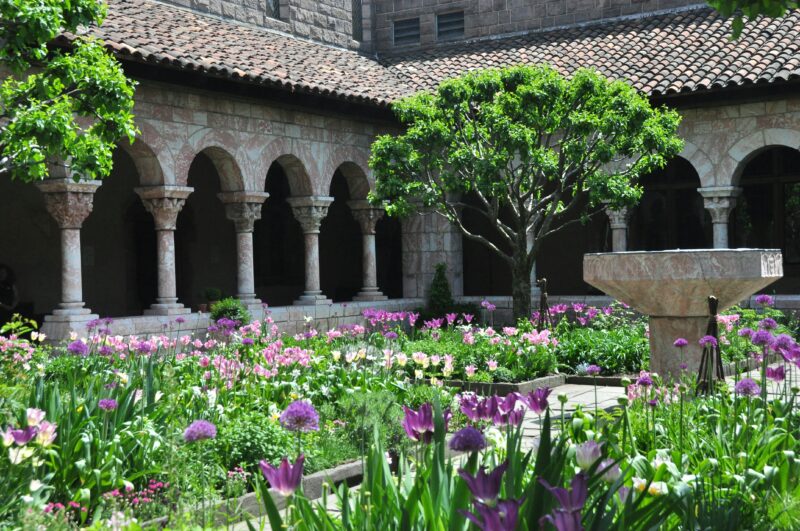
Imagine a morning of frost and incense, where the monks’ chant evaporates between the columns of a cloister. Beyond the gray stones, a world awakens in silence: this is the sacred enclosure, a mirror of Paradise where every corolla is a prayer and every scent a remedy. In the Middle Ages, a flower was never a mere ornament; it was the Word incarnate within the earth.
To step through the gate of these gardens is to enter a universe of symbols where the rose tells of passion, the lily whispers of purity, and “simples” heal the torments of the soul as much as those of the body. Let us journey together toward this botanical golden age, where the hand of man and the grace of nature moved as one.
At the Heart of the Enclosure: The Pathways of Your Exploration
- The Sacred Enclosure: How the garden became a metaphor for paradise regained.
- The Simples and the Sacred: The role of monastic pharmacopoeia in healing both soul and body.
- Hildegarde and Viriditas: The botanical visions and life force of an extraordinary abbess.
- The Art of the Table and the Court: When petals invited themselves to feasts and courtly love.
The Sacred Enclosure: Monastic Gardens as an Earthly Paradise
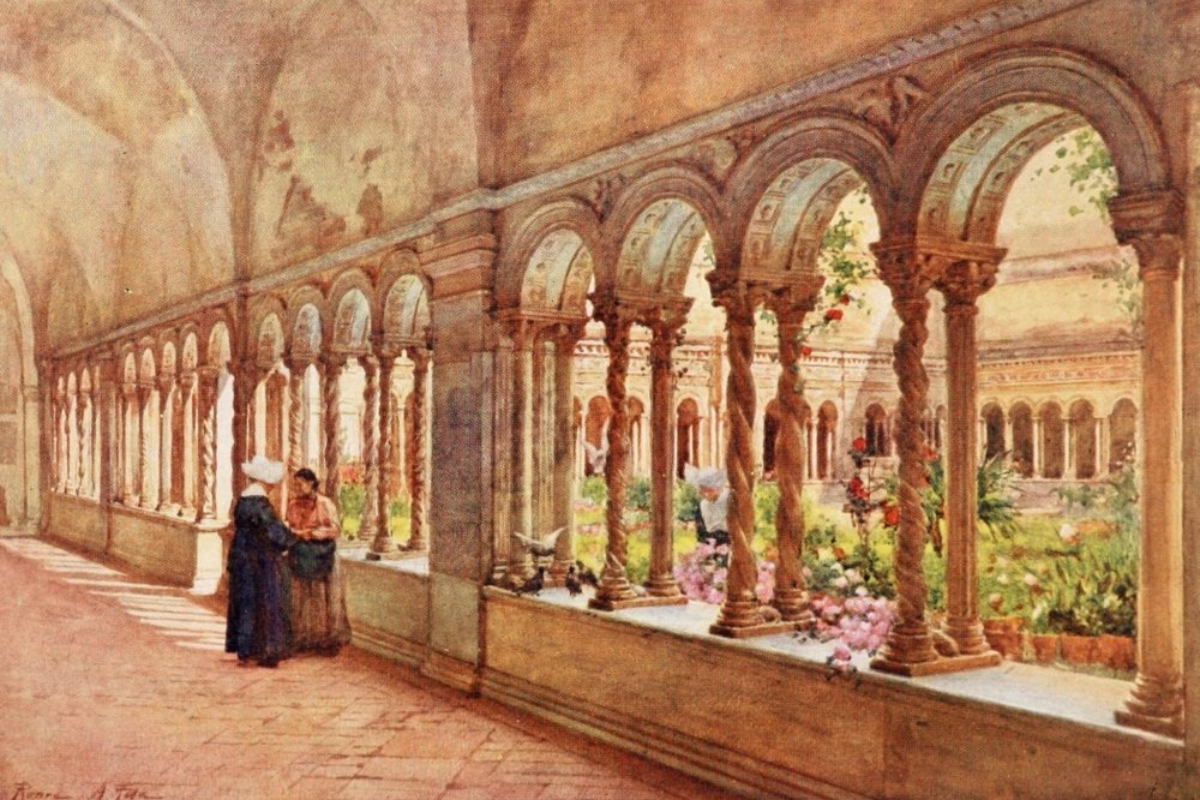
At the heart of the monasteries, the hortus conclusus, or enclosed garden, was a sacred space. Bound by walls, it evoked Eden—a place where man could rediscover divine harmony. Monks cultivated plants with meticulous care, following precise blueprints such as the Plan of Saint Gall (9th century). This famous layout, inspired by Charlemagne, depicts a garden divided into orderly squares: vegetables, medicinal herbs, and an orchard. Every plant had its place, its purpose.
This rigorous organization was far from accidental. It drew its source from the Capitulaire De Villis, a visionary decree by Charlemagne. Like a poet-legislator, the Emperor drew up a list of seventy-three herbs and flowers—lily, rose, sage, or fennel—that were mandatorily required to bloom across the royal estates. Through this gesture, the flower became an institution, a fragment of divine order cultivated upon the lands of the Empire.
These gardens were not merely utilitarian. Their geometry, often in the shape of a cross, symbolized faith. Roses and lilies, planted near chapels, recalled the Virgin Mary, while vine trellises offered shade and a place for meditation. At the center of these green squares often stood a fountain or a well. More than a simple relief for thirsty roots, this living water symbolized the “Source of Life,” Christ nourishing the four corners of the world. The garden thus became a microcosm—a small, enclosed universe where the murmur of water answered the silence of the petals.
Viriditas: The Green Breath of Hildegarde von Bingen
At the heart of this medieval philosophy beat the concept of Viriditas, or “greenness.” For the scholars of the era, and most notably for the Abbess Hildegarde von Bingen, Viriditas was not merely a color but a divine life force infused into every plant cell. It was the sacred breath that allowed the seed to pierce the earth and the flower to heal mankind. This “greenness” was the carnal link between Creation and the Creator—a radiant health that the gardener was tasked to protect.
The Bridge of Centuries: From Cloisters to Parsonages
Though the age of cathedrals has faded, the soul of the sacred enclosure did not vanish; it simply climbed over the monastery walls to settle in the heart of the villages. It is here that the medieval legacy finds its most touching continuation.
The Parsonage Gardens: A Medieval Legacy Serving the Village
Emerging in the 18th century but inspired by medieval monastic gardens, the “jardins de curé” (parsonage gardens) flourished near French rectories, extending the spirit of the hortus conclusus. These rustic gems gracefully blend the practical with the sacred: heirloom roses and lilies for the altars, alongside sage, calendula, and borage for healing. Bound by boxwood or lavender, their teeming beds host vegetables, fruits, and flowers like nasturtiums, known for their peppery bite.
Designed for the rectory’s self-sufficiency, these gardens nourished the priest and his household, yet their generosity extended to the villagers: medicinal plants, turned into infusions or ointments, relieved the fevers and wounds of the most destitute. A delightful anecdote: a vine was often grown there for “altar wine,” linking the earth directly to the liturgy.
Modest yet vibrant, these gardens perpetuate a medieval heritage born in cloisters like that of Saint Gall, where nature sings of faith and solidarity.
Hildegarde von Bingen: The Visionary of Plants
In the 12th century, Hildegarde von Bingen, a German abbess, illuminated the history of medieval gardens. A mystic, musician, and botanist, she saw a divine gift in every plant. In her work Physica, she described the virtues of flowers and herbs with a rare poetic touch. Sage strengthened the body, St. John’s Wort dispelled darkness, and lavender soothed the soul.
Hildegarde experimented within her monastic gardens, transforming plants into remedies, incense, or spiritual symbols. She wrote that the rose, with its soft petals, healed broken hearts as much as it did fevers. Her knowledge, shared with her nuns, makes her a pioneer whose recipes continue to inspire modern herbalists today.
Medicinal Flowers: A Living Pharmacy

Monastic gardens were green pharmacies. Medicinal flowers reigned supreme: sage relieved sore throats, yarrow healed wounds, and calendula soothed burns. Guided by writings such as those of Hildegarde, monks prepared infusions, ointments, and syrups. A charming anecdote: St. John’s Wort, gathered on St. John’s Day, was hung on doors to repel evil spirits.nguents et sirops. Une anecdote charmante : le millepertuis, cueilli à la Saint-Jean, était suspendu aux portes pour repousser les mauvais esprits.
These gardens were also schools. Novices learned to identify plants and harvest them at dawn, when their fragrance was purest. Flowers were not merely beautiful: they healed, comforted, and served as a reminder of nature’s generosity.
Edible Flowers: A Touch of Poetry on the Plate
Medieval flowers were eaten too! Rose petals, mixed with honey, created refined desserts for banquets. Nasturtiums, with their peppery bite, seasoned dishes, while borage brought a fresh note to salads. Hildegarde praised borage for “warming the heart.” In monastic kitchens, these edible blossoms added color and meaning, celebrating creation even upon the dinner plate.
A touching anecdote: in certain convents, the nuns would scatter rose petals across the chapel floors, creating an ephemeral carpet to honor the saints. These simple gestures transformed the flowers into messengers between the earth and the heavens.
Edible Flowers: A Touch of Poetry on the Plate
Medieval flowers were eaten too! Rose petals, mixed with honey, created refined desserts for banquets. Nasturtiums, with their peppery bite, seasoned dishes, while borage brought a fresh note to salads. Hildegarde praised borage for “warming the heart.” In monastic kitchens, these edible blossoms added color and meaning, celebrating creation even upon the dinner plate.
In monastic kitchens, these edible flowers added both color and meaning, celebrating creation even upon the plate.
A Glimpse into Noble Gardens
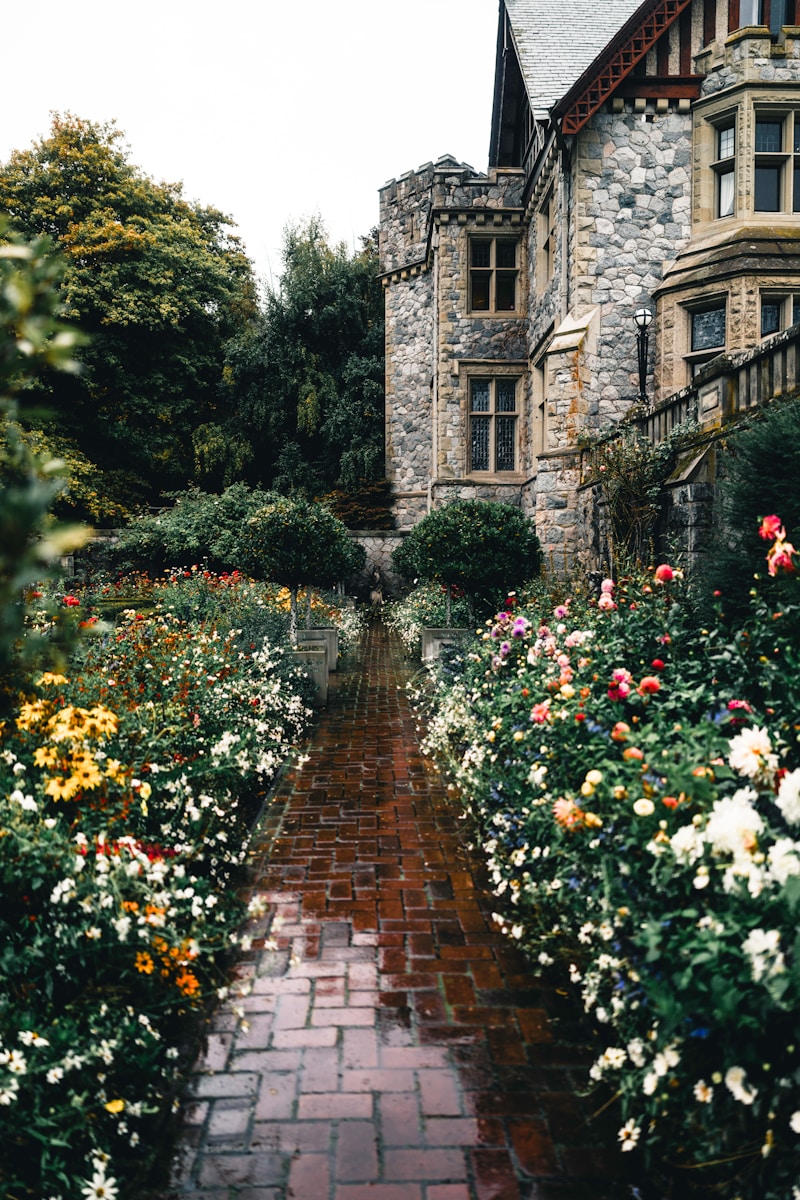
While monastic gardens were spiritual havens, noble gardens shone with prestige. Within castles, rosebushes and carnations scented the walkways, surrounded by fountains and trellises. A famous anecdote tells of the Count of Champagne, Thibaut IV, composing poems under a rose pergola, inspired by their brilliance. Less sacred but equally enchanting, these gardens shared an aesthetic kinship with the gardens of Persia.
In the intimacy of castles, it was also customary to create “flowery meads,” living tapestries that poets called mille-fleurs. Upon these carpets of fine grass, daisies, violets, and wild strawberries were intentionally allowed to grow. It was there that the ladies of the court, seated on turf benches, listened to the verses of troubadours, while the scents of carnation and marjoram wove an atmosphere of dreams and courtly love.
History does not end with this single petal… A new path now unfolds before you: continue your journey by exploring the destinies of other gardens that have shaped our world.
A Flowering Legacy
From the cast shadows of thousand-year-old cloisters to the humble gates of rural parsonages, the legacy of these gardens reaches us like a distant yet persistent echo. Under the imperial impulse of Charlemagne and through the inspired pen of the Sibyl of the Rhine, the flower ceased to be a simple ornament and became a living poem, where the sacred is written in petals and healing is found in roots.
These verdant enclosures—distant heirs to the Persian oases where water and shade defied the desert—have acclimated to our lands and our souls. They remain today a testament to a time when humanity did not merely cultivate the earth, but sought, between two rows of lilies, to cultivate its own eternity.
Explore our themes through the “Flower Collection” tab, or return to the heart of our world:
GatewayEchoes of the Garden: Frequently Asked Questions for the Curious Soul
Why were medieval gardens always enclosed?
The Hortus Conclusus was not merely a protection against the wild world; it was a symbol of purity. To the medieval mind, stepping through the garden wall meant leaving chaos to enter a “Paradise on Earth.” This quest for an intimate sanctuary still inspires our secret gardens and meditation spaces today.
Who was Hildegarde von Bingen and why is she a botanical icon?
Known as the “Sibyl of the Rhine,” this 12th-century abbess revolutionized our view of plants with her concept of Viriditas (green power). She saw flowers not just as remedies, but as sources of spiritual energy. Her legacy is now the foundation of modern holistic herbalism..
What is a “flowery mead” or “Mille-fleurs” style?
It is the medieval ancestor of our wild meadows. In castles, carpets of fine grass sprinkled with violets and wild strawberries were created for the court’s leisure. This style captured wild beauty in famous tapestries and remains the ultimate inspiration for those desiring a natural, poetic garden.