Through the fascinating history of seeds, this text explores how a single seed has shaped civilizations, scientific knowledge, and our relationship with the living world. It examines the biological mechanisms of germination, the remarkable strategies seeds use to disperse, their role in exchanges between empires, the rise of the seed industry, and the contemporary challenges of preserving biodiversity. Blending scientific discoveries, historical narratives, and reflections on the future of life on Earth, this content offers an accessible and engaging perspective on a subject at the crossroads of nature, history, and human societies.
What Seeds Tell Us About Our Past and Our Future
- Why Can Some Seeds Remain “Dormant” for Decades Before Coming Back to Life?
- How Do Wind, Water, Animals—and Even Fire—Help Plants Conquer the World?
- How Have Seeds Served as Instruments of Power, Trade, and Influence Among Nations?
- How Has Plant Breeding Transformed Gardening into a Global Industry?
- Why Did Some Scientists Choose to Starve Rather Than Eat the Seeds They Were Protecting?
- What Are the Massive Seed Banks Built to Safeguard Humanity’s Future For?
- What If Planting a Single Seed Were Also a Way of Preserving Memory and Preparing for the Future?
There is sometimes very little separating nothingness from a garden in full bloom. A seed, for example. Small, dry, almost insignificant. It fits between two fingers, rolls easily across the palm of a hand, and can disappear into the fold of a piece of paper. You could drop it without even noticing. And yet, inside that tiny shell lies a mechanism of astonishing precision: roots, stem, leaves, colors, fragrances—everything is already there, waiting.
Perhaps that is what makes seeds so fascinating: they are both ordinary objects and extraordinary promises. But to truly understand what a seed represents, we need to step back for a moment. A seed is not merely the beginning of a plant. It is also an object shaped by history. Seeds have traveled, been traded, protected, selected, and sometimes even sacrificed. Behind every seed lies a human story. And that story begins in an unexpected place: silence.
Suspended Time: When Life Slows Down Without Disappearing
Before it is cultivated, sold, or collected, a seed is first and foremost a biological marvel. Its secret can be summed up in a single word: dormancy. Contrary to what one might assume, a seed is not dead. It is simply living in slow motion, its internal activity reduced to the bare essentials, as if it were holding its breath. Specialized molecules protect its cells, stabilize its structures, and prevent damage caused by dehydration. It waits. It waits for the signal.
For a seed to germinate, it requires a precise combination of conditions. Nature has built chemical and physical safeguards into the seed to ensure that a plant does not emerge in the middle of a deadly winter.
Some seeds, known as photoblastic seeds, require light and will never germinate if they are buried too deeply, while others demand complete darkness. Still others require a period of freezing temperatures—a process known as stratification—to break their chemical dormancy.
Some seeds even need to be damaged before they can sprout. Their protective coats are so tough that they must first be weakened by erosion, cold weather, or passage through an animal’s digestive tract. Then there are the strangest seeds of all: those that wait for fire.
The cones of the Giant Sequoia and many Australian Proteaceae species are sealed with a resin that only the heat of a wildfire can melt. Without fire, there is no germination. This phenomenon is known as serotiny—the remarkable ability to make destruction itself a prerequisite for life. Some seeds emerge only from the ashes.
This phenomenon is explored in greater detail in our article on the mimosa tree.
Nature has built in a simple rule: a seed does not sprout the moment it can. It sprouts when the conditions for survival are in place. And it is precisely this ability to wait that allows seeds to travel the world. Because a seed, despite appearances, is never truly still.
The Engineering of Dispersal: Conquering the World Without Moving
Since plants cannot walk, flowers have turned their offspring into an army of specialized travelers. Dispersal is a necessity: if all seeds were to fall at the base of the parent plant, they would compete with and ultimately smother one another.
Some seeds rely on the wind—a strategy known as anemochory. The dandelion, for example, uses its silky parachute to catch even the slightest thermal updraft and travel for miles, while the linden tree produces winged bracts that send its seeds spinning through the air like tiny natural gliders.
Others take the strategy even further. The tumbleweed of the American deserts—the iconic rolling shrub made famous by Western films—actually breaks away from its own roots once it has dried out. The wind then carries it for miles across the arid plains, scattering seeds along the way. At that point, it is no longer the seed that travels—the entire plant becomes its own vehicle for dispersal.
Others prefer water as their means of transport. The seed of the sea daffodil can drift on the waves of the Mediterranean for months without losing its ability to germinate. Still others travel as stowaways, clinging to fur or feathers with tiny hooks. It was by studying the burrs of the burdock plant that Swiss engineer George de Mestral came up with the idea for Velcro in 1941.
And then there is perhaps the most remarkable of them all: the Rose of Jericho (Anastatica hierochuntica), native to the deserts of North Africa and the Middle East. When dried out, it curls into a compact ball, breaks free from the ground, and rolls with the wind for as long as necessary—sometimes for years, even decades.
It opens and releases its seeds only when it comes into contact with moisture. It stops only when it has found what it was looking for. Nature invented it all long before we did—including the art of delivering its cargo to the right place at precisely the right time.
Every seed is a masterpiece of adaptation, shaped by millions of years of evolution to colonize new territories.
The Rose of Isfahan, an emblem of Persian gardens, perfectly illustrates how a flower has traveled across the centuries through the power of its seeds.
When Seeds Carried Empires Across the World
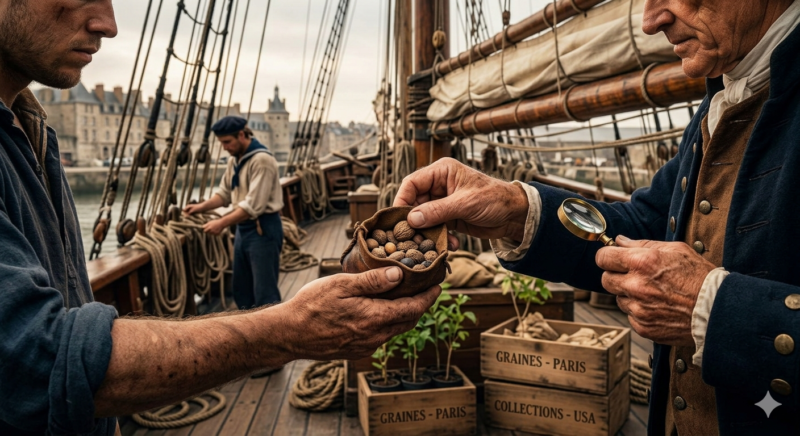
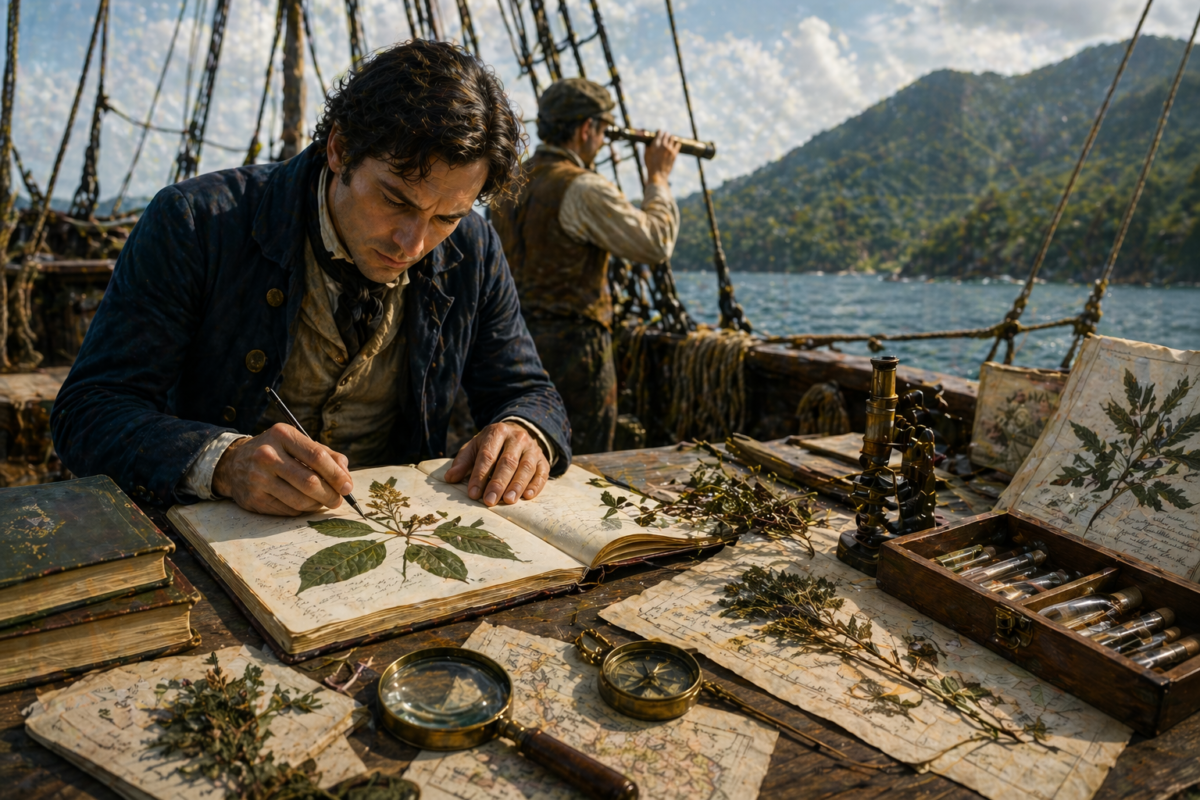
This is where the story becomes deeply intertwined with human history. For centuries, seeds served as diplomatic currency and instruments of power. In the eighteenth century, possessing an exotic seed was much like possessing an industrial secret or a royal treasure.
The most striking example is that of Thomas Jefferson. The third President of the United States was not merely a statesman—he was an obsessive collector and cultivator of seeds. Convinced that “the greatest service which can be rendered any country is to add a useful plant to its culture,” he maintained a discreet correspondence with André Thouin, the head gardener of the Jardin des Plantes in Paris.
While nations were at odds with one another, these two men exchanged bags of seeds across the Atlantic, defying naval blockades. Jefferson thus introduced smuggled Italian rice varieties and European flowers to American soil, while Thouin received wild species from Virginia to enrich France’s national collections. These clandestine exchanges echoed the era of the great plant hunters who worked in the service of empires.
Through these discreet exchanges, the seed became an invisible link, sustaining the universal dialogue of science even as cannons thundered. It carried within it both the ambitions of empires and the curiosity of scholars.
The Birth of an Industry: The Age of Plant Breeders
In the nineteenth century, plant breeding moved beyond empirical practice to become an organized discipline. This marked the rise of major seed dynasties. Companies such as Vilmorin-Andrieux transformed seeds into a structured mass-market product.
No longer did people simply collect seeds—they created varieties. Shapes and colors were stabilized. The marketing of living organisms was born. The seed packet became a promise, often illustrated with striking lithographs. Varieties were listed in catalogs that read like inventories of possible beauty. Selection left the garden and moved into specialized institutions designed to guarantee consistent results.
Standardization and F1 Hybrids
The twentieth century brought a major technological breakthrough with F1 hybrids. By crossing two distinct parent lines, breeders obtain a first generation with exceptional vigor, producing perfectly synchronized flowering—plants across an entire field bloom on the same day and reach the same stem height. It was a revolution for industrial horticulture.
But this performance comes at a cost. The offspring of these hybrids are unstable or sterile. The centuries-old cycle in which gardeners saved their own seeds for the following year is broken. The seed is no longer just a biological beginning—it becomes an annual “software package” that must be repurchased. Selection turns into a managed system, governed by standards and patents.
When Protecting a Seed Becomes an Act of Heroism
There are moments when the abstract value of a seed suddenly takes on a human face—and that face is one of sacrifice.
During the siege of Leningrad between 1941 and 1944, the city was cut off, starved, and subjected to extreme conditions of violence and deprivation. Inside the Vavilov Institute, scientists stood watch day and night over a unique seed collection gathered by botanist Nikolai Vavilov during decades of expeditions across the world.
These men and women knew exactly what they were protecting—not immediate food, but the capacity to rebuild after the war, the genetic memory of thousands of irreplaceable plant varieties. And so they made a choice that few could understand. They did not eat the seeds. Some died of starvation, surrounded by reserves they refused to touch.
This gesture may seem incomprehensible. Yet it is entirely coherent: they were protecting the future.
Gene Banks: The World’s Safes

This same logic has taken on a spectacular form today with the Svalbard Global Seed Vault. Built deep inside a mountain in the Norwegian Arctic, 130 meters below the surface in permafrost and maintained at a constant temperature of –18°C (0°F), it preserves more than one million seed samples. Countries from around the world can deposit backup copies of their plant varieties there.
The goal is simple: to create a global backup of the world’s agricultural heritage. In the event of a climatic, ecological, or political catastrophe, these seeds could make it possible to restore crops that might otherwise be lost forever.
This place speaks to a fundamental reality: we have come to understand that biodiversity is not guaranteed. It can disappear. And when it does, it does not simply return.
In less than a century, we have lost a vast number of traditional crop varieties that once formed the foundation of agricultural diversity.
In 2015, seeds were withdrawn from the Svalbard Global Seed Vault for the first time in order to restore crop collections in Syria after the destruction of the gene bank in Aleppo. The seed had become a form of collective life insurance.
Svalbard is not a monument to paranoia—it is a necessity.
The Gardener: The Last Keeper of the Cycle
Despite industrialization and these fortresses of concrete and ice, the true conservatory remains the garden. Heirloom varieties and farmer-saved seeds are making a quiet yet powerful return. For preserving a variety also means preserving a measure of independence.
Every time a gardener chooses to save and replant seeds from a stable, open-pollinated flower, they allow living organisms to continue adapting to local soils, climates, and growing conditions. They once again become active participants in the process of selection.
This movement reflects a deeper aspiration: to reclaim stewardship of the entire cycle of life, from sowing to harvest.
What We Are Really Planting
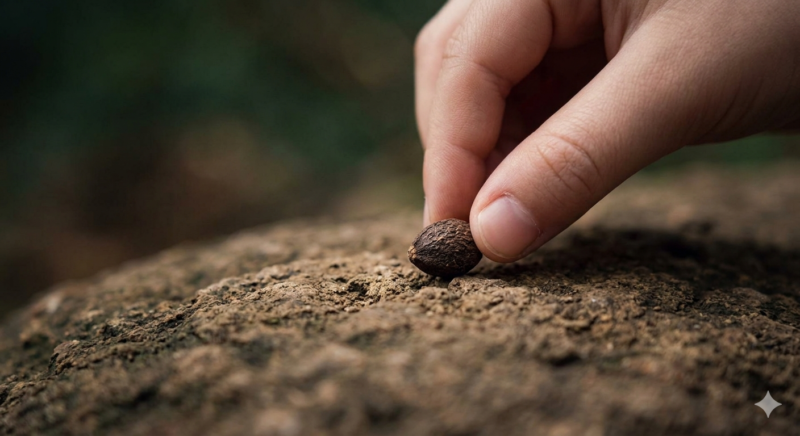
Planting a seed is never a trivial act. It is a simple gesture, almost an ordinary one—you dig, you place the seed, you cover it with soil. And yet that gesture contains an element of uncertainty. Nothing guarantees the outcome. And that is precisely what makes it so remarkable.
You accept waiting. You accept that not everything can be controlled. In a world that moves ever faster, planting a seed is almost a countercultural act. It is an act of trust in time itself. The next time you open a packet of seeds, take a moment. Behind those tiny fragments lie centuries of journeys, experiments, and human choices. Some have crossed entire continents.
Others were patiently selected in long-forgotten gardens. Still others survived great crises—carried forward by hands that chose the future over hunger. You are not simply holding a future flower in your hands. You are holding a memory. And perhaps, too, a possibility for the future.
The story does not end with this petal… Explore more stories at the crossroads of science, technology, and economics.
Continue Your Exploration
Immerse yourself in the world of flowers through our various themes and discoveries.
Start ExploringReceive Our Next Discoveries
Subscribe ✉️